
Are you dreaming of walking the ancient paths of the Incas and reaching Machu Picchu on foot? Cusco is the undisputed trekking capital of South America, but there is one crucial factor that can make the difference between an unforgettable experience and a struggle through the mud: the weather.
Understanding the Cousco trekking weather is the first step in planning your adventure. While the Andes are unpredictable, knowing the seasons will allow you to choose the perfect moment according to your preferences, whether you seek infinite blue skies or the mystical solitude of the mountains.
In this article, we break down month-by-month what to expect on the most famous routes such as Salkantay, Choquequirao, and the Inca Trail.
Understanding Cusco trekking weather: Two distinct seasons
Unlike other parts of the world, in the Peruvian Andes, we don’t talk much about summer or winter, but rather two very defined seasons: the dry season and the rainy season.
Cusco’s geography is complex, varying from warm valleys to freezing mountain passes at over 4,000 meters above sea level (over 13,000 ft). Therefore, Cusco trekking weather requires strategic preparation regarding clothing and logistics.

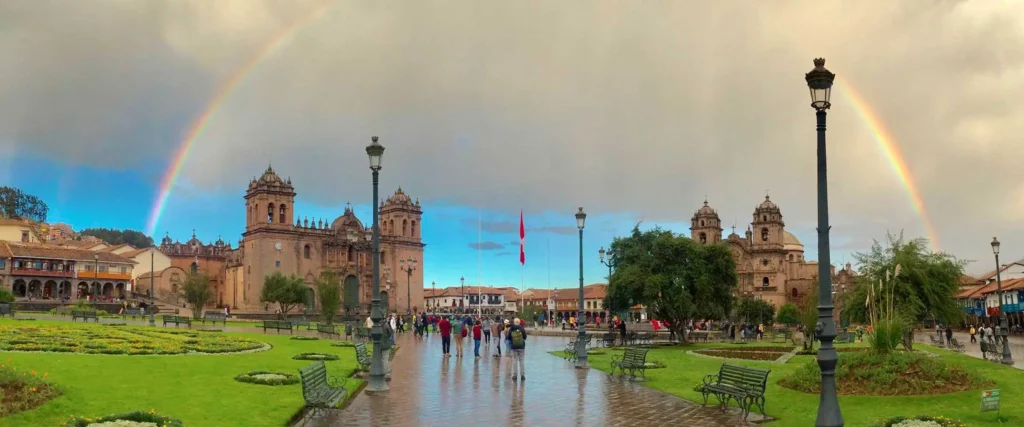
The Dry Season in Cusco (May to October)
This is undoubtedly the most popular time for adventurers. During these months, the probability of precipitation is minimal, offering sunny days and clear views of the snow-capped peaks.
- The Best: Perfect blue skies for photography and firm, dry trails.
- Keep in Mind: Nights are freezing. In June and July, the temperature can drop below $0^\circ\text{C}$ ($32^\circ\text{F}$) at high-altitude campsites.
- Keyword: If you are looking for the classic Andean postcard without clouds, the Cusco dry season is your best option.
However, keep in mind that June, July, and August are the months with the highest tourist influx. If you prefer a balance between good weather and fewer people, the “shoulder” months (May and September) are the best-kept secret.
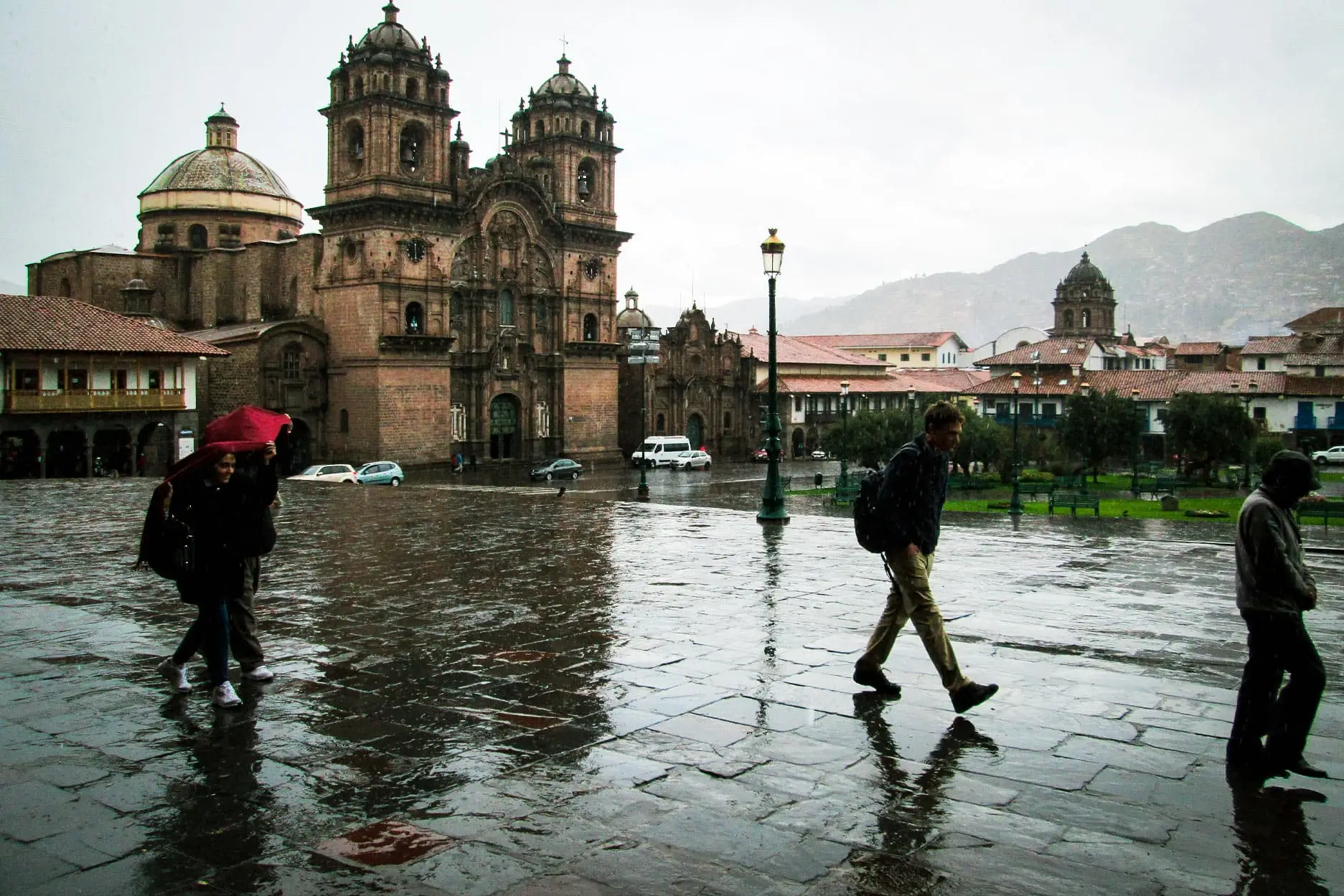
The Rainy Season in the Andes (November to April)
Many travelers avoid these months, but they have a special charm that only experts appreciate. The Andes rainy season transforms the landscape: the arid brown turns into a vibrant green, and the flora explodes in color.
- The Best: Fewer tourists on the trails, warmer night temperatures, and lush landscapes.
- Keep in Mind: Trails can be muddy and slippery. High-quality waterproof gear is vital.
- Important Fact: January and February are the months with the most intense rainfall.
When to go to the Inca Trail? The key fact
This is the million-dollar question: when to go to the Inca Trail to ensure the best experience.
The short answer is: from May to September. However, you should know something crucial:
Important Note: The Classic Inca Trail closes every year during the month of February for maintenance and cleaning, as it is the rainiest month.
If your goal is this specific route, book at least 6 months in advance for the dry season, as permits sell out quickly. For alternative routes like the Salkantay Trek or Lares, they remain operational in February, though challenging due to the mud.
Monthly Breakdown: A Quick Guide for Hikers
To help you decide, we have prepared this quick summary based on our experience at Incredible Peru Tours:
- January – March (Wet): Frequent rain. Very green landscapes. Few people. February is closed for the Inca Trail.
- April (Transition): Weather improves. Rain decreases, and everything is still green. An excellent and underrated time.
- May (Start of High Season): Vegetation is still alive, but the sky is already blue. Ideal for trekking.
- June – August (Peak Dry): Sunny days, very cold nights. High tourist season (book in advance). Cusco festivities in June.
- September – October (Transition): Some clouds return, mild weather. Excellent for avoiding the August crowds.
- November – December (Start of Rains): Sporadic afternoon rains begin. Good option if you don’t mind getting a bit wet.


Expert Tips from Incredible Peru Tours
As a local agency, we have guided thousands of travelers. Here are our golden tips for mastering the weather and the altitude:
- The layer system is law: The Andean sun is strong during the day, but as soon as it sets, the cold is intense. Wear a thermal base layer, an intermediate fleece, and a windproof/waterproof jacket.
- Waterproof footwear: Even in the dry season, you may find damp areas. Trekking boots with Gore-Tex (or similar) and a sole with good grip are mandatory.
- Smart acclimatization: Do not start the trek as soon as you arrive. Spend at least 2 or 3 days in the city of Cusco or the Sacred Valley to acclimate. Drink plenty of water and coca leaf tea.
- Sun protection: UV radiation at high altitudes is extreme. Use a hat, sunglasses with UV filters, and SPF 50+ sunscreen, even if it is cloudy.
Conclusion
There is no “bad time” to visit Peru; you just need the right gear and the right attitude. However, to maximize your chances of clear views and walking comfort, knowing the Cusco trekking weather is essential.
If you seek photographic perfection, aim for the dry season (May-October). If you prefer solitude and mystical greenery, the transition or rainy months may pleasantly surprise you.


