
If you want to reach Machu Picchu on foot but the Inca Trail is sold out, closed in February, or you simply want something different from Peru’s most well-known route, the Salkantay Trek is the most complete answer available. It is not a plan B or a lesser version of the classic route. It is a route with its own identity, with landscapes on a scale that the Inca Trail cannot match in certain sections, and with availability and logistical flexibility that make it the most practical option for a significant number of travelers arriving in Cusco each year.
This guide explains why the Salkantay Trek works as a real alternative to the Inca Trail, how they are similar, how they differ, and what kind of experience each one delivers so your choice is based on understanding rather than reputation.
Why the Inca Trail is not always an option
The Inca Trail has a maximum capacity of 500 people per day, including guides, porters, and cooks. During high season, from May to August, permits sell out four to five months in advance. Travelers who arrive in Cusco with fixed dates without booking that far ahead simply cannot do the Inca Trail on those dates. There is no waiting list, no last-minute availability, and no exceptions.
In addition, the trail is completely closed in February, the only month of the year when it shuts down for maintenance and safety reasons. The requirement to hire a certified guide and an authorized agency, along with the cost that comes with it, also makes the Inca Trail significantly more expensive than other routes to Machu Picchu.
The Salkantay Trek solves all of these issues at once: it has no regulated quotas, it is open year-round, and it is generally more affordable than the classic Inca Trail. For travelers with limited dates, tighter budgets, or those who simply could not book in time, Salkantay is not the second option. It is the right option for their situation.
What the Salkantay Trek has in common with the Inca Trail
Before looking at the differences, it is important to understand what both routes share, because that defines the core experience they offer.
Both are multi-day trekking routes that reach Machu Picchu on foot from the Cusco region. Both cross high-altitude Andean landscapes with significant ecosystem changes between the first and last days. Both require prior acclimatization in Cusco, above-average physical fitness, and the same type of high-mountain equipment. Both end with a visit to one of the most important archaeological sites in the world. And both create the kind of experience that travelers remember and talk about for years with an intensity that conventional trips rarely produce.
This shared foundation is what makes Salkantay a real alternative and not a simulation of the Inca Trail. It is not the same, but the depth of the experience is comparable.
How Salkantay differs from the Inca Trail: the differences that matter
The Inca Trail is primarily a historical and archaeological experience set within an extraordinary natural environment. Along the route, you pass through five archaeological sites from the imperial period located directly on the trail, walk on the original stone path built by the Incas more than five hundred years ago, and arrive at Machu Picchu through the Sun Gate, the historical entrance of the empire. Inca history and archaeology are present in every kilometer, not just at the final destination.
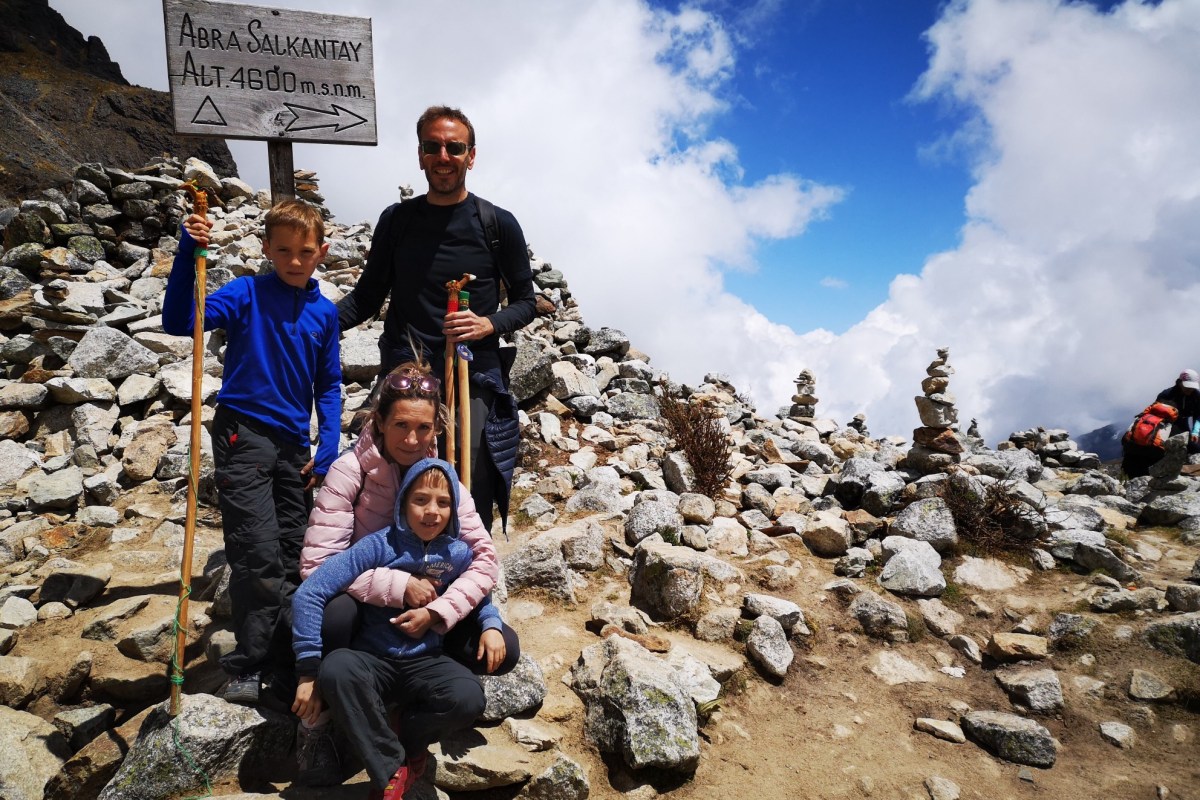
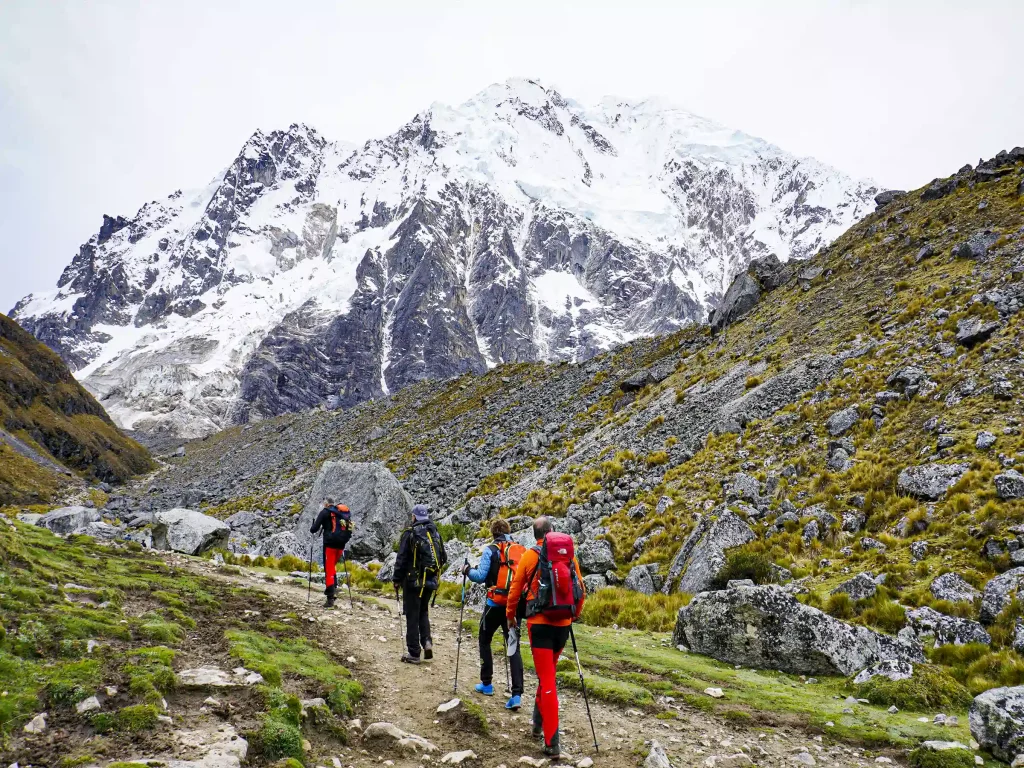
Salkantay is primarily a high-mountain nature experience that ends at an archaeological site. The Salkantay mountain at 6,271 meters, the pass at 4,630 meters with glaciers within close view, the Humantay Lake with its turquoise waters reflecting the snow-capped peak, and the complete transformation of the landscape as you descend into subtropical valleys are the main highlights of the route. There are no Inca ruins along most of the trail, but the landscape itself creates a powerful impact.
In terms of difficulty, Salkantay is slightly more demanding than the Inca Trail on the second day, with the pass at 4,630 meters compared to 4,215 meters at Dead Woman’s Pass on the classic route. However, the downhill sections on Salkantay are generally less punishing than the Inca stone steps, which reduces strain on the knees. Overall, both routes have comparable difficulty for travelers with similar fitness levels and proper acclimatization.
The five-day Salkantay route: what happens each day
The standard Salkantay Trek lasts five days and covers approximately 70 to 75 kilometers, with the visit to Machu Picchu included on the final day. The route begins at the Soraypampa base camp at 3,900 meters, reached by vehicle from Cusco in about three hours.
The first day includes the optional but almost universal hike to Humantay Lake at 4,200 meters, with its turquoise waters and the Salkantay mountain dominating the glacial landscape. The second day is the most challenging and the most spectacular: an early start before sunrise, the climb to the Salkantay Pass with the glacier rising in front of you, and the descent into transitional valleys where the scenery changes dramatically with every hour. The third day crosses the coffee and cacao valleys of Santa Teresa, ending with a visit to the Cocalmayo hot springs, one of the most memorable moments of the trek. The fourth day follows the Urubamba River to Aguas Calientes. The fifth day is the visit to Machu Picchu.
National Geographic and international recognition
In 2008, National Geographic Traveler included the Salkantay Trek in its list of the world’s 25 best treks. This recognition was not because of its proximity to Machu Picchu but because of its own value, combining ecosystems, altitude, and dramatic scenery in a way few routes in the world achieve within five days.
Since then, demand for Salkantay has steadily increased, making it the second most requested trek in the Cusco region after the classic Inca Trail. Unlike the Inca Trail, this growth has not been accompanied by strict quotas, meaning Salkantay remains accessible with much shorter booking times.
Availability, price, and logistics: Salkantay’s practical advantages
The Salkantay Trek does not require a special permit from Peru’s Ministry of Culture for the mountain route itself. The only ticket needed is the entrance to Machu Picchu for the final day, which is usually included by tour operators. This lack of quotas allows bookings to be made much closer to the travel date, even just weeks or days in advance during low season.
Salkantay is generally more affordable than the Inca Trail because it does not include the official permit fee required for the historical route. Five-day trekking packages with reputable agencies typically range between $350 and $600 per person, with upgraded options such as domes or glamping at higher prices. These costs are noticeably lower than equivalent Inca Trail packages.
The Salkantay route also remains open in February, making it the only full multi-day trekking option to Machu Picchu during that month. For travelers with fixed February dates, it is not a second-best option—it is the only real option at that level.
Who the Salkantay Trek is right for
Salkantay is the best choice for travelers who could not secure Inca Trail permits for their dates, those traveling in February, those with a tighter budget, or those who prioritize dramatic natural landscapes over archaeology. It is also ideal for travelers planning with limited time who need a route that can be organized in days rather than months.
It is also the right choice for those who have already completed the Inca Trail and want a second trekking experience in the region from a completely different perspective. The two routes complement each other in a way rarely found in other destinations: different experiences on the same territory leading to the same destination.
Arriving at Machu Picchu: the key difference
The Salkantay Trek reaches Machu Picchu from Aguas Calientes by bus, the same way most visitors arrive by train. It does not enter through the Sun Gate like the Inca Trail. This difference matters for those who consider the historical entrance via Inti Punku an essential part of the experience, and it matters less for those who prioritize the trekking journey itself.
There is also a Salkantay variation that includes access through the Sun Gate by adding a hike on the final day from the entrance to Inti Punku before descending into the citadel. This adds about two extra hours and creates an arrival experience closer to the Inca Trail, although without the cumulative impact of walking the original path for several days.
Want to do the Salkantay Trek with the best possible experience on the route? At Incredible Peru Tours we operate Salkantay in its three-, four-, and five-day versions with specialized guides, full camping equipment, and all logistics coordinated from Cusco. Contact us with your dates and the type of experience you are looking for, and we will design the best option for your trip.


