
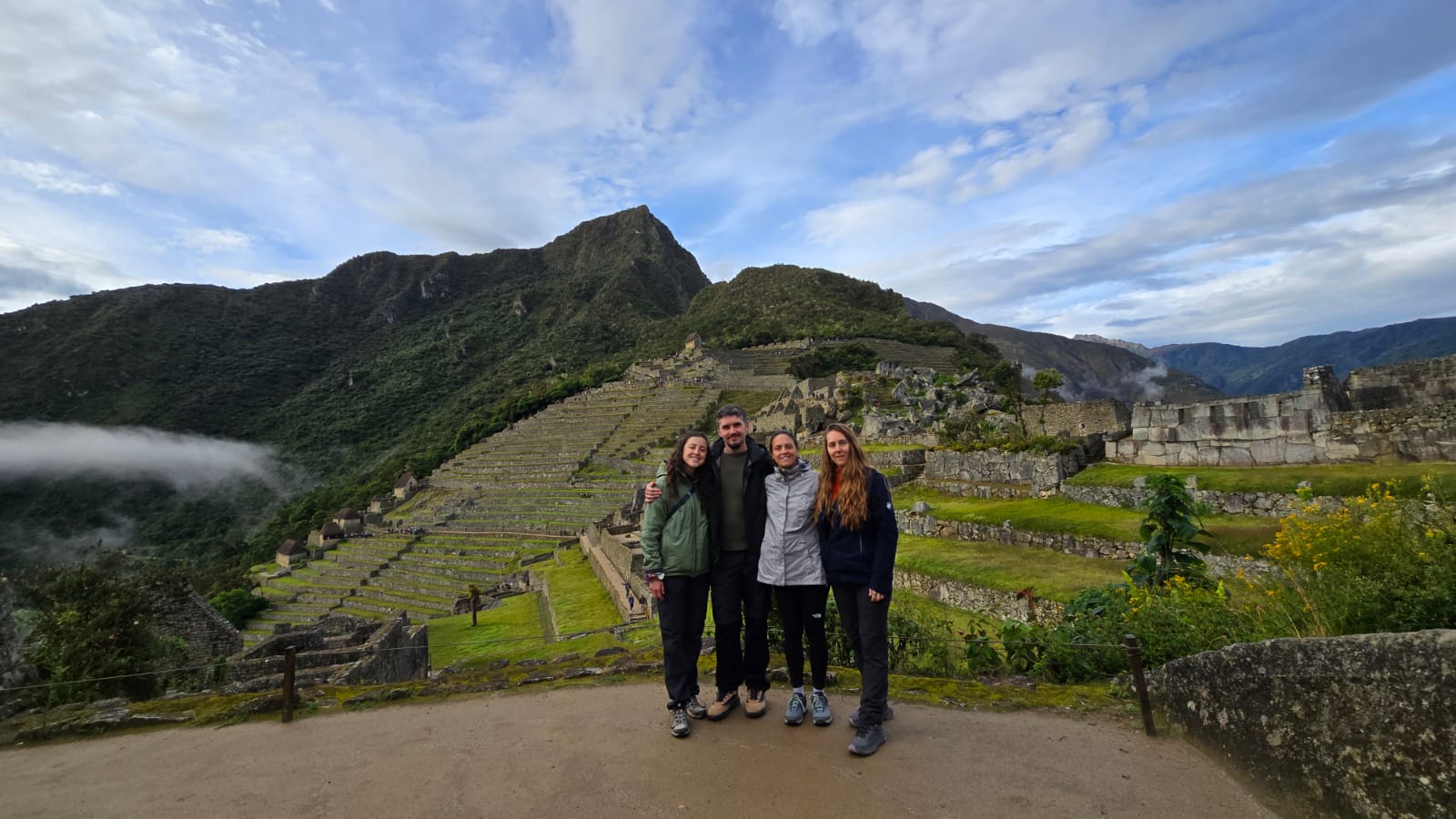
If you are wondering how long you can stay in Machu Picchu, the practical answer is between 2.5 and 3 hours inside the citadel, depending on the circuit you choose. Each ticket has a fixed entry time printed on it and, as a general rule, there is a maximum tolerance of 30 to 60 minutes to enter, depending on the time slot, the season, and the operational criteria of the control staff.
This means you cannot enter at any time or stay all day inside the archaeological complex. Machu Picchu operates with time slots, defined routes, and visitor flow systems designed to prevent overcrowding on terraces, viewpoints, stairways, and narrow sections.
The allowed time is usually enough if you arrive on time, choose your circuit well, and understand in advance which route applies to your ticket. The most common problem is not the duration of the circuit, but arriving late because the train, the bus from Aguas Calientes, or the access lines were not calculated properly.
How do entry times to the citadel work?
Entry times to Machu Picchu work by time slots. Admission is not open for the entire day: when you buy your ticket, you choose a specific time block to enter the Llaqta, which is the main sector of the citadel.
These blocks usually operate from 6:00 a.m. to 3:00 p.m., with limited spaces per hour and per circuit type. Availability changes depending on the season, demand, and current regulations, so it is best to review the official information before confirming trains, buses, and lodging.
In practice, if your ticket shows an 8:00 a.m. entry time, you should organize your arrival so you are at the control gate before that time or within the permitted tolerance window. It is not recommended to arrive right at the limit, because bus lines from Aguas Calientes can vary significantly between low season and high season.
Time tolerance for entering through the control gate
If you arrive a little before the time printed on your ticket, you will usually need to wait until the staff opens entry for your time slot. During periods of lower visitor flow, they may organize the line with some flexibility, but you should not assume that you will be allowed to enter much earlier than the printed time.
If you arrive after your scheduled time, the usual tolerance may be 30 to 60 minutes maximum, depending on the time slot, visitor flow, and the instructions of the control staff. After that margin, access may be denied even if you have already paid for your ticket.
A common situation occurs when travelers take the bus from Aguas Calientes to Machu Picchu too late. Delays caused by the bus line do not always justify entering outside the assigned time. Staff may evaluate specific cases, especially if there is clear operational congestion, but there is no guarantee that they will allow entry if the visitor did not calculate their timing properly.
To avoid problems, the safest option is to be in the bus line at least 1 hour before your entry time, and even earlier if you are traveling during high-demand months. If your train arrives in Aguas Calientes very close to your time slot, the risk of missing your entry increases.
Can you re-enter Machu Picchu after leaving?
No. Re-entry is prohibited on all standard Machu Picchu circuits. Once you leave through the turnstiles or cross the exit point defined for your route, your ticket is no longer valid for re-entry.
This rule applies even if you have not completed the maximum allowed visit time. That is why it is best to use the restrooms before entering, bring water in an allowed container, review your circuit carefully, and stay with your group if you are traveling with a guide.
You should also be careful with internal control points. On certain routes, once you move toward a specific area, you may not be able to go back to the previous sector. The current design aims to keep movement organized and one-way, so leaving early or taking the wrong turn can limit what you are able to see.
Maximum time allowed for each official circuit
The actual time inside Machu Picchu depends on the circuit you reserved. Not all tickets allow visitors to see the same areas, take the same photos, or stay the same amount of time at the site.
In general, the main citadel circuits take between 2.5 and 3 hours. Tickets that include mountains can extend the total visit because they add the ascent, descent, and the permitted archaeological route. Even so, each route has a specific order and does not allow visitors to move freely throughout the entire complex.
| Ticket type | Approximate visit time | What you should consider |
|---|---|---|
| Main Circuits 1 and 2 | 2.5 to 3 hours | They include upper areas and panoramic viewpoints, depending on the available route. |
| Ticket with Huayna Picchu | May exceed 4 hours in total | Adds the ascent, descent, and the archaeological section allowed by the ticket. |
| Ticket with Huchuy Picchu | Less extensive than Huayna Picchu, but longer than a basic circuit | Includes a short additional hike with controlled entry time. |
| Lower circuits or short routes | Around 2 hours, depending on your pace | May cover specific sectors without access to all upper platforms. |
These times are referential because the pace changes depending on physical condition, the number of visitors, the weather, and staff instructions. If you are traveling with an older adult, children, or someone who needs to walk slowly, it is best to choose a schedule with enough margin for trains and buses.
Visit duration on the main circuits (Circuits 1 and 2)
Circuits 1 and 2 are the most requested by visitors who want to explore the upper area and take the best-known panoramic photos of Machu Picchu. At a normal pace, the visit takes approximately 2.5 to 3 hours, including short stops for photos and the guide’s explanation.
The duration can vary because not all areas allow visitors to stop for a long time. On platforms with a high concentration of visitors, park rangers usually ask groups to keep moving to avoid blockages. This does not affect the visit if you follow the order of the route, but it does limit the idea of sitting down or waiting for a long time in one spot.
A common mistake is thinking that the ticket allows you to walk without a fixed direction. In reality, each circuit has a sequence. Once you pass a point, you may not always be able to return. That is why it is recommended to know in advance which photo you want to prioritize and to listen to the guide’s instructions at the beginning of the tour.
Estimated time for mountain routes (Huayna Picchu and Huchuy Picchu)
Tickets that include Huayna Picchu or Huchuy Picchu grant more total time because they add a mountain hike to the permitted archaeological route. In the case of Huayna Picchu, the ascent and descent can take several hours depending on the traveler’s physical condition, trail conditions, and visitor flow.
Huchuy Picchu usually requires less effort and less time than Huayna Picchu, but it also operates with entry control and a defined route. It is not open access to extend the visit without limit, but rather a special ticket with an additional section.
After completing the mountain, the traveler continues or finishes the visit through the lower archaeological sector that corresponds to the ticket. You should not expect access to all upper viewpoints if your ticket does not include them. This difference is key when purchasing, because each ticket determines both the time and the areas you will be able to visit.
If you are unsure whether to buy a classic circuit or a ticket with a mountain, carefully review your return train schedule from Aguas Calientes. Routes with an ascent require more margin, and it is not a good idea to schedule them with a very tight return.
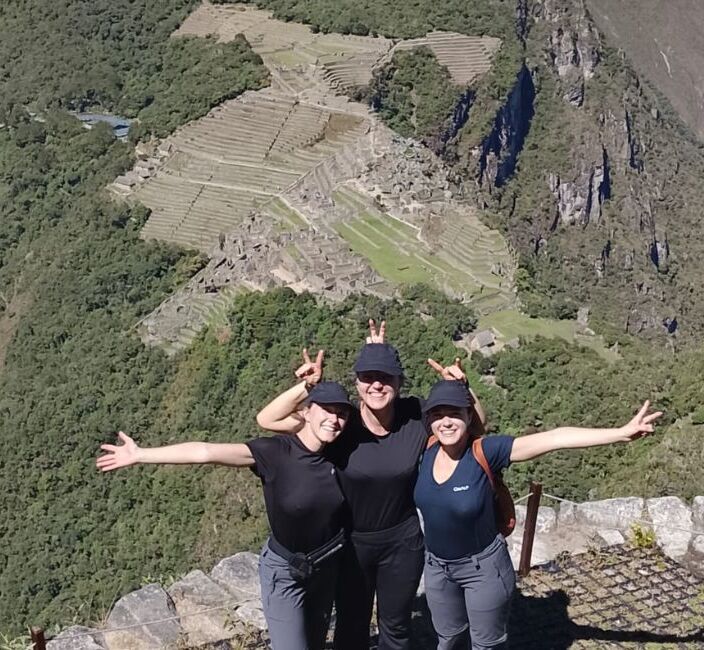
How does staff control the length of stay?
The length of stay is controlled through entry times, one-way routes, surveillance points, and staff distributed throughout the complex. There is no individual stopwatch for each visitor, but the system is designed so that the flow moves forward continuously.
Park rangers monitor the areas where crowding tends to occur, such as photo platforms, narrow stairways, and internal access points. If a group stops for too long, they receive instructions to continue the route.
There are also controls that verify whether the visitor is on the correct route according to the ticket purchased. This prevents someone with a short circuit from trying to access areas not included, or someone from remaining inside the site beyond the permitted flow.
The role of park rangers and one-way visitor flows
The current layout of Machu Picchu is one-way. This means that, in most sections, you cannot go back to return to a platform or repeat a photo. The measure helps reduce crossings between people in narrow passages and keeps groups moving forward.
Park rangers are located at strategic points to organize movement, answer basic questions, and prevent visitors from leaving their assigned path. Their job is not to speed up the visit without reason, but to prevent certain sectors from becoming overcrowded and affecting the following time slots.
For travelers, this has both an advantage and a disadvantage. The advantage is that the route becomes clearer and you do not waste time deciding where to go. The disadvantage is that there is less freedom to improvise, go back, or stay for a long time in one specific area.
Consequences of exceeding the time limit or leaving the permitted trail
If a visitor remains stopped for too long in a transit area, the most common outcome is that they receive a warning and are asked to move forward. The same can happen if they try to take photos in an unauthorized spot or block the passage of other groups.
Leaving the permitted trail, crossing barriers, entering closed areas, or trying to remain outside the assigned time can have more serious consequences. Staff may remove the visitor from the route and, in serious cases, issue reports or restrictions according to current regulations.
It is also best to avoid arguments at the control gate or inside the site. Entry and circulation rules do not depend on the guide or the agency, but on the park administration. If you need to coordinate tickets, circuits, trains, and buses with safe time margins, Incredible Peru Tours can help you organize the itinerary from Cusco without relying on overly tight connections.
Frequently asked questions about staying inside Machu Picchu
These are the most common questions from travelers who want to calculate how long to stay in Machu Picchu without missing their time slot or leaving before completing the route.
Is the allowed time enough to visit the citadel?
Yes. The allowed time is usually enough because the current circuits are designed to cover the key points smoothly. On the main routes, 2.5 to 3 hours are enough to walk, listen to explanations, and take photos without long pauses.
The key is to enter on time, follow the correct route, and not lose minutes trying to go back. If you want to hike a mountain or do two different circuits, you will need a special ticket or two separate tickets.
What happens if I buy two tickets for the same day at different times?
Buying two tickets for the same day at different times is a valid strategy if you want to spend more time in the complex or do two different circuits. You must finish the first route, leave completely, and then re-enter with the second ticket at its corresponding time.
Coordination must be careful. Leave enough margin between both time slots so you do not get stuck at the exit of the first circuit or arrive late for the second entry. Also verify that the circuits you choose complement each other and do not repeat very similar areas.


