
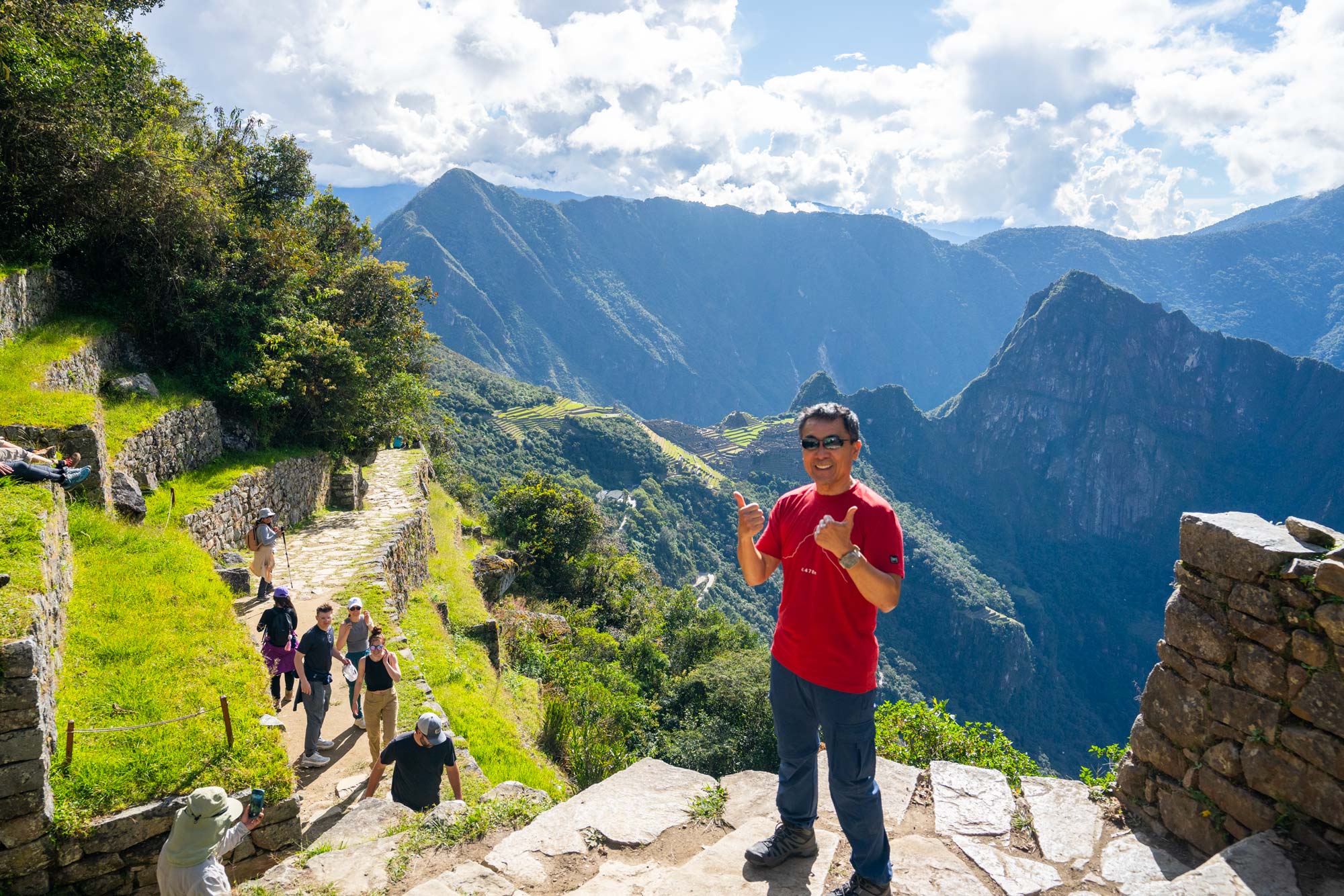
When you book the Inca Trail, one of the first decisions you need to make has nothing to do with the route or the dates. It has to do with the way you want to experience it. With a group of travelers you do not know, sharing camp, pace, and guide? Or privately, with your partner, your family, or your friends, with the trek designed exclusively for you?
Neither option is objectively better than the other. Each one responds to a type of traveler, a budget, and a way of understanding what it means to do a trek. What is true, however, is that choosing without enough information can lead you to pay for an experience that does not match what you were really looking for. This guide gives you the concrete elements you need to make that decision clearly.
How group service works
Group Inca Trail tours bring together solo travelers or couples who have booked independently and who share a guide, porter team, campsites, and schedules throughout the four days of the route. The maximum group size is regulated by Peru’s Ministry of Culture and usually ranges from eight to sixteen participants, although some agencies work with smaller groups as part of their own policy.
The price of group service is lower than private service because the fixed costs guide, porters, cook, entrance permits to the trail are shared among all participants. That cost distribution is the main reason many travelers choose this option: it allows access to a trek with high logistical value at a considerably lower per-person cost.
The group’s pace is set by the guide based on the overall physical level of the participants, not the fastest or the slowest in particular. This means that if you are an experienced hiker, you may feel the pace is too moderate, and if you are a beginner, there may be sections where you feel pressure to keep up with a pace that is not naturally yours. That tension is the usual dynamic in any group activity, and the Inca Trail is no exception.
How private service works
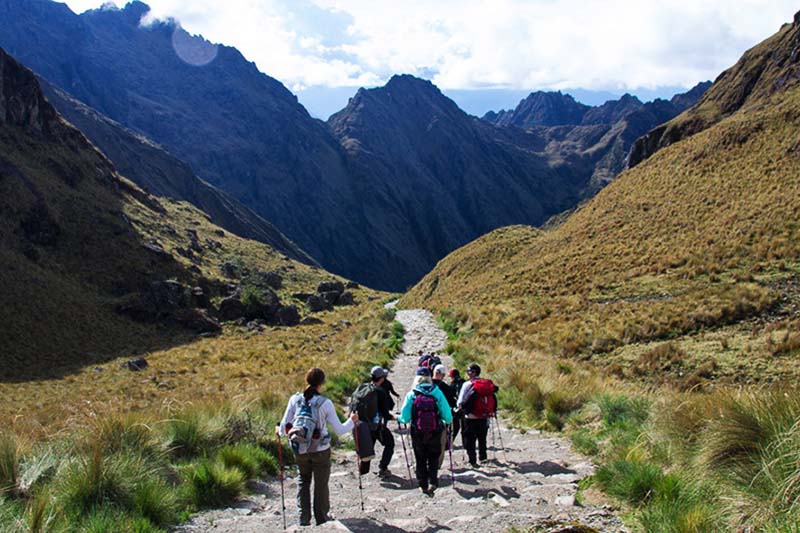
On a private tour, the certified guide and support team work exclusively for the group that booked the service. There are no other participants, no schedules shared with strangers, and no need to negotiate the pace, the stops, or the amount of time spent at each archaeological site along the trail.
The logistical structure is the same as in group service: the same type of campsite, the same quality of food, the same trail sections, and the same permits from the Ministry of Culture. The difference is not in the infrastructure but in who controls how that infrastructure is used. In private service, that control is yours.
The per-person cost is higher because the fixed expenses of the trek which are considerable fall on a smaller number of participants. For a couple, for example, the price difference compared to group service can be significant. For a group of six or eight friends traveling together, the gap narrows considerably and in some cases almost disappears.
Real advantages of group service
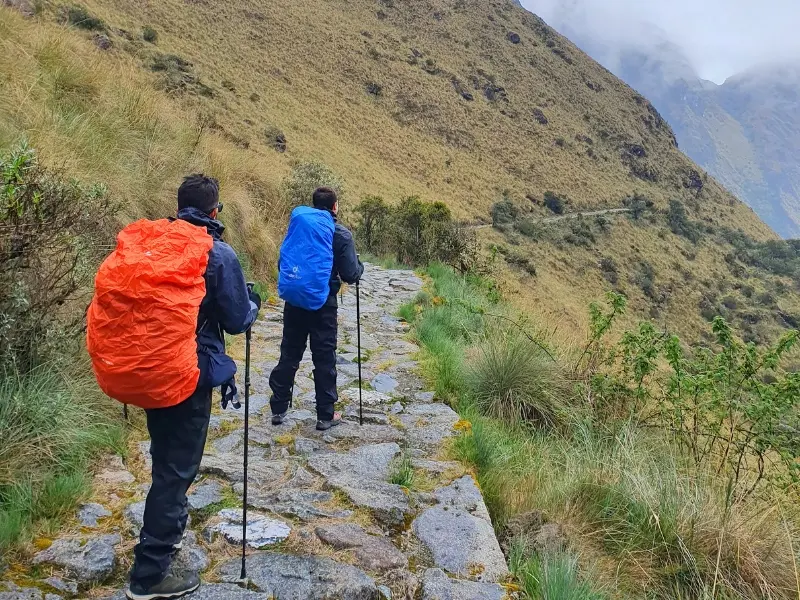
Price is the most obvious advantage, but not the only one. Doing the Inca Trail with a group of people you did not know before starting can create bonds that surprise even the most independent travelers. Four days of shared physical effort, extraordinary landscapes, campsites under the Andean sky, and the collective emotion of reaching Machu Picchu through the Sun Gate create a type of connection between people that everyday life rarely makes possible.
Many travelers who have done the Inca Trail in a group describe those improvised friendships as one of the most unexpected and most valued parts of the whole experience. The campmate from the first night who turns out to be from your same city, the group member who knows every constellation and points them out from the tent entrance, the most determined hiker in the group who climbs Dead Woman’s Pass singing. Those stories do not happen in the private format.
Another less mentioned advantage is that in a large group, the collective energy helps during the hardest moments of the trek. The second day, with the ascent to the highest point of the hike, feels different when there are people around you going through exactly the same thing. Shared effort has a motivational dimension that solo or couple travel does not reproduce in the same way.
Real advantages of private service
Flexibility is the strongest argument for the private format, and it shows itself in every day of the trek. If you want to stop for forty minutes at Wiñay Wayna because the afternoon light on the terraces is perfect for photos, you can do it. If on the third day the group needs to leave later because someone did not sleep well, the guide can reorganize the schedule without affecting anyone else. If someone has knee pain and needs to slow down on the descending stone steps, the team adapts without any friction.
For families with children, that ability to adapt is not a luxury. It is a practical necessity. The pace of a ten-year-old on the second day of the Inca Trail is not the same as that of a fit adult, and a private guide can manage that difference in a way that would be impossible in a group of fourteen people with tight schedules.
The depth of the experience with the guide also changes in the private format. In a large group, the guide manages the collective logistics and divides attention among many participants. In an exclusive service, the relationship is different: there is more space for questions, for conversations about Inca history and culture that go beyond the standard explanation, and for those details of the trail that are only shared when there is trust and real time to do so.
Disadvantages you should consider in each option
Group service has limitations that are worth knowing before booking. The most important has already been mentioned: the pace is not individually negotiable. If the group moves more slowly than you would like on the first day, you will arrive at camp later than you had imagined. If someone in the group has serious difficulties on the second day, the whole group may be exposed to light or weather conditions that complicate the rest of the day. Collective dynamics have that double edge.
There is also the human compatibility factor. In most cases, the atmosphere among participants is very good, but in some groups there are differences in pace, personality, or expectations that create tension. Four days in a shared space under physically demanding conditions amplify both the best and the worst in people. It is not something that happens often, but it does happen, and it is worth keeping in mind.
In the private format, the most direct disadvantage is the cost. For a solo traveler or a couple, the per-person price can be considerably higher than in group service, and that difference is not always justified if what you want is simply to reach Machu Picchu on foot without special needs for adaptation or privacy. If budget is the deciding factor, a well-operated group service is a completely valid option without meaning you are giving up anything essential.
Comparison chart: key points at a glance
- Price per person: Group, more affordable because fixed costs are shared. Private, higher, but lower depending on the size of the booking group.
- Hiking pace: Group, defined by the guide according to the overall level. Private, defined by the group itself with total freedom.
- Schedule flexibility: Group, limited. Private, total.
- Social experience: Group, the chance to meet travelers from different parts of the world. Private, an intimate experience with the people you chose to bring.
- Guide attention: Group, shared among all participants. Private, exclusive to your group.
- Adaptation to special needs: Group, limited. Private, high.
- Ideal for: Group, solo travelers or couples on a tighter budget who are open to collective dynamics. Private, families, groups of friends, couples seeking intimacy, or travelers with specific pacing needs.
Is there a middle ground between the two options?
Yes, and it is more common than it seems. Some agencies offer what are known as guaranteed private groups: a package that works like a group tour but with a very small maximum number of participants four, six, or even two peopleand that combines the more accessible price of the shared format with the greater closeness that comes from a small group.
This option is especially interesting for couples or groups of three or four friends who want the social experience of group trekking but without the crowding that larger groups can create. It does not have the total flexibility of private service, but it does offer a much closer and more intimate dynamic than a standard group of twelve or fourteen people.
So, which option Is right for you?
If you are traveling solo or as a couple, have a tighter budget, adapt well to collective rhythms, and do not rule out the idea of doing the trek with people you do not know, group service with a well-reviewed agency is the most sensible choice. The experience is complete, the quality of the route does not depend on the format, and the chances of living memorable moments with other travelers are real.
If you are traveling with family, with a group of friends, with children, with people who need a particular pace, or simply if you value privacy and flexibility more than savings, private service more than justifies its price. It is not a whim or an unnecessary luxury. It is a different way of living the same route, and for certain traveler profiles, it is the only one that makes sense.
What does not change in either option is the trail itself. The same Inca stones, the same campsites beneath the same mountain range, the same sunrise over Machu Picchu from the Sun Gate. The route does not distinguish between formats. The experience, however, certainly does.
Do you have doubts about which option best fits your group and your way of traveling? At Incredible Peru Tours, we operate both group and private service with the same high standards in guides, equipment, and logistics. Write to us, tell us how many people are in your group, what dates you are considering, and what type of experience you are looking for, and we will guide you with no obligation toward the option that best fits your trip.


