
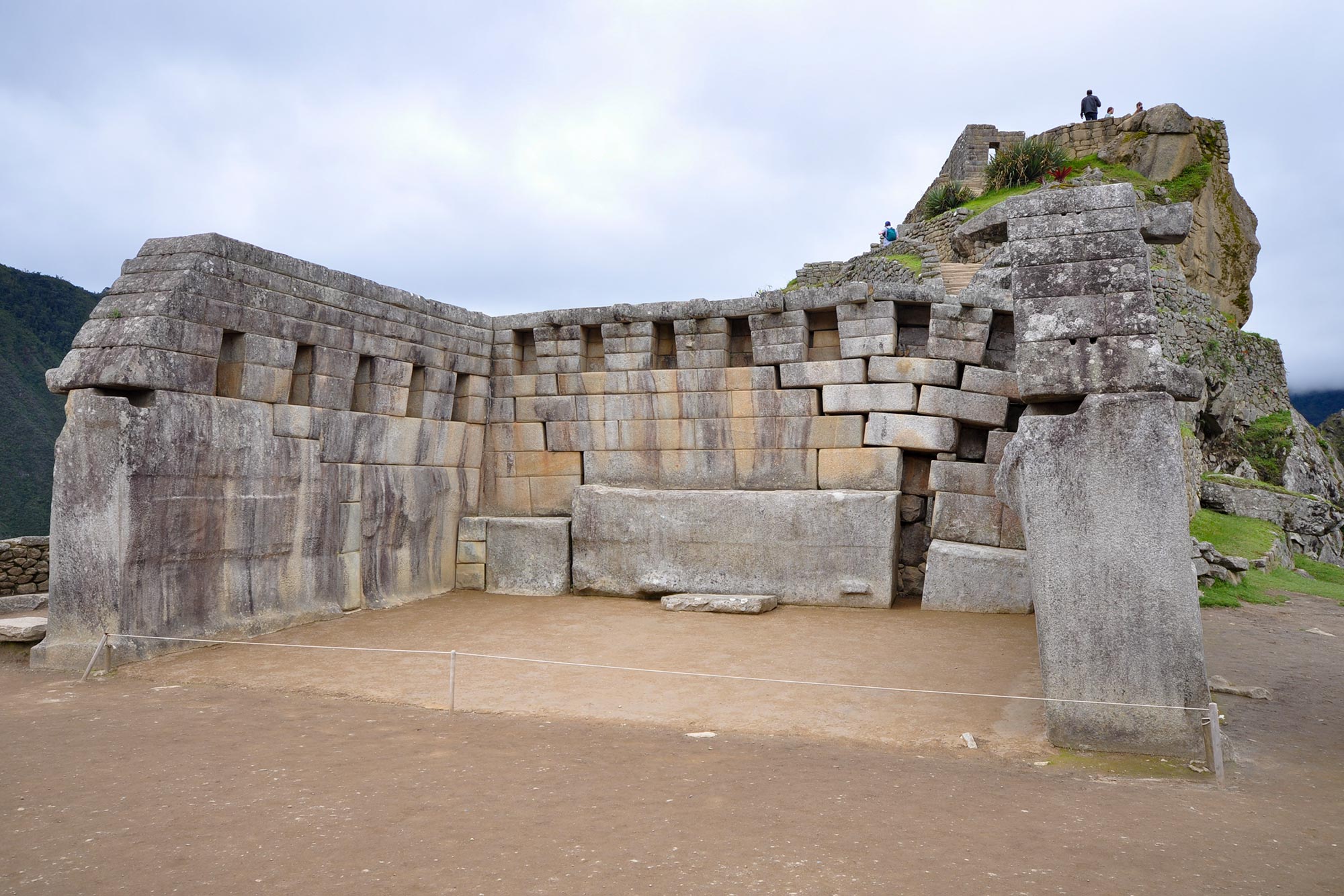
The Main Temple of Machu Picchu is the largest enclosure in the Sacred Plaza and possibly the highest-ranking structure in the ceremonial hierarchy of the complex, according to what the quality of its stonework suggests. And yet, it is the one that receives the least attention in travel guides, the one with the least evocative name, and the one whose original function remains the most debated among archaeologists who have studied the site. This combination of architectural grandeur and functional mystery is what makes the Main Temple one of the most fascinating elements of the complex for travelers who visit Machu Picchu with more curiosity than the standard route requires.
The Scale of the Enclosure: The First Thing That Stands Out
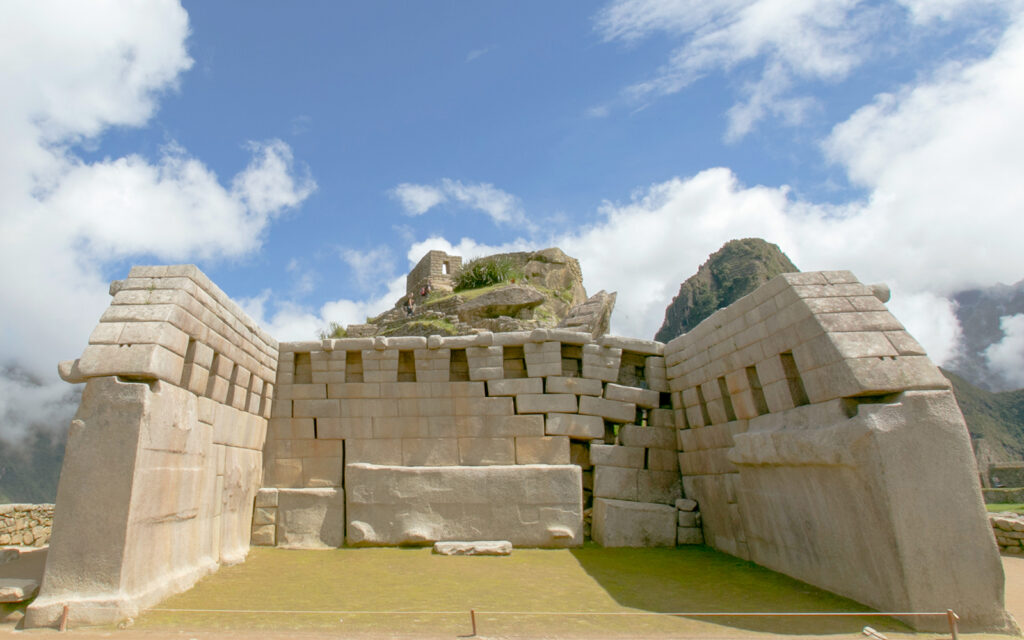
The Main Temple is a roofless three-walled enclosure, known in Inca architecture as an open enclosure, with dimensions considerably larger than those of any other structure in the Sacred Plaza. Its walls are built with large granite blocks, some of the largest at the archaeological site, assembled without mortar with the precision characteristic of the finest Inca architecture.
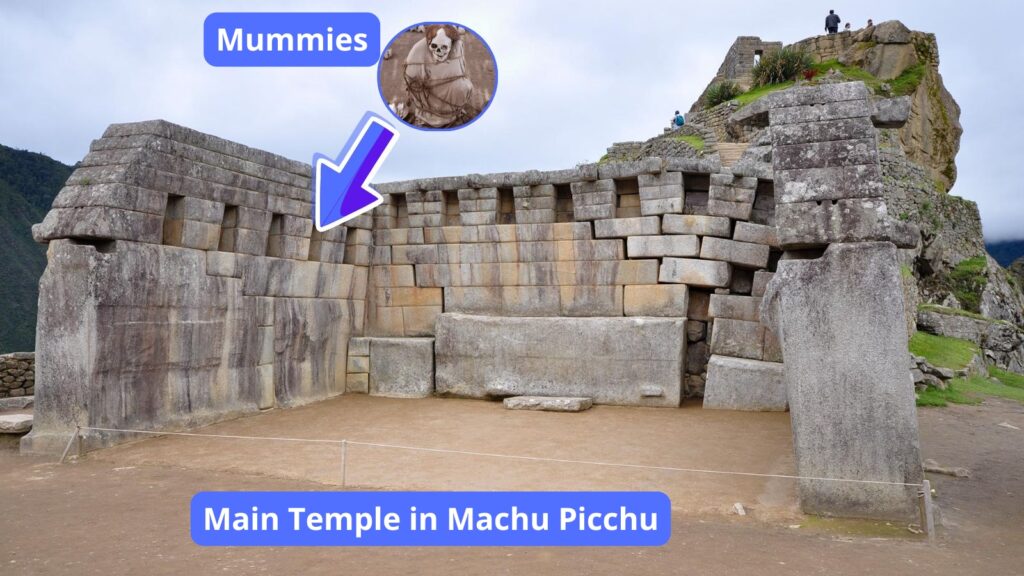
The rear wall of the enclosure, which closes the space on the western side, is the tallest and the one that best preserves its original integrity. The trapezoidal niches opened into that wall in two superimposed rows are one of the most visible features of the enclosure. In Inca architecture, these niches had functions that varied depending on the context, from storing ritual objects to placing the mummies of ancestors in high-ranking funerary contexts. In the Main Temple, the scale and arrangement of the niches suggest that their function was clearly of the highest ritual order.
The Stonework: What the Masonry Reveals About the Temple’s Rank
The stonework of the Main Temple is consistently cited by archaeologists who have studied Machu Picchu as one of the most elaborate examples of Inca construction technique at the entire site. The granite blocks are cut with an apparent irregularity that is actually the result of a progressive fitting process between adjacent stones: each block was carved to fit the exact surfaces of the blocks around it, producing joints that in some places are invisible to the naked eye.
This assembly technique, which archaeologists call polygonal masonry or cellular masonry, required stonemasons with years of specialized training and a construction process that involved returning to blocks already placed in order to adjust the contact faces with the next stones. It was a slow process, intensive in specialized labor, and for that reason it was used only in the most important enclosures. The presence of this technique in the Main Temple, on the scale in which it appears, indicates that whoever commissioned its construction considered this enclosure one of the most important in the complex.
One of the most striking details of the Main Temple’s stonework is a block in the rear wall with 32 perfectly carved joining angles designed to fit with the surrounding blocks on all sides. This particular block is one of the most frequently cited examples in the literature on Inca architecture as a demonstration of the level of sophistication reached by the finest stonemasons of the Tahuantinsuyo.
The Leaning Wall: An Earthquake the Temple Survived
One of the most visible details of the Main Temple for anyone who observes it carefully is that one of its side walls leans outward in a way that can be seen with the naked eye. The wall is not vertical: it tilts slightly toward the outside of the enclosure, which in a conventional mortar-based construction could suggest a risk of collapse.
Archaeologists have interpreted this lean as the result of seismic movement that affected the wall at some point after construction. The fact that the wall did not collapse despite this inclination is a practical demonstration of the advantage of Inca mortarless construction over conventional masonry. In a wall built with mortar, seismic movement fractures the binding material and can cause the structure to progressively collapse. In Inca masonry, the blocks settle again after the movement, and the structure regains stability because there is no rigid binding material to break. The leaning wall of the Main Temple has remained in that position for five centuries without compromising the integrity of the enclosure.
The Unknown Function: What Archaeologists Still Debate
The original function of the Main Temple is the aspect of the enclosure that has generated the most debate in the archaeological literature on Machu Picchu. Unlike the Temple of the Sun, whose astronomical orientation toward the June solstice is documented with verifiable evidence, or the Intihuatana, whose function as a solar gnomon and ritual object of the Inti Raymi ceremony is established with relative solidity, the Main Temple has no associated function with the same level of consensus among specialists.
The most widespread hypotheses about its function connect it to ceremonies of the Inca priestly elite that required a larger space than the other temples in the plaza, rituals associated with the cult of royal ancestors given the arrangement of the niches in its walls, or a function as an antechamber for access to the most sacred spaces in the northern sector of the complex. None of these hypotheses has produced enough consensus to be adopted as a definitive explanation.
This uncertainty is not a weakness in archaeological knowledge of the site. It is the normal condition of working with a civilization that left no written sources of its own and whose oral tradition was partially destroyed and partially distorted during the Spanish conquest. Archaeologists working at Machu Picchu are aware that the functions of some enclosures may never be established with the certainty that others have, and that this lack of definition is part of the nature of what the site is.
The Large Blocks on the Ground: The Temple That May Not Have Been Completed
In the area immediately next to the Main Temple, on the ground of the Sacred Plaza, there are several large granite blocks that are not part of any completed structure. Their presence in that location has led some archaeologists to propose that the Main Temple was in the process of being expanded or modified when the site was abandoned, and that these blocks were construction material still waiting to be placed when abandonment left them in their provisional position.
If that interpretation is correct, the Main Temple we see today is not the complete temple the Incas had planned, but an unfinished version of a more ambitious project. This possibility adds another dimension to the mystery of the enclosure: not only do we not know exactly what it was used for, but it may never have been completed as originally conceived.
Where It Is Located and Which Circuit Includes It
The Main Temple is located on the western side of the Sacred Plaza, in the northern urban sector of Machu Picchu. It is reached from the Main Plaza by climbing the stairway that leads to the upper temple sector and continuing north through the sequence of enclosures that forms the Sacred Plaza.
It is included in Route 2A Classic Designed, which is the circuit that covers the ceremonial enclosures of the northern sector of the site in the greatest depth. It is also included in Route 3B Royalty Designed for the same reason as the other temples of the Sacred Plaza: its construction quality places it at the highest level of the hierarchy of sacred space within the complex.
For travelers visiting the Main Temple with an interest in the archaeological debate about its function and the details of its stonework, a private guide specialized in Inca architecture makes the greatest difference. The 32-angle block, the lean of the side wall, and the open question about the enclosure’s function are the three elements that create the deepest conversation with a specialist and are rarely identified with the attention they deserve during an unguided visit.
Do you want to visit the Main Temple and the other enclosures of the Sacred Plaza with the context that makes what you see truly understandable? At Incredible Peru Tours, we coordinate the most suitable circuit tickets for your Machu Picchu visit and provide specialized guides in Andean archaeology who understand the debates around the Main Temple and explain them in a way that gives the visit the depth this enclosure deserves.


