
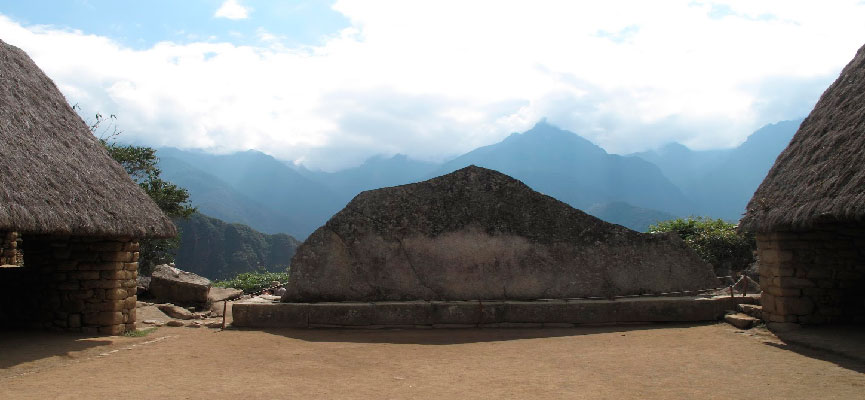
The Sacred Rock of Machu Picchu is one of the elements of the archaeological site that raises the most questions among visitors who see it for the first time and have few prior expectations about it. It is not a building, nor a sculpture worked with the precision of Inca stonework. It is a natural granite rock approximately three meters high that the Incas placed at the northern end of the citadel’s urban sector, and for them it had a sacred meaning directly connected to the mountain rising behind it. This guide explains why this rock matters, what it represents in the Inca belief system, and how to reach it within the site.
What the Sacred Rock Is Physically
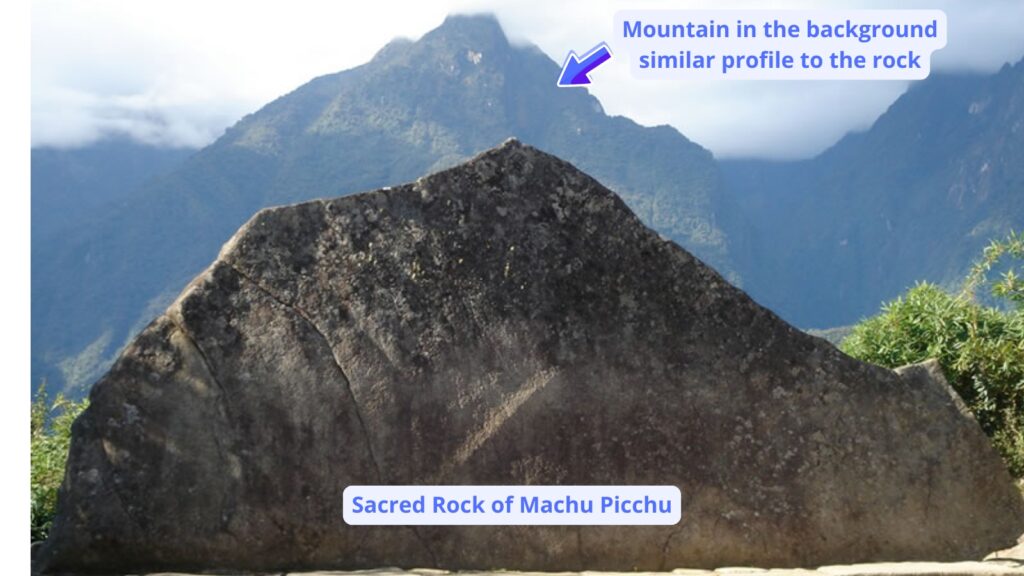
The Sacred Rock is an irregularly shaped, uncarved natural granite monolith that rests on a stone platform built by the Incas at the northern end of Machu Picchu’s urban sector. It is approximately three meters high and has a profile that, when seen from the front, closely resembles the outline of the mountain that appears on the horizon immediately behind it.
This similarity between the profile of the rock and the profile of the mountain in the background is not a coincidence imagined by visitors. It is the criterion archaeologists have used to interpret the rock’s function within the Inca belief system. The rock was deliberately placed at that point in the site and specifically oriented so that its silhouette would replicate the mountain behind it. This intentional orientation is the main argument supporting the sacred interpretation of the object.
The Mountain Behind It: The Apu and Its Representation in Stone
In the Andean worldview, mountains are living sacred entities known as Apus. They are not simply geographic features: they are beings with will, power, and the ability to influence the lives of the communities that live within their territory. Respect for and communication with the Apus were central parts of the ritual life of Andean communities, and that relationship was expressed through offerings, ceremonies, and in some cases through objects that represented or connected with the presence of the Apu.
The mountain that appears behind the Sacred Rock of Machu Picchu is the mountain the Incas identified as the Apu of the place. The rock, whose profile replicates that mountain, functioned as a material representation of the Apu within the space of the citadel, a point of contact between the world of the city and the world of the sacred mountain without the need to leave the citadel to approach the Apu directly.
This logic of representation, in which an object placed in the urban space replicates the form of a sacred element in the natural environment, is characteristic of the Andean worldview, which did not sharply separate the human-built world from the natural world surrounding it. The Sacred Rock is the most visible material expression of that relationship within Machu Picchu.
The Platform Around the Rock: What the Incas Built Around It
The rock does not rest directly on the ground of the site, but on a stone platform built specifically to hold it. This platform, made with good-quality Inca masonry, although not of the highest category seen in the Main Temple or the Temple of the Sun, raises the rock above the surrounding level and frames it as an object of contemplation and ritual.
The platform indicates that the Incas did not simply find the rock in that location and assign meaning to it because of an accidental position. They placed it there intentionally, raised it on a built base, and oriented it so that the effect of replicating the mountain in the background would be visible from the correct direction. This construction process makes the Sacred Rock a deliberate intervention in the landscape, not a found element.
On the sides of the platform are enclosures whose functions have not been fully established. Archaeologists have interpreted them as support spaces for ceremonies performed in front of the rock. The presence of these adjacent enclosures reinforces the interpretation of the Sacred Rock as an active ritual space, not simply as a decorative or symbolic element without practical ceremonial use.
Its Location Within the Site: The Northern End of the Citadel
The Sacred Rock is located at the northern end of Machu Picchu’s urban sector, at the point where the main circuit reaches the limit of the urban complex before heading toward the access checkpoint for the Huayna Picchu trail. It is the last major element of the inner circuit in that direction, and on days with high visitor numbers, it is one of the points where groups visibly gather before continuing toward the exit or the Huayna Picchu checkpoint.
Its position at the northern end has a meaning that complements the rock’s orientation toward the mountain in the background. In the Inca system of spatial organization, the north carried a specific symbolic meaning related to the origin of rivers and the direction of imperial power that radiated from Cusco. Placing the rock at that end of the complex, facing the northern mountain, was consistent with that system of sacred spatial orientation.
Which Circuit Includes the Sacred Rock?
The Sacred Rock is included in Route 2A Classic Designed, the most complete circuit through the urban sector and the one that takes visitors to the northern end of the complex where the rock is located. It is also included in some other circuits that cover the full northern urban sector, such as variations of Route 1B depending on the specific circuit configuration used each season.
The Sacred Rock is also the starting point for the trail to Huayna Picchu, whose access checkpoint is located immediately next to the rock’s platform. Visitors with a Route 3A ticket must pass by the Sacred Rock before beginning the climb to the mountain, making that moment a symbolically coherent transition between the ceremonial space of the citadel and the sacred space of the mountain.
What Many Visitors Do Not Notice Without a Guide
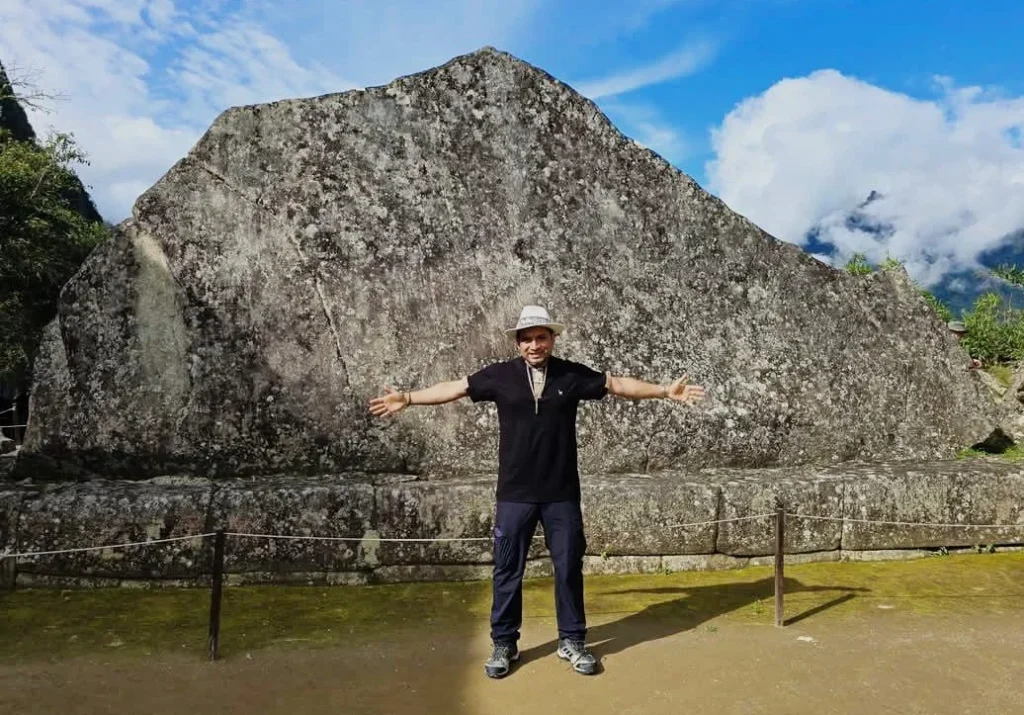
The Sacred Rock produces two opposite reactions among visitors to Machu Picchu. Those who arrive without prior information about it often wonder why this apparently ordinary rock deserves the attention given to it on the circuit. Without the context of the Andean worldview and without knowing how to observe the relationship between the silhouette of the rock and the mountain behind it, the object does not speak for itself in the same way as the Temple of the Sun or the Intihuatana.
Those who arrive with the right context, or who receive it from their guide while standing in front of the rock, have a different experience: they understand that the Incas built an entire city partly to create this point of contact between the urban space and the Apu of the mountain, and that the unworked rock is precisely the one that most faithfully represents that Apu because it does not place the hand of the stonemason between the mountain and its representation within the citadel.
This contrast between the apparent simplicity of the object and the depth of what it represents is what makes the Sacred Rock one of the elements of the site that most rewards visitors who arrive with the right willingness to understand it.
The Sacred Rock and the Rain: An Effect Few People Know About
There is a visual phenomenon associated with the Sacred Rock that experienced site guides mention to their groups, but that few written sources record. On rainy days or in the early morning when there is dew, the wet surface of the rock takes on a color and shine that makes its similarity to the mountain behind it even more pronounced. The damp granite darkens and its texture becomes more visible, creating a sense of presence in the landscape that feels different from what visitors see on dry, sunny days.
This effect cannot be documented in photographs in the same way it is experienced on site, because the relationship between the wet rock and the mountain behind it has a three-dimensional quality and real scale that photography flattens. It is one of those elements of a visit to Machu Picchu that justifies being there in person instead of simply looking at images.
Do you want to visit the Sacred Rock with the context of the Andean worldview that makes what it represents understandable? At Incredible Peru Tours, we coordinate the right circuit tickets for your Machu Picchu visit and provide guides specialized in archaeology and the Andean worldview who turn the Sacred Rock into one of the most memorable moments of the route.


