
Moray is an Inca archaeological site located near the town of Maras, within the Sacred Valley of Cusco. It’s known for its large circular terraces built into natural depressions in the ground, an unusual configuration among Inca agricultural systems. Its design, depth, and relationship with the landscape make it one of the most distinctive archaeological places in the area.
The exact function of Moray’s terraces is still being studied. The most widespread interpretation points to a space for agricultural experimentation, though there are also hypotheses involving crop adaptation and possible ceremonial uses. These theories should be understood as archaeological interpretations, not as settled conclusions.
What is Moray?
Moray is an Inca archaeological complex made up of several groups of circular and semicircular terraces. It sits near Maras, in the Cusco region, at an approximate altitude of 3,500 m.a.s.l. Its terraces were built by taking advantage of natural depressions, which were then transformed with retaining walls, stairways, and water management systems.
The best-known sector has a shape similar to a stepped amphitheater. The terraces descend gradually toward a deep center, creating levels with different conditions of sun exposure, wind, humidity, and temperature. This makeup has turned Moray into a key place for studying the agricultural and hydraulic knowledge developed during the Tahuantinsuyo.
Where is Moray located?
Moray is located in the district of Maras, province of Urubamba, within the Sacred Valley of Cusco. It’s roughly 50 km from the city of Cusco by road, though travel time usually runs between an hour and a half and two hours, depending on the route, traffic, and stops along the way.
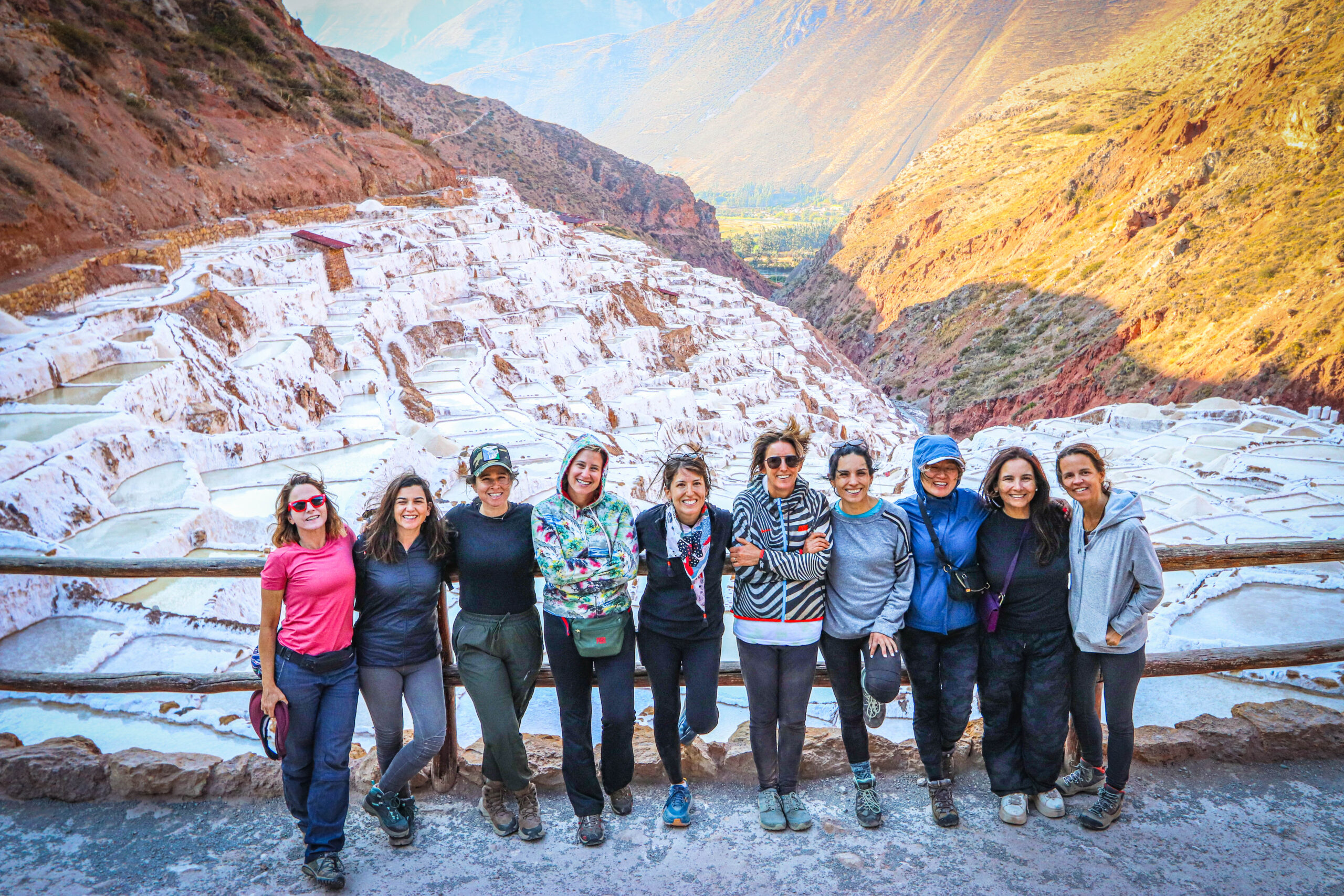
The site is relatively close to the Maras Salt Mines, so both attractions are usually visited on the same outing. It’s also common to combine the visit with Chinchero. That closeness makes a half-day route workable, though you’ll want to account for the travel time to and from Cusco.
Why is Moray different from other Inca sites?
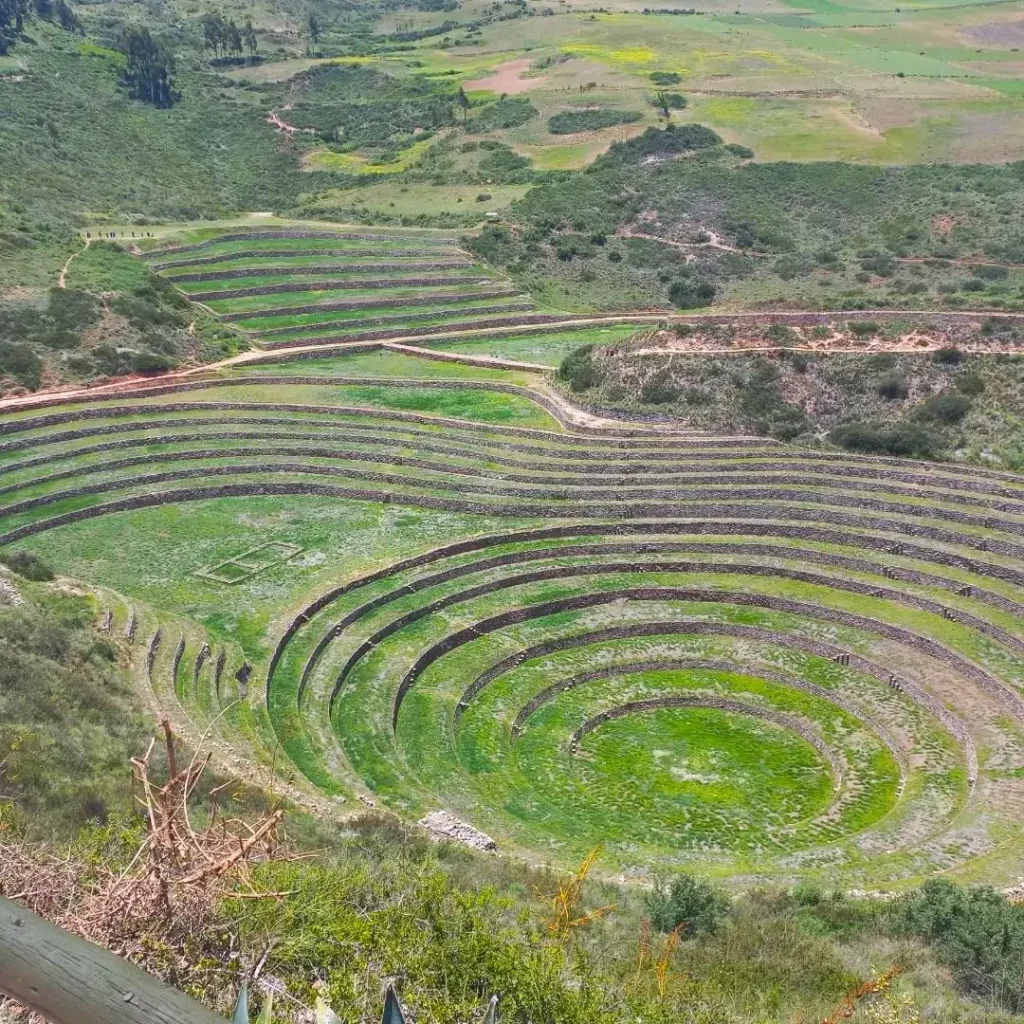
Moray’s main difference is its circular design. While many Inca terraces were built on hillsides to expand the land available for farming, here the terraces are arranged around natural depressions, forming concentric rings that step down toward the center.
Its various levels, the depth of the main sectors, and its precise adaptation to the topography set the complex apart from other agricultural systems in Cusco. Moray shouldn’t be understood as just a series of terraces: its layout reveals planning tied to the soil, the water, and the local climate conditions.
What are Moray’s circular terraces like?
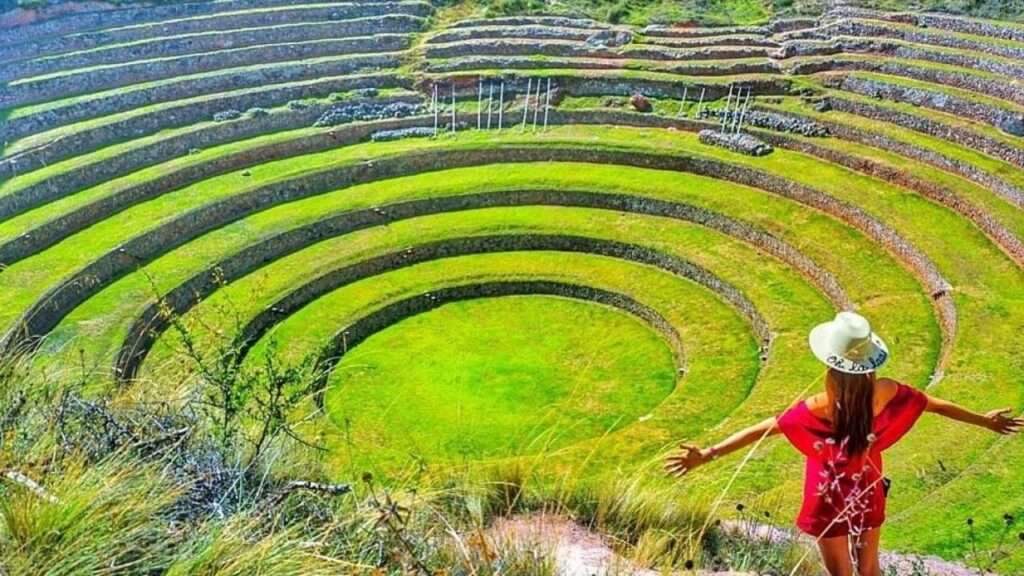
Moray’s circular terraces are made up of stepped platforms bounded by stone walls. Each level follows the contour of the depression and connects to the others through stairways built into the walls. From the upper edges you can clearly see how the terraces descend step by step toward the center.
Along with the walls and stairs, the site shows evidence of channels and drainage solutions. The construction made it possible to stabilize the ground and carry rainwater away without letting it pool on the lower platforms. The site’s current condition also reflects conservation work carried out over the years.
The main sectors of Moray
The Moray complex is made up of several groups of terraces, not a single circular depression. The deepest and most photographed sector draws most of the attention, but there are other smaller groups nearby that help you grasp the full scale of the place.
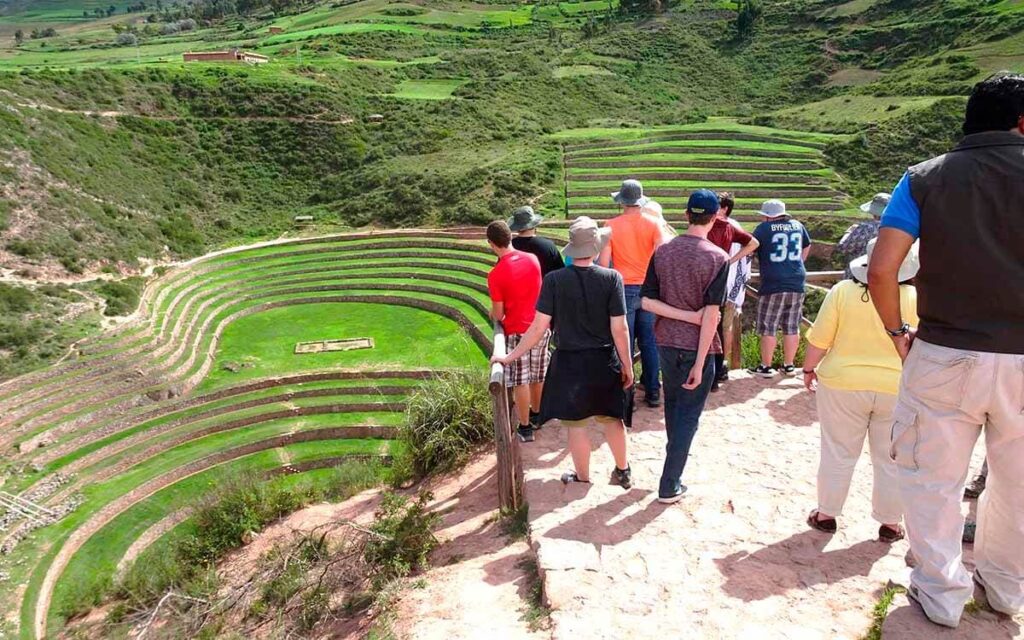
During the visit, the terrace groups can be seen from trails, walking platforms, and authorized viewpoints. It’s worth walking slowly and pausing at the marked points, since the perspective from up top makes it easier to recognize the shape of the circles, the walls, and how the different sectors relate to one another.
The drainage system of the terraces
The terraces were designed to handle rainwater and reduce the risk of erosion or flooding. The walls, the internal layers of the terraces, and the conduits associated with the site would have helped keep the platforms stable through the wet season.
Some specific aspects of how Moray’s water system worked remain under study. That’s why it’s more accurate to say the site incorporates drainage solutions adapted to the terrain than to claim the original path of the water or the exact use of each channel is fully known.

What were Moray’s circular terraces used for?
There’s no full consensus on Moray’s function. The best-known hypothesis suggests its terraces may have been used to observe how crops behaved under different environmental conditions. That idea rests on the variation between levels and on the possible differences in temperature and humidity within the depressions.
Interpretations tied to agricultural administration, the reproduction of conditions from different territories, and ceremonial activities have also been proposed. Popular accounts tend to present Moray as an Inca agricultural laboratory, but it’s worth recognizing that the archaeological evidence is still being weighed and that “laboratory” is a modern comparison.
Moray as a possible center of agricultural experimentation
The most widespread theory holds that Moray may have worked as a space for studying crops in distinct environments. The Incas managed products from regions with varied climates, so a place with terraces at different depths would have allowed them to observe how certain plants responded to local changes in temperature, humidity, and sun exposure.
This interpretation fits well with how central agriculture was to the Inca Empire, but it shouldn’t be presented as a proven fact in every detail. It isn’t known with certainty which species were grown at each level or how all the activities carried out at the complex were organized.
The microclimates of Moray
The depth, orientation, and arrangement of the terraces can create environmental variations between the upper and lower levels. Wind behavior, sun exposure, and moisture retention aren’t necessarily the same on every platform, especially at certain hours of the day or times of year.
These differences are usually described as microclimates. That said, the temperature figures that circulate about Moray should be treated carefully, because not all the published data comes from comparable studies or from measurements taken under the same climate conditions.
Crop adaptation at different elevations
One possibility raised by various studies is that the terraces allowed the Incas to observe how products from different parts of their territory adapted. The Tahuantinsuyo included valleys, highlands, and regions with different productive conditions, so knowledge about farming was key to running the state.
Moray may have been part of a broader network of agricultural management, seed exchange, and variety observation. This reading helps place the site within a complex territorial system, though it doesn’t let us claim that each terrace held a specific crop or served a single function.
Did Moray also have a ceremonial function?
Some researchers and local traditions connect Moray with ceremonial activities, partly because of the shape of the site and the symbolic weight certain landscapes and built spaces could carry. The presence of ritual activity wouldn’t be incompatible with agricultural or administrative uses.
Even so, there’s no conclusive proof that would let us define Moray primarily as a ceremonial center. The most responsible approach is to treat this possibility as a complementary interpretation and avoid claiming the terraces were built exclusively for rituals.
How did the Incas build Moray’s terraces?
The Incas made use of natural depressions in the ground and turned them into systems of stepped platforms. To do that, they raised retaining walls, leveled growing surfaces, built stairways, and applied solutions for channeling or filtering water based on the soil’s characteristics.
Moray’s construction reflects a careful adaptation to the topography. Rather than reshaping the landscape entirely, the builders used the existing form of the hollows and organized the terraces around them. That choice reduced the need for large fills and let the complex blend into its setting.
Inca agricultural knowledge and engineering
Building terraces called for knowledge of gradients, wall stability, drainage, and soil quality. The Incas developed agricultural systems capable of making use of geographically complex spaces, from valleys to steep hillsides and areas of varying elevation.
At Moray, that knowledge shows in how the levels are organized and in the way the terraces adapt to the shape of the ground. The site makes clear that Inca agriculture didn’t depend only on expanding the area under cultivation, but also on controlling conditions that could affect crop yields.
Materials used in the terraces
Inca terraces were generally built with stone walls and internal layers meant to aid drainage and hold the agricultural soil in place. In different parts of Cusco, those layers could include larger stones, gravel, sand, and soil suited to farming, depending on what materials were available and on the conditions of the ground.
At Moray, the use of stone in the walls made it possible to define and stabilize the circular levels. The exact composition of each platform can vary and has to be analyzed sector by sector, so it’s best not to assume every terrace had the same internal structure or the same type of soil.
The importance of Moray during the Inca Empire
Moray may have been connected to agricultural production and to the knowledge needed to manage crops across different environments. In a state that administered vast and varied territories, the ability to select, adapt, and distribute products was fundamental to feeding the population and to economic organization.
The site is also linked to an understanding of ecological tiers, a principle that allowed the Incas to draw on resources from different altitudes. Although Moray’s specific administrative role can’t be determined with certainty, its design shows that managing the landscape and agricultural production involved complex planning.
Moray and the ecological tiers
Ecological tiers are altitude bands with different conditions of temperature, rainfall, soil, and vegetation. Those differences shape which products can be grown and which activities take place in each territory. In Cusco, a few kilometers can mean meaningful changes in climate and production.
The Incas made use of that diversity through exchange networks, population movement, and the complementary management of land. Moray’s possible connection to this system rests on the idea that its terraces allowed people to work with or study different environmental conditions within a single complex.
The value of agriculture for the Incas
Agriculture sustained the population’s food supply, the storage of goods, and the redistribution organized by the Inca state. Crops such as potatoes, corn, quinoa, and other foods adapted to specific conditions, which made knowledge of climate and soil decisive.
The expansion of the Tahuantinsuyo also required systems of collective labor, irrigation infrastructure, terraces, and storehouses. Sites like Moray are interpreted within that context, where producing food and reducing climate-related risk were part of territorial management.
What to see during a visit to Moray
During a visit to Moray you can take in the large circular terraces, the stone walls, the stairways, and the site’s secondary sectors. The viewpoints let you appreciate the depth of the depressions and the orderly shape of the levels, especially in the main group.
The route also offers views of the rural landscape around Maras and of the mountains ringing the Sacred Valley. Bringing a camera or a charged phone is useful, but avoid stopping in narrow passages or getting close to unmarked edges for a photo.
Viewpoints over the circular terraces
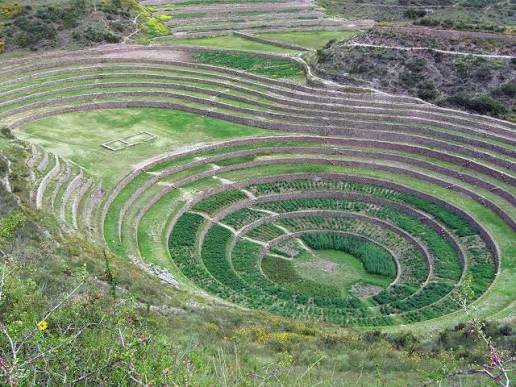
The viewpoints on the upper edges are the best places to grasp Moray’s scale and design. From there you can make out the sequence of concentric platforms and the way the terraces drop toward the center of each depression.
Always respect the marked zones, the barriers, and the instructions from site staff. Entering restricted sectors can affect the conservation of the walls and soil, and it creates risks from drop-offs, uneven surfaces, or access changes tied to maintenance work.
Trails and the archaeological route
The visit follows marked trails and authorized observation points. The route is relatively easy, though the altitude and uneven ground can tire out anyone who arrived in Cusco that same day or isn’t used to walking at high elevation.
To take in the complex without rushing, count on 45 minutes to an hour and a half inside the site. If you’re on a tour, check how much free time is included, since some tight itineraries leave little room to walk the secondary sectors and take photos at an easy pace.
How to visit Moray from Cusco
From Cusco you can visit Moray on an organized tour, by private transportation, by taxi, or by combining public transportation with a local taxi. The most practical option for most travelers is an organized route, especially if you want to include the Maras Salt Mines on the same day.
Going on your own gives you more flexibility with timing, but it means coordinating several legs and confirming access ahead of time. The road can vary depending on the route you choose, so it’s a good idea to leave early and allow extra time if you’re traveling in the rainy season.
Visiting Moray on an organized tour
Organized tours usually combine Moray with the Maras Salt Mines and, in some cases, with Chinchero. This option simplifies the transportation and makes better use of a morning or afternoon, though it normally follows a fixed schedule and the time at each attraction can be limited.
If you’re looking for a half-day outing that covers both places, take a look at the Maras Moray Tour in Cusco and confirm the pickup time, the admissions included, and the conditions of the route beforehand. Also check whether the service covers the Tourist Ticket and admission to the salt mines, since those are usually handled separately.
Visiting Moray on your own
To visit Moray on your own, you can take transportation from Cusco toward the Maras or Urubamba area and finish the trip with a local taxi. Another possibility is hiring a private taxi from Cusco for several hours, agreeing in advance on the route, the waiting time, and the return.
This option takes more planning, since public transportation doesn’t always drop you directly at the entrance to the complex. Ask about the last return time, carry cash in soles for local rides, and avoid depending on a tight connection if you have another transfer or activity scheduled that day.
Admission and hours for Moray
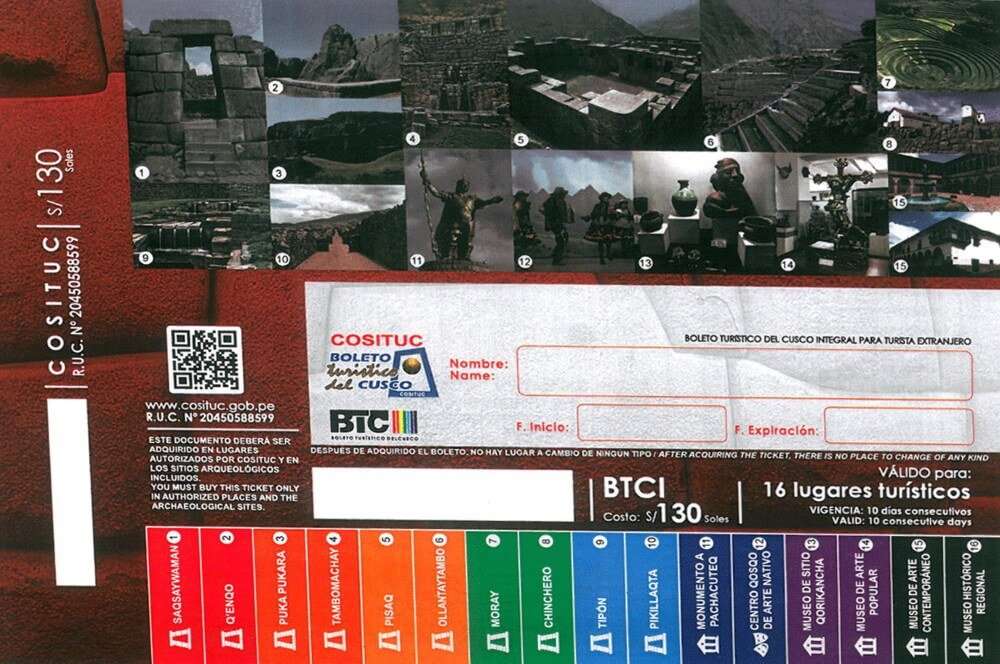
Entering Moray generally requires the Cusco Tourist Ticket in the option covering the Sacred Valley attractions. The Maras Salt Mines aren’t part of that ticket and normally charge separately. Access conditions can change due to rulings from cultural authorities or conservation work.
As a reference, the archaeological sites managed within this circuit generally operate during daylight hours, typically from morning until afternoon. Before you travel, confirm the hours, the current ticket option, prices, and restrictions directly through the official channels of the Comité de Servicios Integrados Turístico Culturales Cusco and the Ministry of Culture.
Is Moray included in the Tourist Ticket?
Moray is normally included in the General Cusco Tourist Ticket and in Circuit III, known as the Sacred Valley circuit. That option usually covers sites such as Pisac, Ollantaytambo, and Chinchero as well, along with other attractions listed in the ticket’s current terms.
Prices, validity periods, categories for national or foreign visitors, and rules of use can change. Don’t buy a ticket based only on old information: verify which option you need before your visit, especially if you plan to combine Moray with museums or sites from other circuits.
Recommended time of day to visit Moray
Visiting Moray in the early hours usually means fewer groups and softer light for photos. It can also work well if you want to continue on to the Maras Salt Mines, Chinchero, or another spot in the Sacred Valley without rushing the route.
Morning temperatures can be low, even in the dry season, so bring a warm layer. If you visit in the afternoon, keep in mind that the weather can shift quickly and that you need to account for the time it takes to get back to Cusco before local transportation thins out.
Best time of year to visit Moray
The dry season, which generally runs from roughly May to October, brings days with less chance of rain and roads that are usually more stable. It’s a good time for anyone who wants clear views and more predictable transfers, though it coincides with heavier visitor numbers in Cusco and the Sacred Valley.
During the rainy season, roughly November to March, the landscape tends to look greener and the fields take on more color. In exchange, you may run into heavy rain, mud on some trails, and quick weather changes. Bring a rain jacket and shoes with good soles, and avoid planning connections that are too tight.
Tips for visiting the Moray terraces
Before visiting Moray, try to acclimatize in Cusco for at least a day or two if you’re coming from a low-altitude city. Walk at an easy pace, drink water along the way, and avoid heavy meals or too much alcohol the night before. The altitude can affect even people who feel fine at the start of the trip.
Bring layered clothing, sunscreen, a hat, sunglasses, and a rain jacket depending on the season. The weather can move from a cold morning to intense midday sun to afternoon rain. Comfortable shoes with good traction are better than smooth-soled footwear.
Respect the marked trails and don’t climb on walls, closed platforms, or areas with barriers. Don’t leave trash behind or pick up stones, plants, or fragments from the site. A common mistake is assuming every sector is open: restrictions can change to protect areas under conservation.
Frequently asked questions about Moray
These answers cover common questions before visiting the circular terraces of Moray. For operational information such as access, hours, or tickets, confirm the current details before leaving Cusco.
Was Moray an Inca agricultural laboratory?
That’s the best-known theory about the site. The terraces are thought to have served for observing crops under different environmental conditions, but Moray’s exact function remains a subject of archaeological research. The word “laboratory” is a modern way of explaining that possible function.
Why are Moray’s terraces circular?
Their circular shape makes use of natural depressions in the ground and organizes different terrace levels around a central point. This design sets Moray apart from terraces built mainly on hillsides and may have influenced the conditions on each platform.
What temperature difference exists between the terraces?
Variations in temperature and humidity can occur between the upper and lower levels, due to depth, sun, and wind. That said, exact figures should come from verifiable studies, since much of the data repeated in guides and on social media doesn’t cite a reliable source.
Can you go down to the center of Moray?
Access to the terraces and the lower sectors depends on the site’s current restrictions. Some areas may be closed for conservation or safety. Follow the trails, barriers, and posted signs, even if you’ve seen older photos showing different routes.
Can you visit Moray and the Maras Salt Mines on the same day?
Yes. Moray and the Maras Salt Mines are close together and are normally visited on a half-day excursion from Cusco. Keep in mind that each place has different entry conditions and that the salt mines usually require a payment separate from the Tourist Ticket.


