
One of the most practical questions before doing the Salkantay Trek is also one of the questions that receives the least attention in general articles about the route: who carries what during the five days? The answer has direct implications for how to prepare your gear, what goes in which bag, how much each item can weigh, and what happens at the transition points where the gear changes hands between the participant and the support team. This guide explains it precisely.
The basic principle: the participant only carries what they need during hiking hours
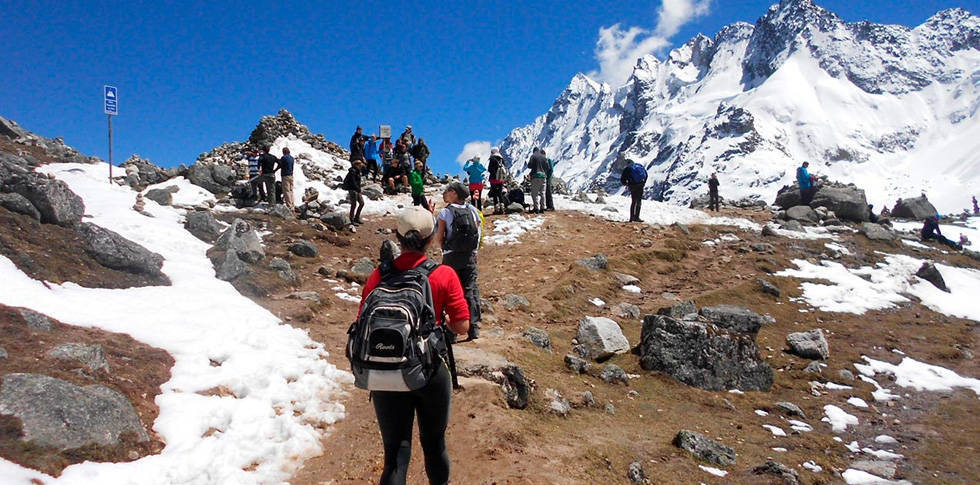
The Salkantay Trek with an organized agency works with a load-sharing system that frees the participant from the weight of camping gear and food during hiking hours. The team of porters or muleteers transports everything needed at camp but not during the hike. The participant carries only the daypack with what they use during the hours on the trail.
That division is what makes the difference between doing the Salkantay Trek with your body free to enjoy the route and doing it while carrying all the weight as in a self-sufficient expedition. On the second day of Salkantay, with the crossing of the Salkantay Pass at 4,630 meters and the 1,500-meter descent to the Chaullay campsite, the difference between carrying 7 kilograms and carrying 20 is not only physical: it is the difference between facing that day with energy available for the surroundings and simply surviving it.
What the support team transports
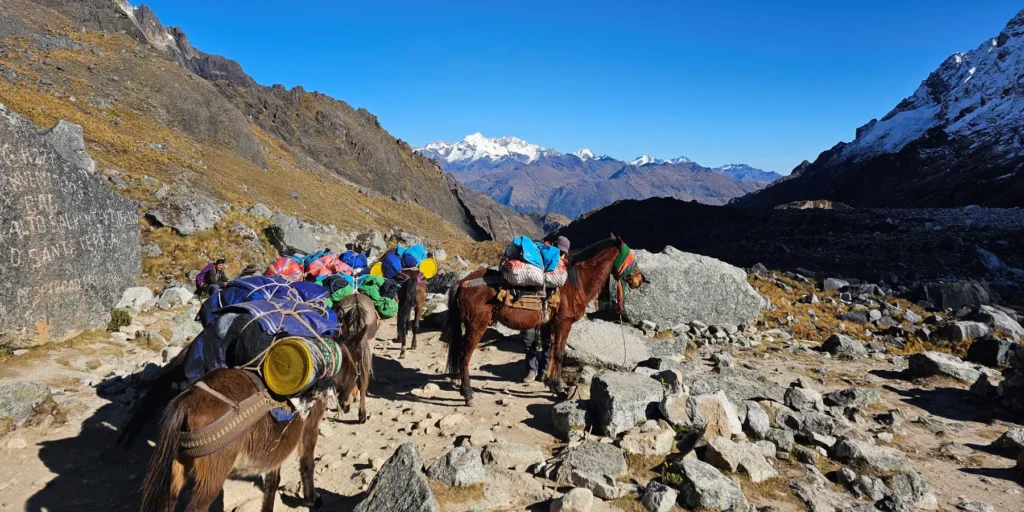
The team of porters or muleteers on the Salkantay Trek transports all camp and food items for the group during the five days of the route. This includes sleeping tents, ground insulation mats, sleeping bags if the agency provides them, the kitchen and dining tent, portable gas stoves, fuel canisters, all cooking utensils, complete food supplies for the five days of the route, and the personal equipment of the cook and the porters themselves.
In addition to the collective camp equipment, the support team also transports each participant’s personal luggage. That individual bag, which contains change of clothes, hygiene items, sleepwear, and any personal item that is not needed during hiking hours, travels with the porters or muleteers from the departure campsite each morning to the destination campsite for that day.
Personal luggage carried by the porters: limits and type of bag
Each participant’s personal luggage carried by the porters has a weight limit that varies depending on the operator, but it is usually between 5 and 8 kilograms per person. That limit exists for reasons related to the sustainability of the porters’ work: the total load carried by each member of the support team includes their share of the collective equipment plus the personal luggage of the assigned participants, and exceeding the individual limit contributes to overloading a job that is already physically demanding.
At Incredible Peru Tours, we communicate that weight limit clearly before departure and ask each participant to weigh their personal bag before the trek begins. If the bag exceeds the agreed limit, the extra items go into the daypack for that day or are handled in another way on the ground. It is not a rule that is negotiated on the day of departure in Soraypampa.
The most suitable type of bag for personal luggage carried by the porters is a duffel bag or cylindrical canvas bag without a rigid structure, with a capacity between 40 and 60 liters and a perimeter zipper closure. A flexible bag is easier to distribute among the support team’s loads than a rigid backpack or a structured suitcase. Some agencies provide this bag as part of the package service to standardize the type of load handled by the team.
When luggage is handed over and picked up
The process of handing over and picking up personal luggage between the participant and the support team takes place at the campsites, not in the middle of the trail. Each morning before the group leaves for the next section, the participant hands their bag to the head porter or assigned muleteer. That bag travels with the support team during the hiking hours and is available at the destination campsite when the group arrives at the end of the day.
The logic of this system means that during hiking hours there is no access to the personal luggage bag. If something from that bag is needed during the trail, it must be moved to the daypack before the morning handover. The most common things forgotten at that moment are moisturizer or lip balm left in the toiletry bag inside the large bag, spare batteries for the flashlight, or the extra clothing layer left in the bag because the day was expected to be less cold than it turned out to be.
In dome complexes: how the logistics change
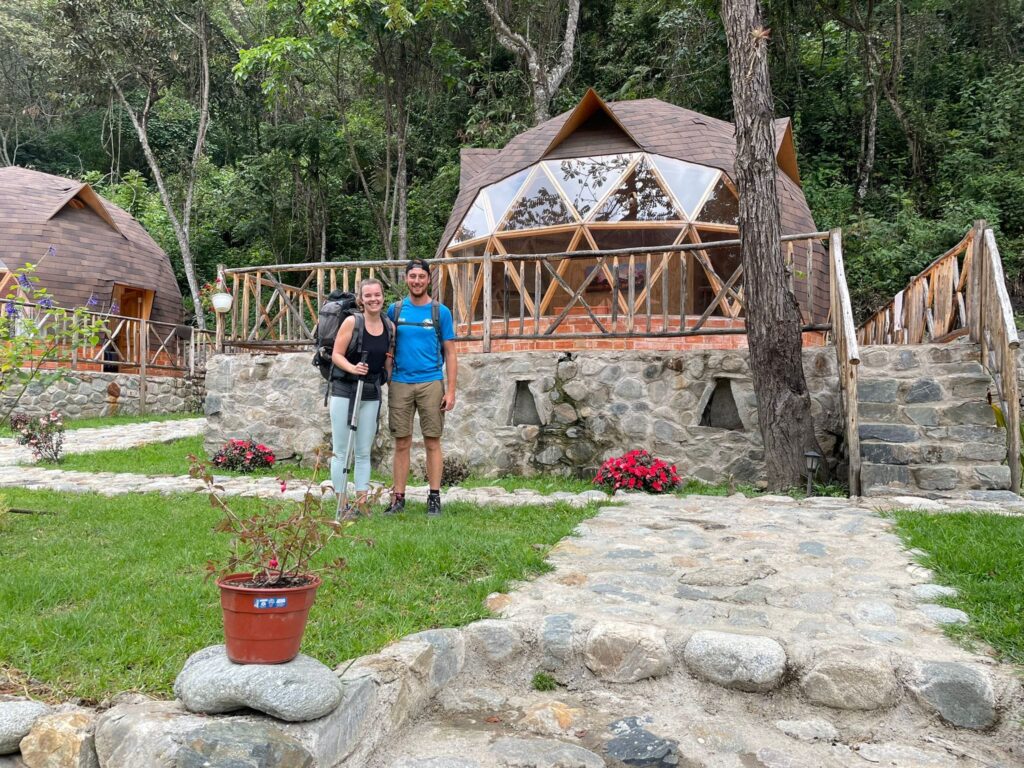
In Salkantay Trek packages with accommodation in domes or ecolodges instead of a conventional campsite, luggage logistics have an important variation. Dome complexes have fixed rooms with direct access to luggage during the night, which eliminates the need for the cylindrical duffel bag that is handed over to the porters and picked up at the next campsite.
In those packages, personal luggage travels between accommodation points in the agency’s support vehicle on sections accessible by road, or with the muleteer team on sections that are only accessible on foot or with pack animals. The practical difference for the participant is that at points with road access, they can bring a wheeled suitcase or a larger backpack, while on pure trail sections, the weight and bag-type restrictions apply just as they do in a conventional campsite.
What happens at the transition points between road and trail
The Salkantay Trek has a more complex logistical profile than the Inca Trail in terms of access types. The start of the route in Soraypampa is reached by vehicle from Cusco, but from that point, luggage must be transported on foot or with pack animals because there is no road. The final section toward Aguas Calientes has access to the train route, from where luggage can be moved through a specific transport service.
Those transition points are where luggage logistics require more coordination from the operator. At Incredible Peru Tours, we manage those transitions with an established protocol that each participant knows before departure: which bag goes with the muleteers, what goes in the support vehicle when one is available, and how the group’s full luggage is brought together at each point of the itinerary before continuing to the next one.
Luggage that stays in Cusco
For the five days of the Salkantay Trek, the participant does not need to bring all the luggage from their entire trip to Peru. City clothes for the days in Cusco before and after the trek, shoes that are not used on the trail, souvenirs bought before the trek, and any other travel item that has no function during the five days of the route stay at the hotel in Cusco.
Most hotels in Cusco offer luggage storage service during the trekking period at no additional cost or for a minimal fee. Confirming that service with the hotel before leaving for the route and clearly labeling the bags with the guest’s name and return date is the step that prevents confusion upon return.
Bringing only what is needed during the five days of Salkantay to the trek not only makes the support team’s logistics easier: it also simplifies the preparation each morning at camp, which, with the accumulated fatigue of the route, makes having fewer items to manage much appreciated.
How to organize luggage the night before each day
The most useful habit for properly managing the luggage transport system during the Salkantay Trek is to spend ten minutes each night at camp preparing the contents of the two bags for the next day. Those ten minutes allow you to move the items you will need during hiking hours into the daypack, check that the flashlight is accessible and charged for the second day’s departure, and close the porter bag with everything that is not needed until arrival at the next campsite.
That nightly organization ritual prevents the most uncomfortable situation in the system: realizing halfway up the ascent to the Salkantay Pass that the rain jacket, trekking poles, or sunscreen were left in the bag that the muleteers are already carrying toward the Chaullay campsite.
Do you have questions about how to manage your luggage during the Salkantay Trek, or do you want to know exactly what the agency provides and what you need to bring yourself? At Incredible Peru Tours, we send each confirmed group a detailed gear guide that includes the protocol for handing over and picking up personal luggage at each point of the route.


