
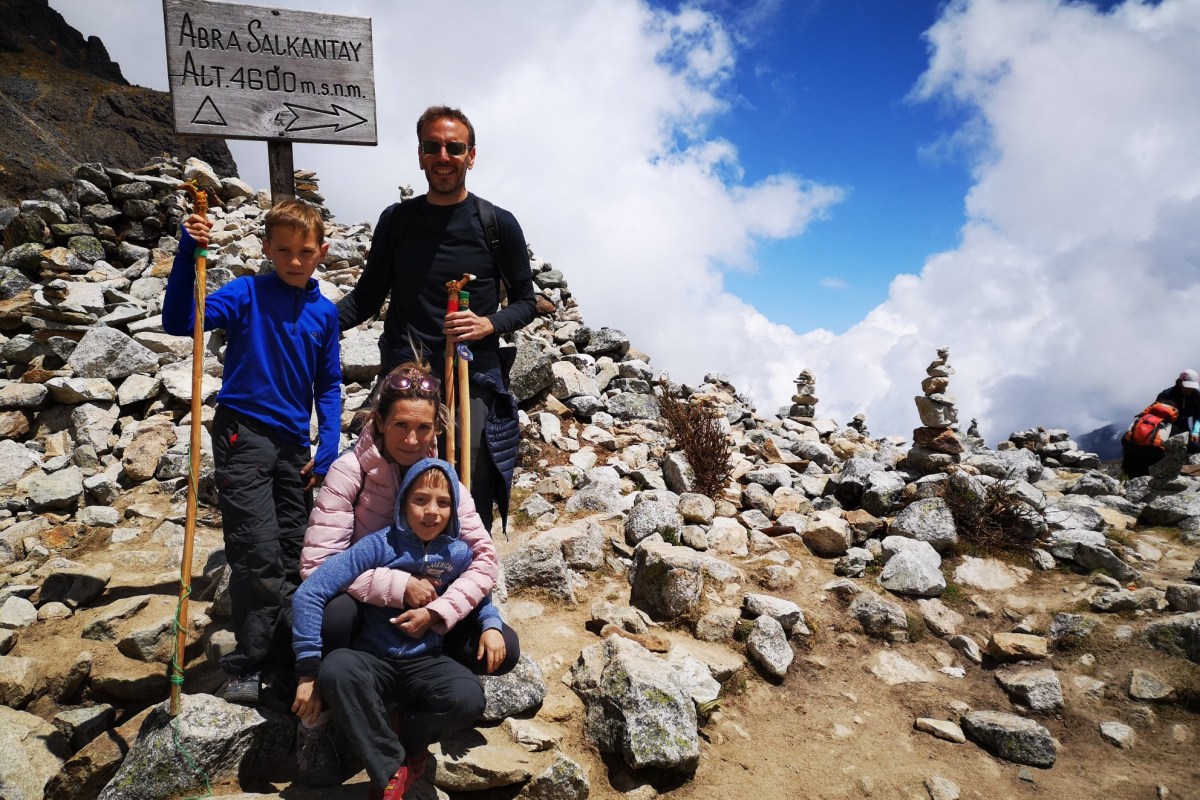
Taking a child on the Salkantay Trek is a decision that deserves more thought than most of the ones you make when planning an adventure trip. Not because it is impossible or inherently irresponsible, but because the variables that determine whether the experience will be positive for the child and the adults traveling with them are more specific and more consequential than in most trekking destinations in the region. This guide gives you the concrete information to make that decision with real criteria.
Altitude: the most critical factor with children
The Salkantay Trek crosses the Salkantay Pass at 15,190 feet (4,630 meters) above sea level. That altitude is not just a geographical fact: it is the most important physiological condition to evaluate before bringing a child on this route. Developing bodies respond to altitude differently than adult ones, and in some cases with greater symptom intensity because the cardiovascular and respiratory systems have not yet reached full functional maturity.
Altitude sickness symptoms in young children can be harder to identify than in adults because younger children cannot always describe precisely what they are feeling. A child who becomes irritable, loses their appetite, cries more than usual, or shows apathy in an environment that would normally excite them may be responding to the altitude even without saying “my head hurts.” Parents with experience traveling at altitude with children learn to read those signs, but for those doing it for the first time that diagnostic difficulty is an additional risk factor worth knowing about.
A pediatric consultation before the trip is not optional for children under 12 who will be exposed to altitudes above 11,500 feet (3,500 meters) for several days. The pediatrician can assess the child’s health, confirm there are no specific contraindications, and advise on preventive measures that reduce the risk of altitude sickness.
Minimum age: what real trail experience recommends
There is no legal minimum age restriction for the Salkantay Trek because the route does not have the Ministry of Culture regulatory system that applies to the Inca Trail. That means the decision about the appropriate minimum age falls entirely on the parents and the guidance of the operator.
Based on Incredible Peru Tours’ operational experience on the Salkantay Trek, the age at which the full route is reasonably viable for a healthy, properly acclimatized child is approximately 10 years old. Below that age, the second day of the Salkantay Trek with the crossing of the Salkantay Pass at 15,190 feet (4,630 meters) and the 4,900-foot (1,500-meter) descent to the Chaullay campsite concentrates a level of physical effort and altitude exposure that a younger child’s body may handle with greater difficulty.
Between ages 10 and 14, viability depends largely on the child’s physical condition and prior experience with mountain activities. A 12-year-old with strong legs, accustomed to long hikes and with adequate prior acclimatization has a strong chance of genuinely enjoying the Salkantay. A child the same age with no mountain experience and no acclimatization may find the second day very difficult to get through.
From age 14 onward, the Salkantay Trek is viable for most teenagers with reasonable fitness and the same preparation conditions that apply to adults.
Acclimatization with children: more time, more patience
Prior acclimatization in Cusco for a family group with children should be longer than the standard minimum of two nights recommended for adults. With children under 14, three nights in Cusco before starting the trek is the reasonable minimum, and four nights are more appropriate for children who have never been at altitudes above 6,500 feet (2,000 meters).
During those nights in Cusco, activities should be deliberately moderate. Children’s enthusiasm upon arriving somewhere new can lead to a level of physical activity in the first days that an acclimatizing body should not take on. Short visits to the historic center, excursions to the Sacred Valley at lower altitude than Cusco, and plenty of rest are more useful for preparing a child’s body for the Salkantay than trying to make the most of every hour of the acclimatization days.
Water is the most important ally of acclimatization in children. Consistent hydration with water or Andean herbal teas such as muña or coca tea in age-appropriate amounts noticeably reduces the intensity of altitude adaptation symptoms. Many children who drink well during the acclimatization days handle the start of the Salkantay better than adults who did not pay enough attention to hydration.
Which version of the Salkantay Trek makes the most sense with kids
The five-day version is the most suitable for family groups with children because it distributes the effort across more days with lower daily demands. The three- or four-day versions, which compress the route into longer and more intense days, are not recommended for families with minors because the recovery margins children need between days are significantly reduced.
Private service is more appropriate than group service for families with children for reasons of pace and flexibility. On a shared group trek, the guide sets the pace based on the general level of participants, and children can feel the pressure of keeping up with the adult group. On a private service, the pace adapts entirely to the family group and the guide can make the additional stops the child needs without anyone feeling held back.
Dome accommodation instead of conventional camping has a real impact on children’s experience, especially for the first night at Soraypampa. The below-freezing temperatures at that campsite in a tent can be very uncomfortable for young children with no high-altitude camping experience. Domes with more controlled interior temperatures eliminate that nighttime stress factor and improve sleep quality, which in turn largely determines the child’s physical and emotional state the following day.
The second day with kids: how to manage it well
The second day of the Salkantay Trek is the most demanding of the route and the one that requires the most care with children. The pre-dawn departure, the extended ascent to the Salkantay Pass, and the hours-long descent to Chaullay concentrate a level of physical effort and altitude exposure that the child and the adults accompanying them need to manage with different criteria than an adult-only group.
The pace of the ascent should be consciously slower than the terrain seems to demand, especially above 13,000 feet (4,000 meters). Children, like adults, tend to climb faster than their bodies can comfortably handle at that altitude, and correcting the pace is the responsibility of the guide and the adults in the group not the child, who has no frame of reference for what that level of altitude means.
Frequent stops with energy snacks and water have a direct impact on children’s performance during the ascent. A child’s body burns through glucose faster than an adult’s under sustained physical effort, and the energy drop when that glucose runs out can be more abrupt and harder to manage emotionally. Keeping trail mix, granola bars, energy bars, and dried fruit in the adults’ packs in an easily accessible spot without needing to open the whole pack is the right preparation for that day.
How to make the Salkantay a real adventure for your child
Children who do the Salkantay Trek with their families have a capacity to absorb and process the experience that frequently surprises the adults with them. The turquoise waters of Humantay Lake seen from a ten-year-old’s eye level have a different dimension than they do from an adult’s. The sunrise over the glacier on the second day, explained by the guide in terms a child can understand, creates a connection with the natural world that no nature book can replicate.
Guides with experience leading family groups on the Salkantay know how to adapt their explanations to the age of the youngest members of the group without oversimplifying them. Stories about the Salkantay glacier as an Apu the sacred mountain of Andean communities animals along the route identified by their Quechua names, edible plants on the trail, and the mysteries of Inca architecture at Machu Picchu are all content that a ten-year-old can absorb with an intensity that in many cases surpasses that of the adult walking beside them.
What kids remember about the Salkantay Trek years later
Families who have done the Salkantay Trek with children between 10 and 14 years old describe a remarkably consistent experience afterward: the children remember the trek with a precision and an emotion that the parents did not expect. The glacier on the second day, the llamas at the Soraypampa campsite, the hot springs at Cocalmayo at the end of the third day, and the first view of Machu Picchu are the moments children mention most frequently years after living them.
That lasting memory is not accidental: it is the result of having experienced something physically demanding, visually extraordinary, and completely unlike anything before during a period of life when memories of that kind are formed with a depth that more comfortable experiences rarely produce. For many of those children, the Salkantay Trek is the first time they discover they are capable of doing something that seemed too big for them.
Are you planning the Salkantay Trek with kids and looking for guidance on the right age, the most appropriate version of the route, and the logistical details that make the difference for a family group? At Incredible Peru Tours we have experience with families on the Salkantay Trek and tailor every detail of the itinerary to each group’s specific profile, including the pace of the second day and the most suitable accommodation for younger travelers. Send us your children’s ages and the dates you are considering and we will put together the most appropriate proposal for you.


