
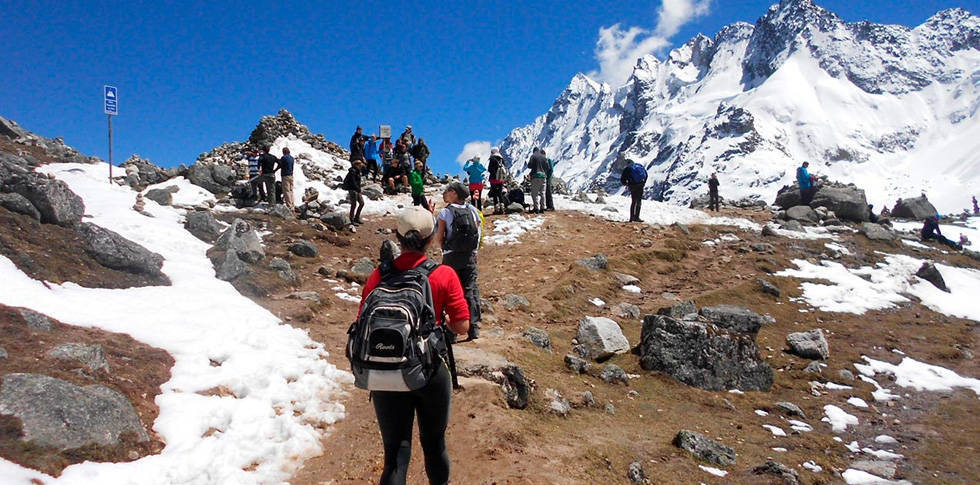
Tips on the Salkantay Trek are one of those questions that often come up at the very last minute, sometimes at the fourth-day campsite when the group starts preparing for the return to Aguas Calientes and someone asks out loud whether anyone has cash ready. This guide exists so that conversation is not the first time you think about the topic, and so that anyone reading it reaches the end of the trek with envelopes already prepared and the right information about what is reasonable and why.
Why tips matter more in this context than in others
On the Salkantay Trek, tips are not just an optional gesture of satisfaction for the service, as they might be in a restaurant or hotel. They are a significant part of the real income of the people who make the journey possible. Porters, cooks, and guides work under very demanding physical conditions for five days in the high mountains, with days that begin before sunrise and end after the group is already in their sleeping bags. The tip they receive at the end of the trek can represent between 30 and 50 percent of what they earn during those five days.
Understanding that context does not create any obligation to give more than what feels appropriate, but it does change the way the moment of tipping is experienced. It is not a social formality at the end of the trip: it is the financial recognition of extraordinary physical work that, for five days, has literally carried everything needed so the group can focus on enjoying the trail.
Who receives tips on the Salkantay Trek
The support team on a Salkantay Trek usually includes three types of people who receive tips separately.
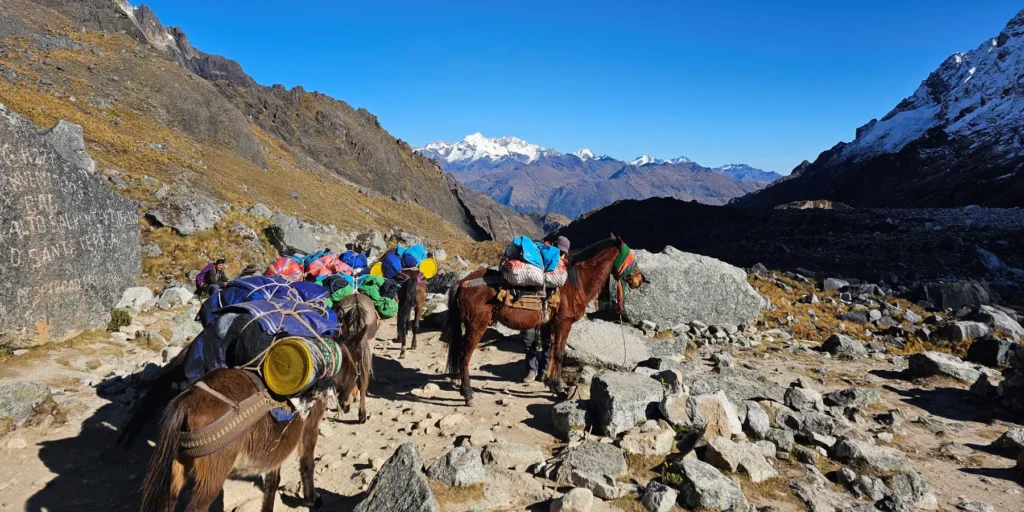
The porters or muleteers. They are responsible for transporting the camping gear, food, and cooking equipment from Cusco to the different points along the route. On the Salkantay Trek, some operators use porters on foot, while others use muleteers with mules or horses for the initial section. In both cases, the tip is given for the work of transporting the equipment during the days of the trek. The tip is handed to the porter team as a group, usually in a single envelope that the guide or head porter distributes internally according to the number of days worked by each person.
The cook. This is the person who prepares all meals during the trek, from the first breakfast to the final lunch before arriving in Aguas Calientes. On the Salkantay Trek, the cook leaves before the group every morning to have the food ready at the next destination point, works in field kitchen conditions with portable equipment, and prepares elaborate menus that many travelers describe as one of the most pleasant surprises of the trek. The tip for the cook is given individually, not grouped together with the porters.
The main guide. This is the professional who accompanies the group throughout the five days, manages the pace of the trek, provides historical and natural context for each section, coordinates the entire support team, and handles any unexpected situations on the ground. The guide receives the highest tip on the team because of the level of responsibility and training involved, and it is handed directly to them at the end of the trek.
How much to give: suggested ranges for 2026
Tipping ranges on the Salkantay Trek can vary somewhat depending on the source, but there is a fairly stable market consensus that Incredible Peru Tours shares with its groups before departure as a general reference. All ranges are per person in the group and for the full five-day trek.
Porters: between 15 and 25 dollars per person in the group for the porter team as a whole. This amount is not per individual porter, but rather each participant’s contribution to the shared tip fund for the entire transport team.
Cook: between 20 and 30 dollars per person in the group. The cook works more continuously than the porters because, in addition to transporting kitchen supplies, they prepare all meals without rest days throughout the trek.
Main guide: between 25 and 40 dollars per person in the group. This is the highest range for the reasons already mentioned: responsibility and professional qualification. For very small private groups of two or three people, the range may be adjusted upward because the guide provides the same level of attention as in a larger group, but to fewer participants.
For a group of four people doing the five-day Salkantay Trek, these ranges add up to a total of between 240 and 380 dollars in tips distributed among the entire team. For a group of eight people, the total rises to between 480 and 760 dollars, which, divided among eight participants, represents an additional 60 to 95 dollars per person on top of the package price.
What currency to use and how to prepare it
Tips on the Salkantay Trek are given in cash. The preferred currency is the Peruvian sol, although U.S. dollars are also accepted without any problem by most guides and porters who regularly work with international groups. Euros are less common on the Salkantay route, and although they may be accepted, the exchange rate the recipient can get when changing them at local banks is usually less favorable than the dollar rate.
The most organized way to handle tips is to bring the cash prepared in individual labeled envelopes from Cusco before starting the trek. One envelope for the porter team, one for the cook, and one for the guide. Preparing everything in advance avoids the uncomfortable situation of counting bills and dividing amounts at the last campsite while the whole team is watching.
Small-denomination bills are more useful than larger ones for this purpose: 10- or 20-sol bills are easier for the recipient to manage than a 100-sol bill, which can be difficult to break in the villages along the route.

When to give the tip
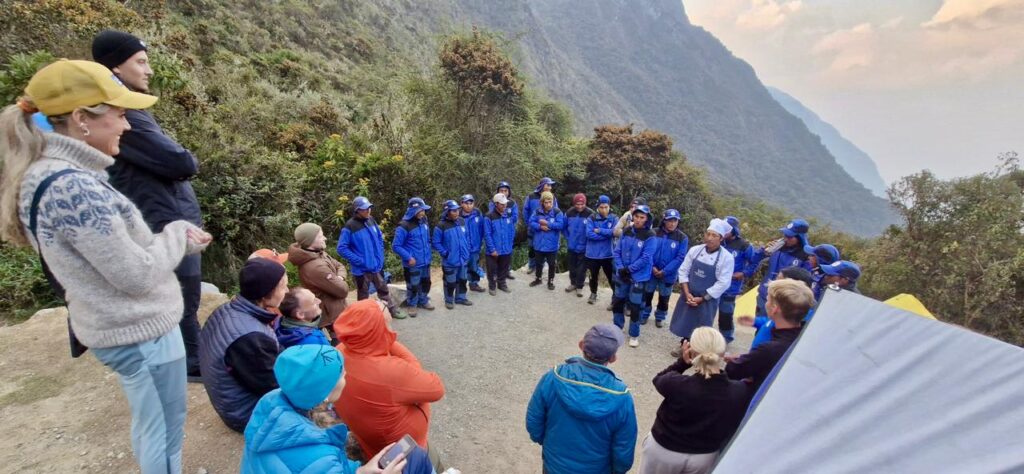
The usual time to give tips on the Salkantay Trek is on the final day of the route, in Aguas Calientes, before the support team takes transportation back to Cusco or to their home communities. In some groups, the tip is given at the fourth-day campsite before descending to Aguas Calientes, allowing the team to receive it while the whole group is still together.
The guide usually coordinates the most appropriate moment for the tip and, in many cases, organizes a small informal ceremony of mutual gratitude at the end of the trek. That moment, which in some groups includes words of appreciation for each member of the team, has a dimension that goes beyond the financial gesture and closes the trek in a way many travelers describe as unexpectedly moving.
If the service was not what you expected: how to handle it
A tip is a recognition of the support team’s work, not an evaluation of the package price or a way to protest elements of the service that fell below expectations. If there are aspects of the package you are not satisfied with, the proper channel is to communicate that to the agency, not to reduce the tip for the field team, who in most cases have no control over those decisions.
The exception would be a case in which the attitude or performance of a specific team member was clearly inappropriate during the trek. In that case, that person’s individual tip may be reasonably adjusted. But reducing the tip for the entire team because of dissatisfaction with the package price or agency decisions that the field team does not make is a reaction that has financial consequences for people who worked properly for five days.
What your tip says about how you value the experience
In the context of trekking tourism in the snow-capped Andean mountains, tipping has a meaning that goes beyond a financial transaction. Quechua-speaking communities from the Sacred Valley and surrounding areas who work as porters, cooks, and guides on the Salkantay Trek depend heavily on this income to support family economies in areas where employment alternatives are limited. A tip within a reasonable range is not just a gesture of courtesy: it is a decision with real consequences for specific lives in a specific region of Peru.
That does not force anyone to give more than they can or more than they consider fair. But it does place the decision within a context that deserves to be understood before making it.
Do you have questions about tipping on the Salkantay Trek or about any other logistical aspect of the route before booking? At Incredible Peru Tours, we inform each group about the recommended tipping ranges before departure and make sure the support team reaches the end of the trek with the information and cash needed to close the journey properly. Send us your questions before booking.


