
High in the mountains overlooking the Sacred Valley of the Incas stands Huchuy Qosqo, an archaeological complex known for its agricultural terraces, stone and adobe structures, water channels, and sweeping views over the Vilcanota River valley.
Although it receives fewer visitors than other archaeological sites around Cusco, Huchuy Qosqo helps you understand how the Incas adapted their buildings to mountainous terrain and combined residential, productive, and possibly ceremonial spaces.
Its current name means “Little Cusco,” but the place was once known as Qaqyaqawana. In addition, colonial chronicles link this settlement to the Inca Viracocha, one of the rulers who came before Pachacútec.
What is Huchuy Qosqo?
Huchuy Qosqo is an Inca archaeological complex located in the district and province of Calca, in the department of Cusco. It sits at approximately 3,650 meters above sea level, in an elevated position over the Sacred Valley.
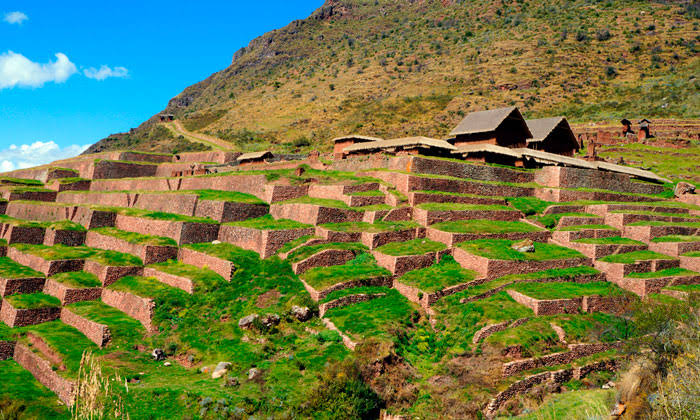
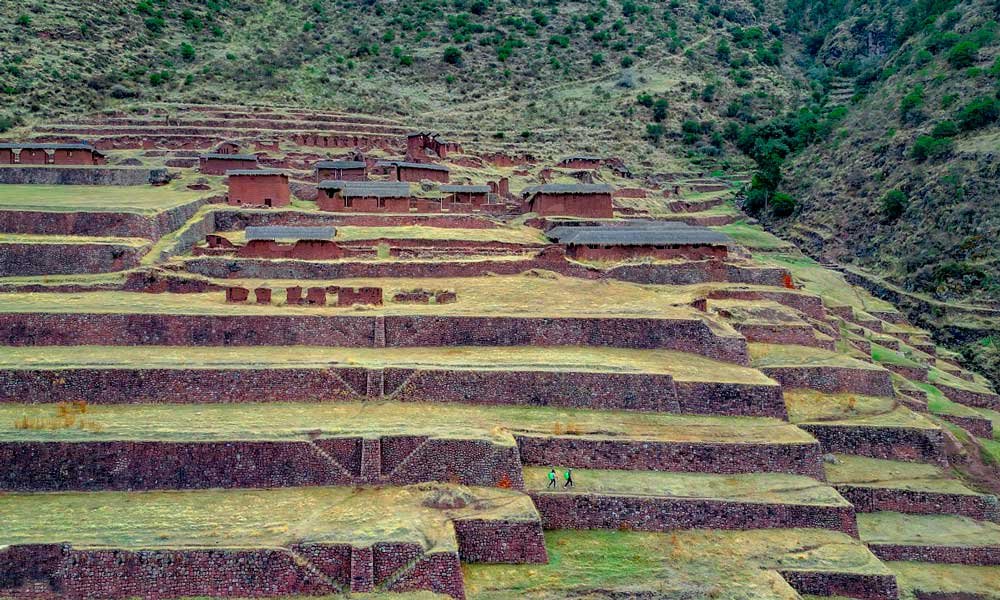
The site is made up of architectural structures built on a steeply sloping area. To make the most of the terrain, the Incas developed platforms, terraces, stairways, enclosures, and irrigation channels.
The location also offers a broad view of the valley and the mountains that surround Calca and Lamay. This position would have allowed the settlement to visually monitor the territory and organize the activities carried out there.
What does Huchuy Qosqo mean?
The name Huchuy Qosqo comes from Quechua:
- Huchuy: small.
- Qosqo: Cusco.
It can therefore be translated as “Little Cusco” or “Small Cusco.”
This would not have been the settlement’s original name, however. The official record in the National Inventory of Tourism Resources notes that it was once called Qaqyaqawana, and that the name Huchuy Qosqo came into use in the early twentieth century because of certain similarities between the layout of its buildings and the city of Cusco.
Qaqyaqawana is connected to the Qaqya mountain and to the Quechua word linked to thunder. For that reason, some interpretations present this old name as a reference to a place from which thunder is observed or watched.
History of Huchuy Qosqo
The history of Huchuy Qosqo still holds questions that archaeology and the study of the chronicles are trying to answer. There is no exact, fully verified date for all the stages of its construction.
Historical sources connect the old settlement of Caquia Xaquixaguana, another colonial way of writing Qaqyaqawana, with the Inca Viracocha. Some accounts state that the ruler withdrew to this place during the conflict with the Chancas.
Based on these references and on the features of the complex, Huchuy Qosqo is often interpreted as a residence tied to Viracocha Inca and his family. It may also have worked as a center for administering land, agricultural goods, and workers.
It is important to use expressions such as “according to the chronicles,” “it is thought,” or “probably.” To categorically state that Viracocha personally built the entire complex would present as definitive a matter that remains open to historical interpretation.
Huchuy Qosqo after the Inca period
Over time, several structures suffered damage from rain, wind, humidity, vegetation, and some human activity.
During 2013 and 2014, restoration and conservation work was carried out on certain enclosures, terraces, and walls. These efforts sought to stabilize the structures and protect the adobe elements in particular.
The site was declared Cultural Heritage of the Nation on August 19, 2003, through Directoral Resolution No. 611-2003 of the then National Institute of Culture.
What was Huchuy Qosqo used for?
No single function has been established for the whole complex. Because of its layout and architectural features, Huchuy Qosqo is thought to have served several different purposes.
A residence tied to the Inca elite
The presence of large enclosures, plazas, and carefully planned buildings supports the interpretation that part of the settlement was connected to members of the Inca elite.
The chronicles that mention the Inca Viracocha have led some to identify the site as a possible royal residence or retreat. This interpretation, however, should be presented as a hypothesis based on historical sources.
An administrative and agricultural center
The terraces, storehouses, channels, and circulation spaces show that agricultural production and resource management were important.
The terrace system has horizontal and vertical channels used to distribute water. Stone stairways were also built to make it easier to move between the different levels.
A ceremonial space
The official MINCETUR record describes platforms and open grounds that may have been used for ceremonial activities. The elevated position and the visual relationship with the mountains and the valley would also have been significant within the Andean understanding of the landscape.
For this reason, Huchuy Qosqo should not be understood solely as a fortress or a palace. It was a complex settlement in which residential, administrative, agricultural, and ceremonial functions may have come together.
The architecture of Huchuy Qosqo
One of the most interesting aspects of the site is its combination of stone, clay, and adobe.
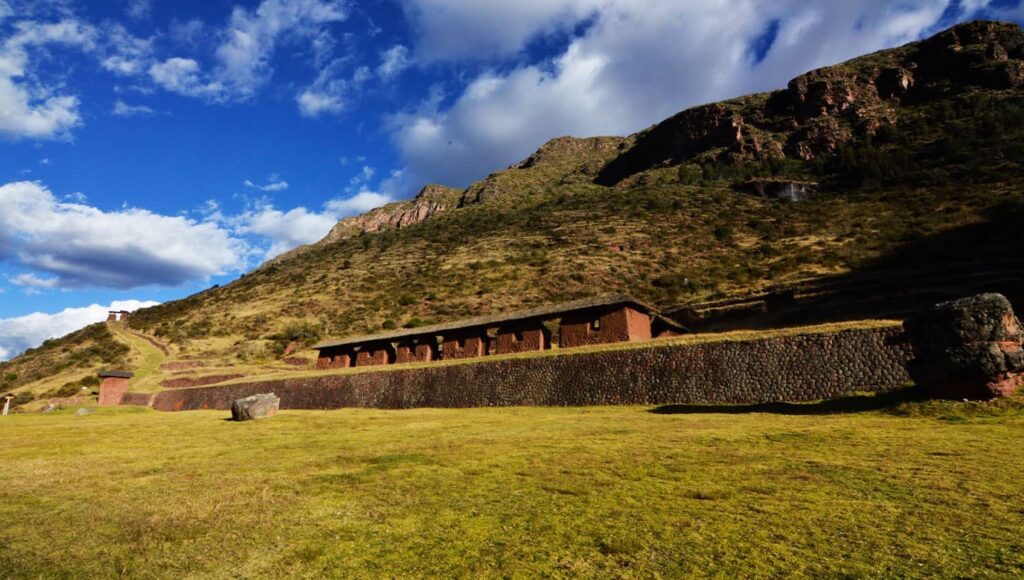
The buildings have stone foundations and footings. On top of these bases, adobe walls were raised, some of which still stand at a considerable height despite the climate and the passage of time.
Its main architectural elements include:
- Enclosures built with stone bases and adobe walls.
- Platforms and terraces adapted to the slope.
- Stairways connecting the different levels.
- Channels for distributing water.
- Open grounds and outdoor spaces.
- Walls with worked stone and clay mortar.
The mix of materials shows that Inca architecture was not limited to the well-known walls of perfectly fitted stone. In places like Huchuy Qosqo, builders used different techniques according to the terrain, the climate, and the function of each building.
Why is Huchuy Qosqo important?
Huchuy Qosqo is important because it lets you study the Inca occupation of the Sacred Valley from a different perspective than the major tourist destinations.
The complex shows a remarkable handling of the topography. Instead of removing the slopes, the builders transformed them with terraces and platforms that gave the ground stability and created spaces for farming and construction.
It also preserves significant examples of the combined use of stone and adobe. These materials provide information about the building techniques developed in the highlands and about the current challenges of preserving archaeological heritage.
Its old name, its possible connection to Viracocha, and its position above the Sacred Valley make the site an important source for understanding the region’s history before the definitive establishment of the Tahuantinsuyo.
How to see Huchuy Qosqo
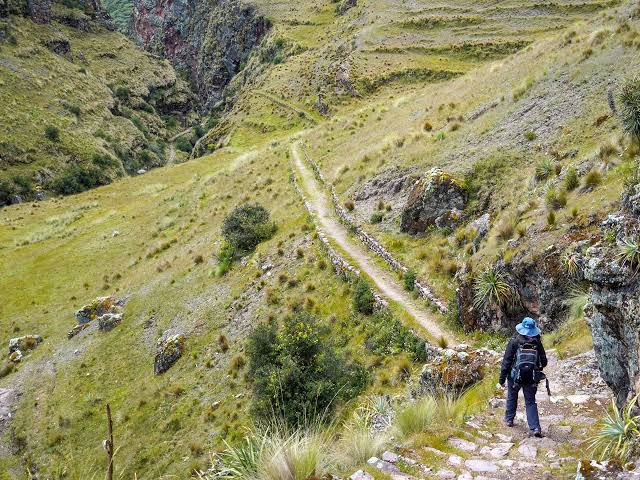
The final approach to the site has to be done on foot. One of the traditional routes climbs up from the Lamay area, while other routes begin in higher sections near Cusco, Chinchero, Patabamba, or Tambomachay. The length and difficulty depend on the starting point you choose.
To take in not only the buildings but also their historical and cultural context, it is a good idea to do the route with a professional guide.
Travelers looking for an experience that combines hiking, mountain landscapes, and archaeological heritage can take the 2-day Inca Trail to Huchuy Qosqo, a route that starts near Cusco and lets you reach the archaeological complex on foot.
During the visit, it is important to stay on the marked trails, avoid climbing on the walls, refrain from removing stones or materials, and follow the instructions of the site staff.
Frequently asked questions about Huchuy Qosqo
Where is Huchuy Qosqo located?
It is located in the province and district of Calca, in the department of Cusco, on an elevated area of the Sacred Valley of the Incas.
What altitude is Huchuy Qosqo at?
The archaeological complex sits at roughly 3,650 to 3,677 meters above sea level, according to the technical and official sources consulted.
What does Huchuy Qosqo mean?
It means “Little Cusco.” This name came into use during the twentieth century. Before that, the site was known as Qaqyaqawana.
Was Huchuy Qosqo built by the Inca Viracocha?
The chronicles connect the place with Viracocha Inca and allow it to be interpreted as a possible residence tied to this ruler. It would not be accurate, however, to present the complete construction of the site by Viracocha as a definitively proven archaeological fact.
Can you get there by vehicle?
The routes let you cover part of the trip by transportation, but the final approach to the archaeological complex requires a hike. The time depends on the route and the starting point.
Huchuy Qosqo, a testament to Andean knowledge
Huchuy Qosqo is far more than an alternative destination in the Sacred Valley. Its terraces, enclosures, channels, and adobe walls show how the Incas organized complex spaces in the middle of mountainous terrain.
Its history is also a reminder of how important it is to separate proven facts from interpretations. The connection to Viracocha comes mainly from the chronicles, while its architecture provides evidence of administrative, agricultural, residential, and ceremonial activities.
Visiting Huchuy Qosqo lets you get closer to a lesser-known part of Cusco’s history and understand the relationship that existed between architecture, territory, and landscape in the Andean world.


