

The route to Machu Picchu is a dream for thousands of travelers. While the Classic Inca Trail requires strict permits and authorized operators, a wild and challenging alternative emerges. Many adventurers wonder if it is feasible to complete the Salkantay trek without a guide, seeking absolute freedom and a more intimate connection with the mountains.
The short answer is: Yes, it is both possible and legal. Unlike the Inca Trail, there are no regulations prohibiting self-guided entry. However, heading into the Andes without logistical support is not a decision to be taken lightly.
In this article, we will analyze the reality of trekking solo, the risks, the real costs, and everything you need to know before packing your bag.
What does a Salkantay self-guided trek involve?
Doing the Salkantay self-guided means being 100% self-sufficient. You won’t have muleteers or horses to carry your gear, nor cooks waiting for you with a hot drink after 8 hours of hiking through intense rain or sun.
While the freedom to set your own pace is tempting, you must consider that you will be responsible for:
- Transportation logistics: Finding “colectivos” (shared vans) from Cusco to Mollepata and Soraypampa.
- Food: Calculating, buying, and carrying food for 4 or 5 days (and cooking it at 13,000 feet).
- Accommodation: Managing your campsites or finding basic shelters (domes or paid camping areas) along the route.
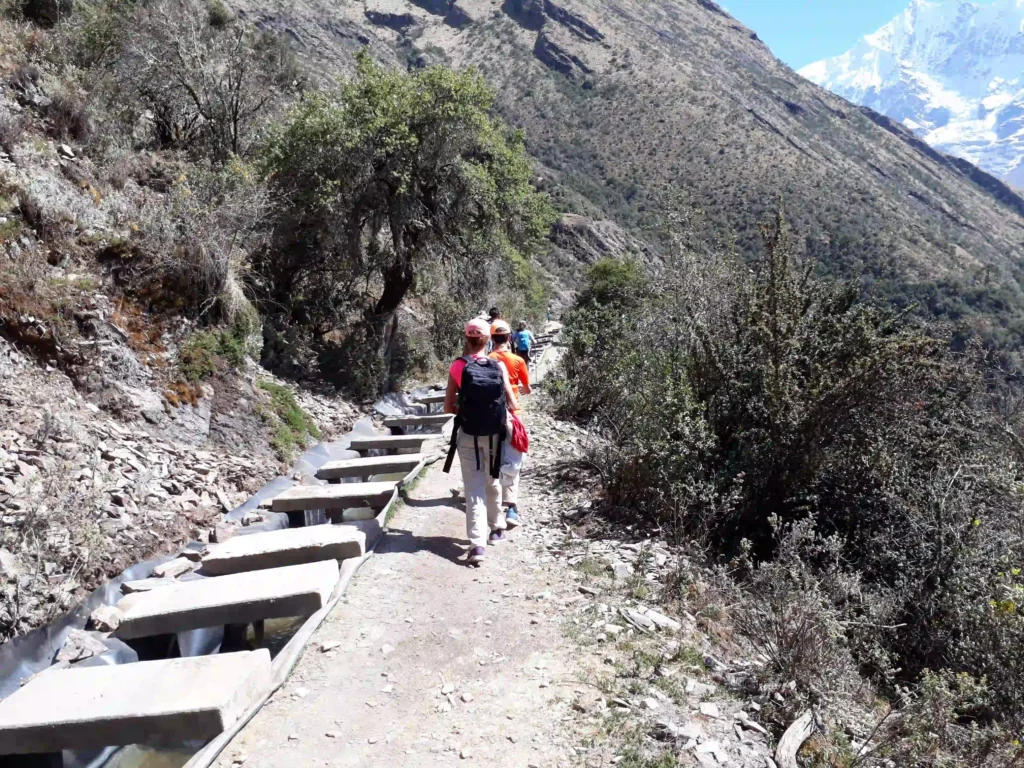
- Navigation: Although the path is mostly clear, thick fog at the Salkantay Pass can disorient even the most experienced hikers.


Challenges of Salkantay without a guide: What nobody tells you
While it is a rewarding experience, doing the Salkantay trek without a guide presents technical and physical challenges that go beyond just walking.
1. Altitude and Weight
It is one thing to hike at 4,600 m.a.s.l. (15,000 ft) with a daypack, and quite another to do it with 35 to 40 lbs on your back. The extra weight accelerates exhaustion and increases the risk of altitude sickness (soroche).
2. Navigation and the Salkantay Map
It is vital not to rely solely on cell signal, as it is non-existent for most of the trek. You must carry a physical Salkantay map or download offline GPS apps (like Maps.me or Wikiloc). Getting lost in the Pass area or during the transition to the cloud forest is a real risk if the weather turns bad.
3. Emergency Safety
If you suffer a sprain, severe indigestion, or acute altitude sickness, you won’t have a guide with a satellite radio or an emergency horse. You are on your own until you reach the next settlement.
Budget Analysis: Salkantay trek solo cost vs. Agency
There is a myth that going solo is “free.” While you save on professional services, you incur other expenses that add up quickly. Here is an estimated breakdown of the Salkantay trek solo cost:
- Transportation (Round trip): ~40 – 55 USD (including bus to Hidroelectrica and return train/bus).
- Entrance fees: 20 soles (Mollepata) + Machu Picchu Entrance (variable depending on the circuit and booking time).
- Accommodation/Camping: Many landowners charge between 10 to 30 soles to let you camp or use their bathrooms. If you opt for basic domes, the cost rises.
- Food and Gas: ~40 USD (dehydrated food, snacks, water).
- Gear: If you don’t own a 4-season tent, a -15°C sleeping bag, and trekking poles, renting them in Cusco can cost another 50-60 USD.
Verdict: Savings exist, but the price difference compared to an economy or standard agency often doesn’t compensate for the logistical effort and the risk involved.
Salkantay Fast Facts
To help you make an informed decision, here are the hard facts you need to know:
- Total Distance: Approximately 74 km (46 miles).
- Maximum Altitude: 4,630 m.a.s.l. / 15,190 ft (Salkantay Pass).
- Difficulty: High / Challenging.
- Best Season: May to October (dry season). Avoid February due to constant heavy rains.
- Weather: Varied. From below-freezing temperatures at night (14°F to 23°F) to humid heat and mosquitoes in Santa Teresa (77°F).
Expert Tips for the Route
As experts in Peru tourism, if you decide to take on this adventure, we leave you with these safety tips:
- Mandatory Acclimatization: Spend at least 2 or 3 days in Cusco before leaving. Your body will thank you at the Salkantay Pass.
- Water is Life (and Danger): Never drink directly from streams; there is livestock in the area. Use purifying tablets or a high-quality filter.
- Cash is King: There are no ATMs in the mountains. Carry small Soles bills to pay for campsites, extra water, or local transport.
- Early Start: Andean weather changes at noon. Aim to cross the highest pass before 10:00 AM to avoid strong winds and storms.
Conclusion
Trekking Salkantay without a guide is a real possibility for experienced mountaineers with the right gear and physical preparation to carry their own survival. It is a pure adventure, but it carries risks and a heavy logistical burden that may distract you from enjoying the scenery.
If your goal is to enjoy turquoise lagoons, imposing snow-capped peaks, and the Cusquenian jungle without worrying about pitching tents in the rain or cooking while exhausted, having a support team is your best investment.


