
Before confirming any Salkantay Trek reservation, most people build up a list of questions that general articles never fully answer. How much fitness do you really need? Can you do it solo? What happens if it rains on the day of the tour? Does the price include the return train? This guide brings together the most frequently asked questions travelers have before setting out and answers them with the same clear, practical information you would get in a direct conversation with an operator who knows the route well.
How many days does the Salkantay Trek last?
The standard version lasts five days and includes a visit to Machu Picchu on the final day. There are also four-day and three-day versions that shorten the route, with longer hiking days and less time to explore the intermediate sections. The five-day version is the most recommended for people doing the trek for the first time because it allows you to arrive at Machu Picchu with enough energy to enjoy the visit instead of dealing with the level of exhaustion that shorter versions usually cause.
Do you need a special permit for the Salkantay Trek?
No. Unlike the Inca Trail, the Salkantay Trek does not require an official permit from Peru’s Ministry of Culture for the mountain route itself. What is mandatory, and must be purchased separately, is the Machu Picchu entrance ticket for the last day, which is bought through the official Ministry of Culture website. In most cases, the tour operator handles that purchase as part of the package.
Is it necessary to hire an agency, or can it be done independently?
Technically, the Salkantay Trek can be done independently, since it does not require a mandatory guide like the Inca Trail. However, the reality of the route makes going with an agency the most sensible option for the vast majority of people. The logistics of carrying food for five days in an area without stores, coordinating transportation to and from the start and end points, knowing the trail conditions at different times of year, and handling unexpected issues on the ground are all difficult to manage alone unless you already have experience with multi-day high-altitude trekking. People with that background may consider doing it on their own. For everyone else, an agency is not a luxury but a safety and quality-of-experience tool.
What level of fitness do you need for the Salkantay Trek?
The Salkantay Trek is classified as a high-difficulty hike, mainly because of the combination of the 4,630-meter pass on the second day and the cumulative elevation loss on the descents during the second and third days. No technical mountaineering experience or athlete-level training is required, but you do need a fitness level above that of a sedentary person. What affects performance on the trail most is not fitness by itself but prior acclimatization: anyone who has spent at least two nights in Cusco before starting the trek has a much better chance of enjoying the second day than someone who arrives without that adjustment period.
How many days of acclimatization do you need before starting?
The recommended minimum is two full nights in Cusco before leaving for the trek. Three nights are more appropriate for people over 55, for those with high blood pressure, or for travelers who have experienced altitude sickness at similar elevations in the past. During those adjustment days, activity should be moderate: short walks through the historic center, a visit to the Sacred Valley, or excursions to areas at lower altitude than Cusco are the best options to support acclimatization without overloading the body.
How high does the Salkantay Trek go?
The highest point of the route is the Salkantay Pass, at 4,630 meters above sea level. It is crossed on the second day and concentrates the greatest physical effort of the entire trek. From that point, the route descends progressively to 1,580 meters in the Santa Teresa area on the third day, then continues to Aguas Calientes at 2,040 meters, and ends at Machu Picchu at 2,430 meters.
What happens if it rains on the second day, the day of the Salkantay Pass?
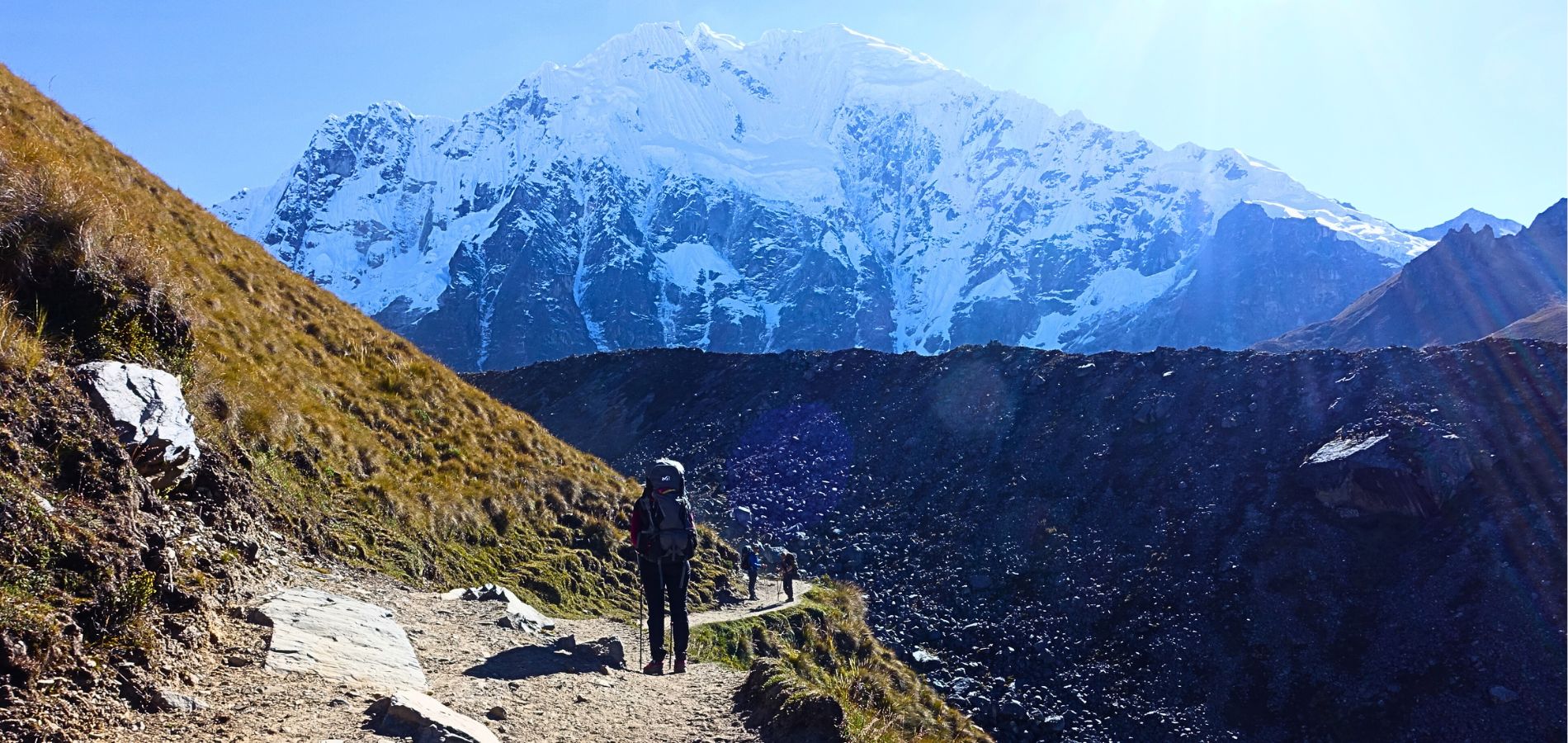
The trek continues regardless of rain, except in extreme weather conditions that create a real safety risk for the group. Rain on the second day reduces visibility of the snowcapped peak from the pass, which changes the visual experience but does not prevent crossing the pass itself. With the right waterproof gear, a rainy day on the Salkantay route is completely manageable. Weather-related cancellations are exceptional and usually correspond to situations such as heavy snowfall or electrical storms that the guide evaluates in real time.
What is the temperature like on the second day of the trek?
At the Soraypampa base camp, at 3,900 meters, nighttime temperatures can drop several degrees below freezing at any time of year. While crossing the Salkantay Pass, with the wind and the altitude of 4,630 meters, the felt temperature can range between 32 and 41 degrees Fahrenheit on clear days and significantly lower on windy days. On the descent into the valleys on the third day, the temperature rises progressively until it exceeds 77 degrees Fahrenheit in the bottom of the Santa Teresa Valley. That swing of more than 35 degrees between the morning and afternoon of the third day is what makes a layering system essential in your gear.
Does the Salkantay Trek close in February like the Inca Trail?
No. This is one of the most important practical differences between the two routes. The Inca Trail closes for the entire month of February for official maintenance and because of rainy-season conditions. The Salkantay Trek does not have that closure: it is accessible year-round with no official restrictions. For travelers with fixed dates in February who want to reach Machu Picchu on foot, Salkantay is the most complete alternative available during that period.
What does a standard Salkantay Trek package include?
Packages from authorized agencies usually include transportation from Cusco to the starting point of the trek and the return from Aguas Calientes, the guide for all trekking days, the porters or muleteers with mules carrying the camping equipment and food, tents and sleeping pads, all meals during the route, and the Machu Picchu entrance ticket for the final day. Some operators also include entrance to Humantay Lake and a visit to the Cocalmayo hot springs. What the standard package usually does not include is a personal sleeping bag, which can be rented from the agency, and the return train from Aguas Calientes, which in some packages is billed separately.
Is there a difference between doing the Salkantay Trek with camping or with dome lodging?
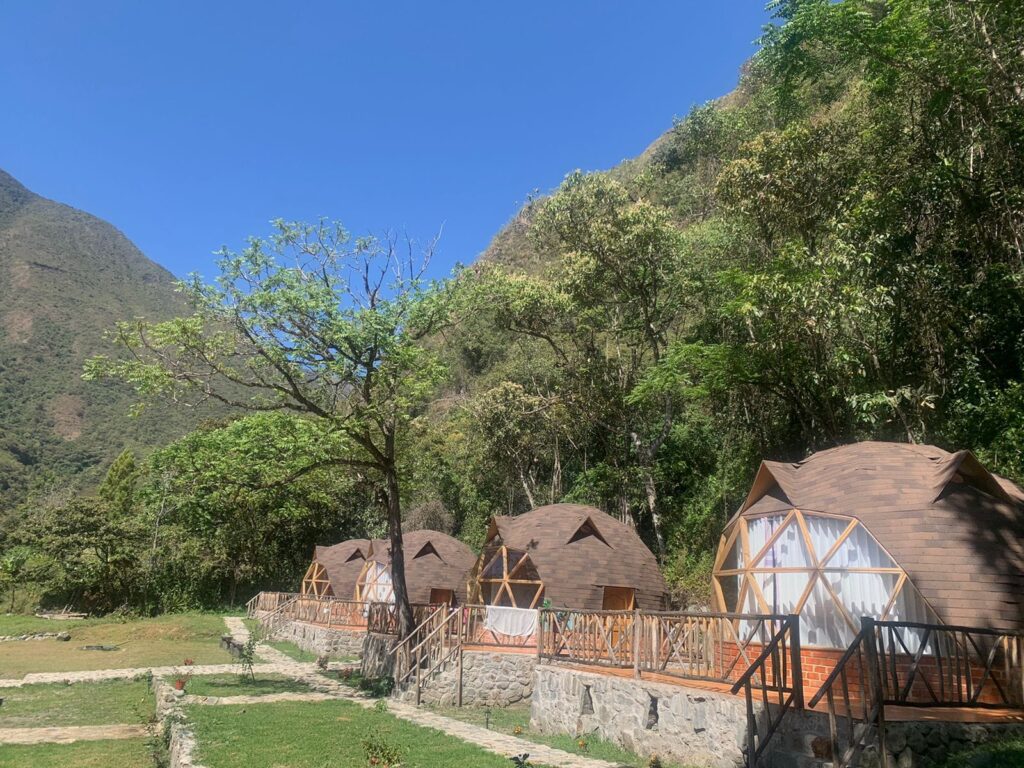
The main difference is nighttime comfort and price. Domes are glamping-style structures with real beds, quality bedding, and transparent panels that let you see the starry sky and the snowcapped mountain from your room. Standard camping uses tents with sleeping pads and a sleeping bag, offering a deeper immersion in the natural environment but less temperature comfort at the higher-altitude camps. The daytime route is identical in both cases. Dome packages cost between 40 and 80 percent more than standard camping packages, depending on the level of the lodge.
Can the Salkantay Trek be done with children?
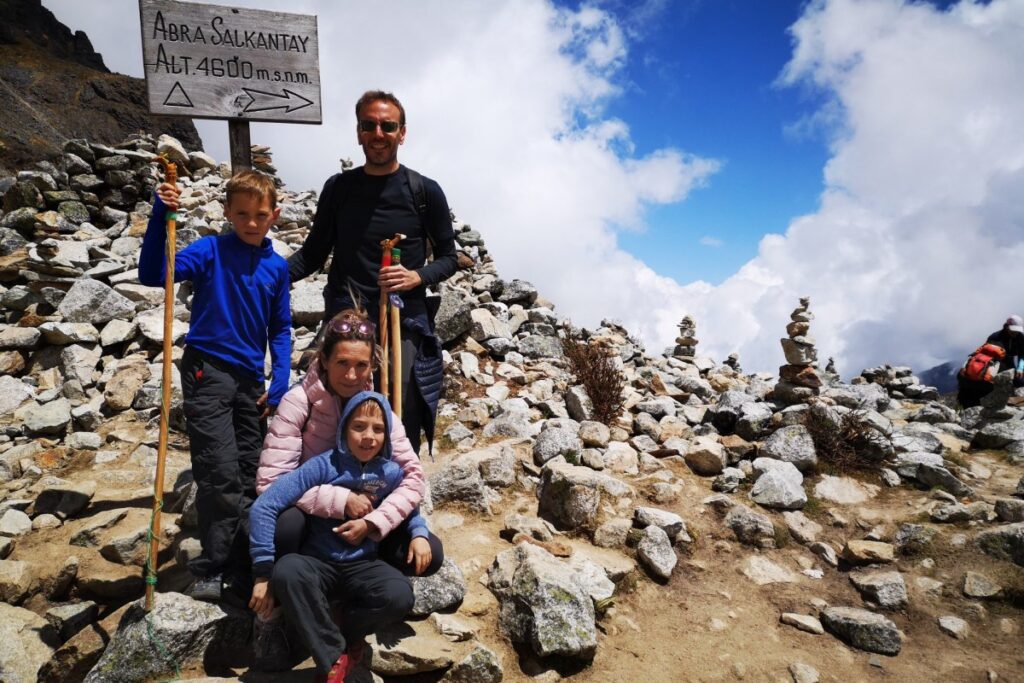
It depends on the child’s age and physical condition. For children under 8, the second day with the crossing of the 4,630-meter pass is not recommended because of the impact of altitude on developing bodies and the physical demands of that day. For children between 10 and 14 with good physical condition and proper prior acclimatization, the route is feasible in the five-day version. For teenagers aged 14 and older, the Salkantay Trek is completely accessible with the right preparation. In all cases, private service is more appropriate than a group departure when traveling with minors because it allows the pace to be adjusted to the child’s needs without group pressure.
Can you do the Salkantay Trek solo as an individual traveler?
Yes. Group Salkantay Trek packages bring together solo travelers who book independently and share the guide, support staff, and campsites during the route. It is one of the most common ways for solo travelers to do the trek, and the group dynamic during five days of shared effort often creates bonds that many participants describe as one of the most unexpected and most valued parts of the experience. There is also the option of booking a private service as a solo traveler, with a higher per-person cost but with the entire trek paced entirely to your rhythm.
What should you do if altitude sickness symptoms appear during the trek?
Mild altitude sickness symptoms, such as a moderate headache, slight loss of appetite, or unusual fatigue, are common on the second day and are generally managed with a slow pace, constant hydration, and rest upon reaching camp. If symptoms intensify, especially if repeated vomiting, disorientation, shortness of breath at rest, or loss of balance appear, you must tell the guide immediately. Descent is the only effective treatment for severe altitude sickness, and the guide is trained to manage that situation and coordinate the evacuation routes available at each point along the route.
Is it possible to combine the Salkantay Trek with the Inca Trail on the same trip?
Yes, and it is a combination that some travelers with more than a week available in the region choose deliberately. The two routes have completely different identities: Salkantay offers large-scale nature with glaciers and extreme ecosystem changes, while the Inca Trail offers Inca archaeology and the historic arrival to Machu Picchu through the Sun Gate. Doing both on the same trip requires additional planning, especially to secure Inca Trail permits far enough in advance, and a level of physical condition that allows you to handle two high-altitude treks in the same week. For travelers who have that time and fitness, the combination is one of the most complete trekking experiences the Cusco region can offer.
How much does the Salkantay Trek cost?
The price varies considerably depending on the operator, the length of the package, the type of lodging, and the services included. As a general reference, five-day camping packages with well-regarded agencies range between $350 and $600 per person. Dome or glamping packages range from $500 to $900. Packages priced far below those ranges almost always involve cuts in guide quality, porter conditions, or camping equipment. An unusually low price is more of a warning sign than an opportunity.
What makes the Salkantay Trek different from the Inca Trail?
There are several differences, and all of them matter. The Salkantay Trek does not require a special permit and is available year-round, including February. The Inca Trail has limited permits and closes in February. Salkantay offers monumental natural scenery with glaciers, lakes, and changing ecosystems; the Inca Trail offers Inca archaeology along the route and arrival at Machu Picchu through the Sun Gate. Salkantay is more difficult in terms of maximum altitude and cumulative elevation change. The Inca Trail is generally more expensive because of the cost of the official permit. For anyone choosing between the two without having done either, the decision mainly depends on whether your priority is large-scale scenery or the historical and archaeological context of the route.
What tips are given at the end of the Salkantay Trek?
Tipping the support staff is a common and economically significant practice for the porters and cook on the route. As a general guideline for the five-day version, the usual per-person ranges are between $15 and $25 total for the porters, between $20 and $30 for the cook, and between $25 and $40 for the lead guide. Tips are given in cash on the final day of the trek, before the support staff takes transportation back. Bringing the cash prepared from Cusco in individual envelopes is the most organized way to handle it.
Do you have more questions about the Salkantay Trek that are not covered in this guide? At Incredible Peru Tours, we answer any questions before confirming any reservation and help each traveler choose the version of the route that best fits their situation.


