2026 Book your spot for the Inca Trail 2026!

Inicio » salkantay » Page 2

The Salkantay Trek has a reputation for being the most demanding trek that reaches Machu Picchu, and that reputation is well deserved: the crossing of Salkantay Pass at 15,190 feet is the highest point of any trekking route in the region, and the 4,920-foot descent that follows the pass puts a level of joint impact into just a few hours that few people have experienced before. But those facts do not answer the real question for someone reading them for the first time without mountain trekking experience: can I do it?

The answer depends on specific factors that this guide will help you evaluate honestly before making a decision. At Incredible Peru Tours, we welcome groups of beginners every season who complete the Salkantay Trek with great satisfaction, and we have also seen well-intentioned travelers arrive without enough preparation and experience the second day in a way they did not expect. The difference between those two scenarios is almost always the same.

The Salkantay Trek Is More Demanding Than the Inca Trail: What That Means for a Beginner

The Classic Inca Trail reaches 13,828 feet at its highest point. The Salkantay Trek goes 1,362 feet higher, crossing Salkantay Pass at 15,190 feet. That difference is not just numerical: it means lower oxygen pressure, a higher chance of altitude symptoms, and a greater cardiovascular demand during the ascent that the body handles differently than at lower elevations.

For a beginner, this means that prior acclimatization in Cusco matters even more on the Salkantay Trek than on the Inca Trail, and that the pace on the second-day ascent must be more consciously slow than any pace the body may have adopted on previous hikes. It is not impossible; it is simply more demanding at that specific point. Knowing that before reaching the Soraypampa campsite is what makes it possible to manage the day properly.

Salkantay Trekking
Salkantay Trekking

What Type of Beginner Can Do the Salkantay Trek?

There is an important distinction between different types of beginners before answering this question. Someone who has no experience with multi-day high-altitude trekking but does have an active lifestyle, walks regularly, climbs stairs without difficulty, and has reasonable cardiovascular fitness has the right starting point for the Salkantay Trek with proper preparation. Someone who leads a sedentary lifestyle and has not exercised regularly in recent months has preparation ahead that cannot be compressed into the two weeks before the flight.

Knee and joint condition is the second most relevant factor for a beginner on the Salkantay Trek. The descent on the second day from the pass to the Chaullay campsite creates a level of joint stress that people with a history of knee problems may find very difficult to manage. If there is a history of chondromalacia, meniscus problems, or previous knee injuries, consulting a doctor before deciding is a necessary step, not an optional one.
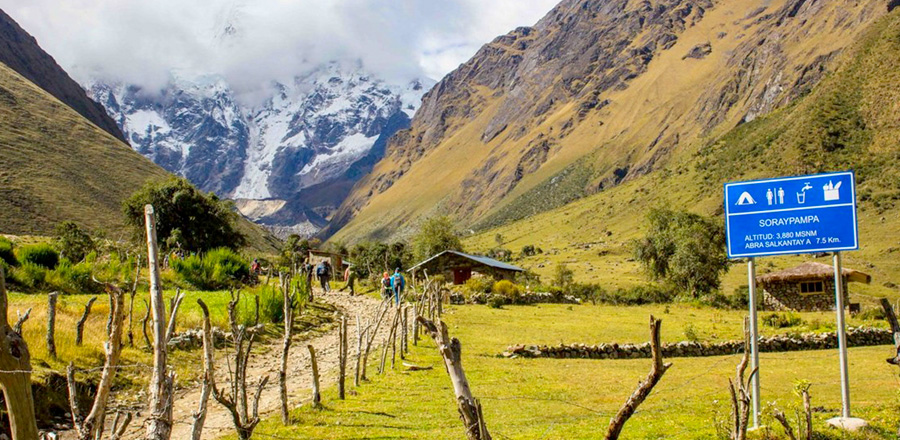
Ascent on the Salkantay Trek

Acclimatization for Beginners on the Salkantay Trek: At Least Three Nights in Cusco

For someone doing the Salkantay Trek for the first time and who has never been above 8,200 feet, the standard recommendation of two nights in Cusco before starting the trek is not enough. At Incredible Peru Tours, we recommend three full nights in Cusco for beginners with no previous high-altitude experience, and in some cases even an excursion to the Sacred Valley during those days, since it is slightly lower in elevation than Cusco and helps with gradual adaptation.

During those nights in Cusco, activities should be moderate. Short walks through the historic center, visits to nearby archaeological sites at a relaxed pace, and good hydration are more useful than trying to fill every hour of the day before the trek. Alcohol during the first 48 hours amplifies the effects of altitude sickness and delays the acclimatization process in a way that can be clearly felt on the second day of the route.

First day acclimatizing in Cusco

Physical Preparation: What to Train Before the Trip

The most effective preparation program for a beginner who wants to do the Salkantay Trek begins at least eight weeks before the trip, or twelve weeks if the starting fitness level is low. It does not require a gym or special equipment. It requires consistency and progression.

The first few weeks should focus on one- to two-hour walks on terrain with some elevation gain, two or three times per week. Starting in the fourth week, those walks should extend to three hours while wearing the trekking backpack and the boots that will be used on the route. In the final weeks before the trip, at least one four- to five-hour hike per week on uneven terrain helps build the endurance the Salkantay Trek will require over five consecutive days.

The training most beginners overlook is specific preparation for long descents. The downhill sections on the second and third days of the Salkantay Trek require sustained eccentric work from the quadriceps, something that flat cardio, uphill training, and gym machines do not prepare in the same way. Walking down stairs for 20 or 30 minutes at a time with a backpack, or descending long hills at a controlled pace, is the exercise that makes the biggest difference for the knees during the trek.
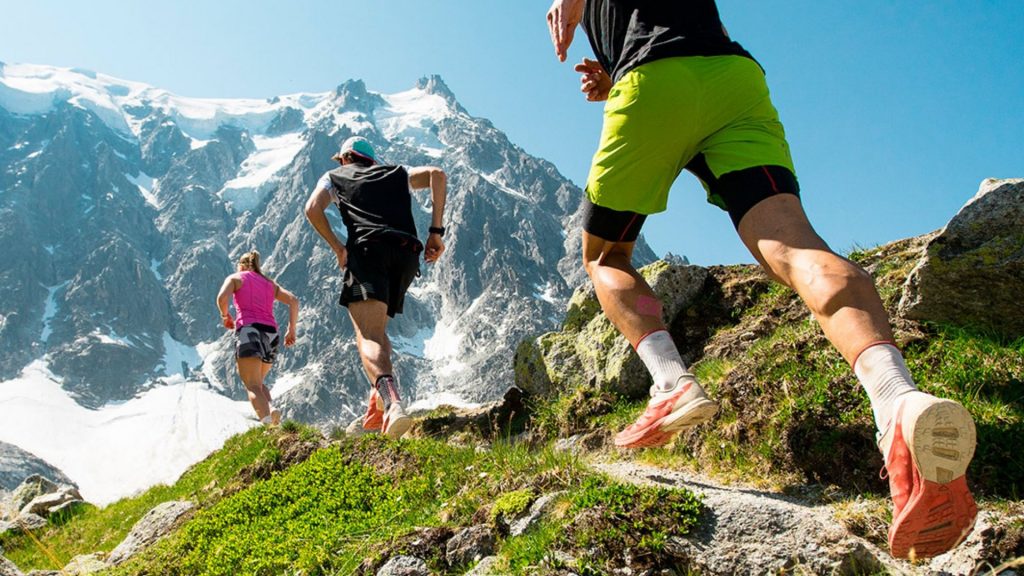
Physical preparation and knee training
Physical preparation and knee training four weeks before the Salkantay Trek

The Second Day: What a Beginner Should Know Before Experiencing It

The second day of the Salkantay Trek is the one that defines the experience for a beginner. It begins before sunrise at the Soraypampa campsite, at 12,795 feet, with departure between 4:30 and 5:30 a.m. depending on the operator. The ascent to Salkantay Pass at 15,190 feet takes between two and three hours depending on the group’s pace, and the descent afterward to the Chaullay campsite adds several more hours of effort with pronounced elevation loss.

What a beginner needs to know about that day before experiencing it is this: the uphill pace must be slower than the terrain seems to demand. At that altitude, the body needs more time to process each effort, and breathing becomes the regulator the body imposes regardless of willpower. Trying to keep up with the fastest people in the group during that section is the most common mistake made by motivated beginners, and it is the one with the biggest consequences in the second half of the day.

Trekking poles are essential on that second day, both uphill and downhill. On the ascent, they distribute effort toward the arms and improve stability on uneven terrain. On the descent, where most beginners feel their first real knee pain, they reduce the joint impact of each step in a way that can be clearly felt by the time you reach the Chaullay campsite.

Footwear: The Same Criteria as the Inca Trail, but With Greater Urgency

Footwear for the Salkantay Trek follows the same criteria as footwear for the Inca Trail: waterproof boots with a firm-grip sole, a mid- or high-cut design for ankle support, and above all, boots that are already broken in before the trek. The difference is that on the Salkantay Trek, the terrain on the second-day descent—with glacial moraine and irregular rock in the higher sections and wet mud in the lower valley—demands more from your footwear than the Inca stone stairways of the Classic Inca Trail.

Wearing brand-new boots for the first time at the Soraypampa campsite is the gear mistake that causes the most blisters on the Salkantay Trek. The three or four practice walks used to break in your boots before the trip are the best-invested time of the entire preparation process.
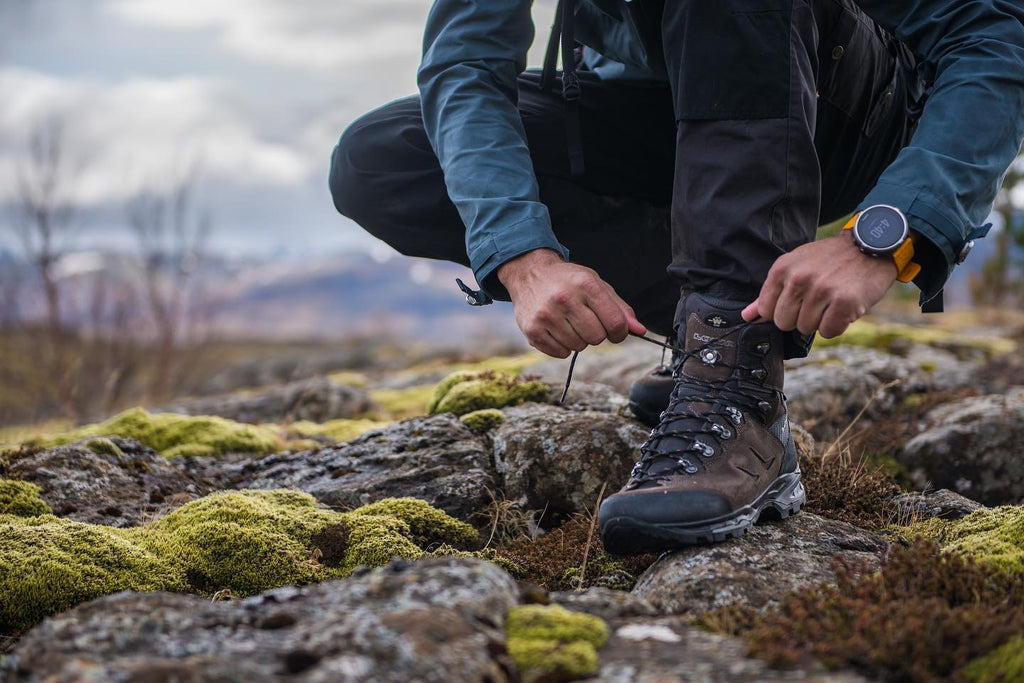
Trekking shoes for the Salkantay Trek
Do not wear brand-new trekking shoes on the Salkantay Trek

What Salkantay Offers a Beginner That the Inca Trail Cannot

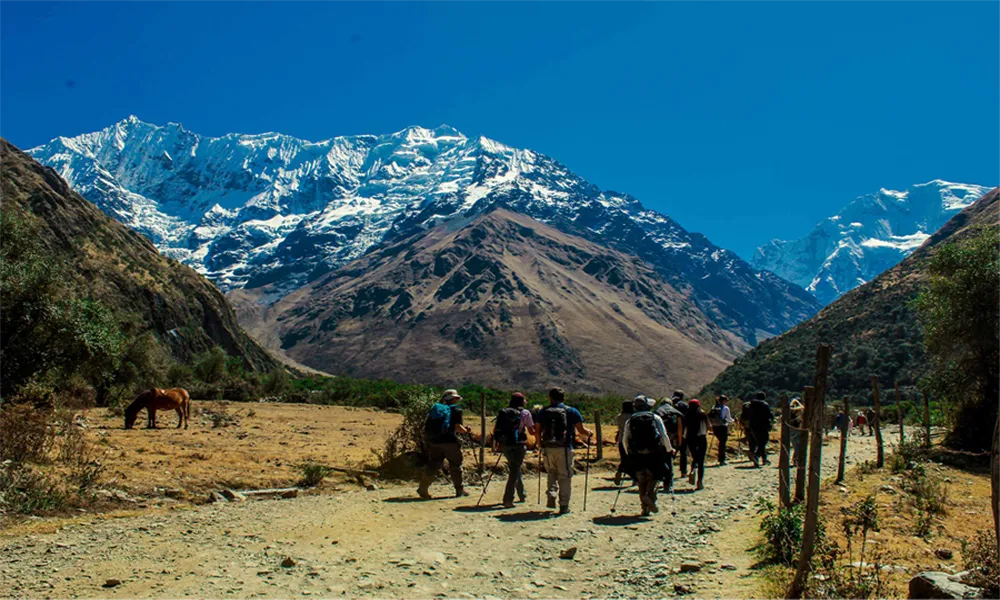
There is a dimension of the Salkantay Trek that no difficulty guide fully captures, and for a beginner, it carries particular weight. Over five days, the route passes through more ecosystems, temperatures, and landscapes than most people see in years of conventional travel. The first night at the Soraypampa campsite with the snow-capped Salkantay mountain in the background, sunrise over the glacier during the second-day ascent, the warmth of the coffee valleys on the third day, and the Cocalmayo hot springs at sunset create a sequence of experiences that no resort itinerary can replicate.

For a beginner who arrives well prepared, that five-day contrast has an effect that experienced mountain trekkers already know, but that feels different in intensity for someone living it for the first time. Crossing Salkantay Pass without previous experience at similar altitudes, reaching the other side, and then watching the landscape change beneath your feet as you descend: that is something you do not forget.

Questions a Beginner Should Ask the Agency Before Booking

Before confirming any Salkantay Trek booking as a participant with no previous mountain trekking experience, there are specific questions worth asking the agency to make sure the service is designed to manage that profile properly.

  • Does the guide have mountain first-aid training and experience with groups of different fitness levels? Not all guides manage groups with very mixed physical conditions in the same way.
  • What is the agency’s policy if a participant cannot complete the second day for altitude-related reasons? Knowing the available evacuation routes and the agency’s protocol before heading onto the trail reduces anxiety and allows for informed decisions if that situation occurs.
  • Is the sleeping bag provided rated for the temperatures at Soraypampa? For a beginner with no experience camping in high mountains, a very cold night with an inadequate sleeping bag can be the factor that most affects performance on the second day.
  • Do you offer the five-day version instead of the shorter options? For someone without previous experience, the five-day version distributes the effort more appropriately than the three- or four-day versions.

Are you considering doing the Salkantay Trek for the first time and want to know whether your fitness level and experience are suitable for the route? At Incredible Peru Tours, we evaluate each participant’s profile before confirming the booking and guide travelers toward the most appropriate version of the route, with honest information about what the trek requires and what the right preparation can achieve. Contact us and we will help you decide with real criteria.
Inicio » salkantay » Page 2

Before booking the Salkantay Trek, one of the most important questions is knowing exactly what is included in the price and what is not. At Incredible Peru Tours, the first thing we do when sending a proposal is break down every element of the package because we have seen that the most avoidable disappointments on the route do not come from the trail itself, but from incorrect expectations about what the agency provides. This guide gives you that breakdown with the clarity you need before comparing quotes between operators.

What every serious Salkantay Trek package includes

Regardless of the package level, number of days, or type of accommodation, a Salkantay Trek tour operated by a responsible agency always includes a set of elements without which the route cannot function logistically. These are the minimum foundation of the service, and if any of them are missing from a quote, you should ask specific questions before confirming your reservation.

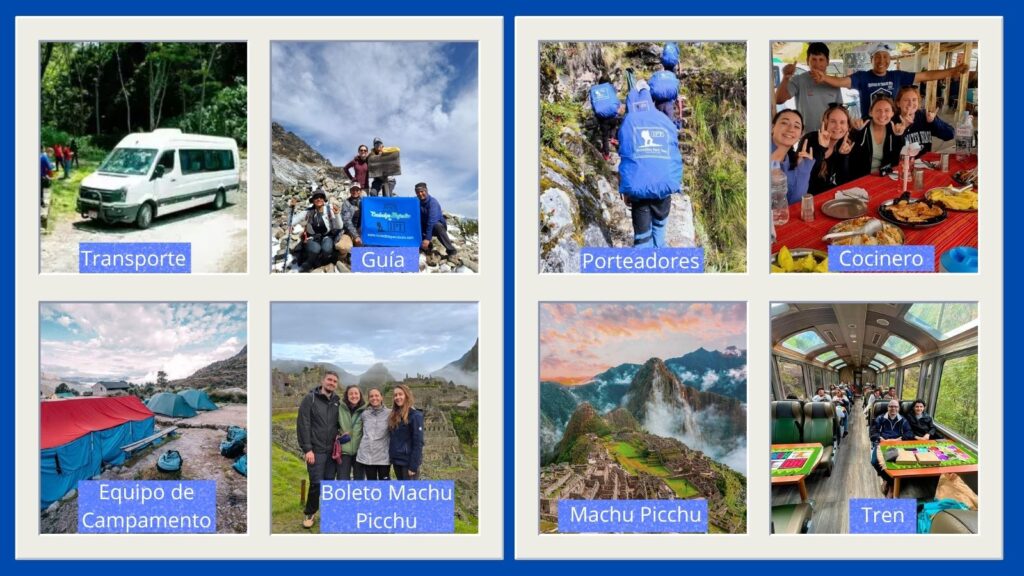
Transportation from Cusco to the starting point in Soraypampa. The drive from Cusco to the base camp takes approximately three hours by road and is done in a private or shared vehicle depending on the size of the group. This transfer is included in all Salkantay Trek packages without exception.

Certified guide throughout the five-day route. The guide accompanies the group from the departure in Cusco to the arrival in Aguas Calientes, manages the pace of the trek, provides historical and natural context along each section, coordinates the support team, and handles any unexpected situations on the ground. At Incredible Peru Tours, all our guides have specific experience on the Salkantay route and knowledge of the weather behavior of each section during every season of the year.

Support team with porters or muleteers and mules. The collective equipment, including tents, sleeping mats, cooking equipment, and food, is carried by the support team. Participants only carry their personal daypack during the hiking hours. The number of porters varies depending on the group size and the package level.

Cook and all meals during the trek. From the first breakfast in Soraypampa to lunch on the fourth day before arriving in Aguas Calientes, all meals are included. That means four breakfasts, four lunches, three dinners, and hot drinks with each meal. Dietary restrictions, such as vegetarian, vegan, or gluten-free diets, can be managed if they are communicated to the agency with enough advance notice.

Camping equipment. Two- or three-person tents, insulated sleeping mats, and in many packages the sleeping bag are part of the service. The sleeping bag is the most important item to verify: it should be rated for comfort temperatures of 32°F / 0°C or lower for the first night in Soraypampa. Some lower-priced packages do not include the sleeping bag and offer it as a separate rental.

Machu Picchu entrance ticket for the final day. Access to the archaeological site is included in all standard Salkantay Trek packages. The specific circuit and entrance time vary depending on the operator and the fifth-day itinerary. Before confirming, it is important to verify which circuit the ticket includes and whether the entrance time is compatible with the group’s real arrival time from Aguas Calientes.

Return train from Aguas Calientes to Ollantaytambo or Cusco. In most standard packages, the return train is included. In some lower-priced packages, it is charged separately, which can add an extra cost of $60 to $90 per person. Verifying whether the train is included before comparing prices between operators is essential for a fair comparison.

What higher-level packages include

Higher-category packages add a series of elements to the basic service that improve the overnight experience and the level of service during the trek.

Accommodation in domes or ecolodges instead of standard tents. Domes offer real beds, quality bedding, and in some complexes, private bathrooms with hot water. Ecolodges add sustainability criteria and a stronger connection with local communities to the accommodation experience. Both domes and ecolodges cost more than standard camping, and the price difference is justified by the fixed infrastructure these complexes maintain in remote points along the route.

Private dining and kitchen tent. Higher-level packages include an independent tent separate from the sleeping area that works as a covered dining space, protecting the group during meals even on rainy days and creating a shared area separate from the rest area.

Menu prepared with Peruvian cuisine. Some higher-level operators design Salkantay menus with local Andean ingredients and dishes that go beyond basic camp cooking. Quinoa in different forms, native potatoes, trout from the Urubamba area, and wild aromatic plants are ingredients that cooks with specific training in Peruvian cuisine include in higher-priced package menus.

Spa or massage service. Some dome complexes in the intermediate valley areas include or offer sports massages after the second day, the most demanding day of the trek. This service has a real impact on muscle recovery and sleep quality on the second night, and for some types of travelers it can be the factor that turns a tough day into an enjoyable one.

What is never included in any package

There are elements that, by definition, are not part of any Salkantay Trek package and that each participant must cover on their own, regardless of the price of the tour they booked.

Tips for the support team are not included in the package price, although some operators suggest them in their informational materials. Suggested ranges for the five-day Salkantay Trek are between $15 and $25 per porter, between $20 and $30 for the cook, and between $25 and $40 for the main guide, calculated per person in the group. Bringing that cash in Peruvian soles from Cusco at the beginning of the trek is the most practical way to manage it.

Travel insurance with coverage for high-altitude trekking and evacuation in remote areas is each participant’s individual responsibility. No agency can replace that coverage because the risk is linked to the person, not the package. At Incredible Peru Tours, we always request insurance confirmation before departure because not having it in case of an emergency can have very significant financial consequences.

Personal expenses in the towns along the route, additional drinks outside the included meals, and any optional activity not included in the itinerary are additional costs that each participant manages with their own cash. Bringing between 80 and 120 soles in cash for these expenses is enough for the five-day trek.

Personal trekking gear, including hiking boots, technical clothing, a daypack, a headlamp, and trekking poles, is each participant’s responsibility or can be rented in Cusco before departure. The sleeping bag may or may not be included depending on the package, and it is the most important item to verify before confirming your reservation.

Personal expenses
Personal expenses are not included in travel packages

How to compare two Salkantay Trek quotes correctly

The correct way to compare two Salkantay Trek quotes is not by simply looking at the final numbers. It is done by verifying that both quotes include exactly the same elements. A package that does not include the return train, the Machu Picchu ticket, or the sleeping bag may appear cheaper and end up being more expensive once the additional costs are added.

The specific questions to ask any operator before comparing their price with another are the following: Does it include the return train from Aguas Calientes? Does it include the Machu Picchu ticket, and with which circuit and entrance time? Does it include a sleeping bag rated for Soraypampa temperatures? How many porters are included in the service, and what are their working conditions? Is the entrance to Humantay Lake included or paid separately?

Once those questions are answered in writing, the comparison between quotes becomes real and allows you to choose based on clear criteria instead of simply choosing the number that appears in the email.

Do you want to know exactly what the Salkantay Trek with Incredible Peru Tours includes and compare it with what you are evaluating from other operators? Contact us with your dates and the number of people in your group, and we will send you the complete package breakdown before you confirm any reservation.

Inicio » salkantay » Page 2

One of the clearest advantages of the Salkantay Trek compared to the Inca Trail is that it does not have the regulated permit system from the Ministry of Culture that requires travelers to book months in advance. There are no permits that sell out, no reservation system opening dates, and no irreversible consequences if you start the process late. That flexibility is real, and it is one of the reasons why Salkantay is the most practical option for travelers with tight dates or itineraries that are still being defined along the way.

However, “there are no regulated permits” does not mean “you can book the day before without any problems.” There are parts of the Salkantay Trek that do sell out in advance, and it is important to know them before assuming that availability is unlimited at any time of the year.

What makes Salkantay different from the Inca Trail in terms of advance booking

The Inca Trail has a fixed maximum number of permits per day established by the Ministry of Culture. Once that number is reached, there are no more options, regardless of how much someone is willing to pay or which company they want to travel with. The Salkantay Trek does not have that restriction: capacity depends on each operator’s own resources, such as guides, porters, and equipment, and different tour operators may have different availability for the same dates.

This means that on the Salkantay route there is never a day when every spot on the trail is completely sold out in an absolute sense. What can sell out are the spaces with a specific operator, the most requested dome complexes during high season, or the availability of experienced bilingual guides for very specific dates.

Salkantay trek
Salkantay trek

High season June, July, and August: book two to three months in advance

During the busiest tourist months in the Cusco region, the dome complexes and ecolodges along the Salkantay Trek are the first elements to run out of availability. The domes in Soraypampa with views of the snow-capped mountain, glamping complexes in the intermediate valleys with hot tubs, and the most reputable ecolodges along the route have a fixed capacity that fills up well in advance in July and August. For travelers who want to do the Salkantay Trek during those months with quality dome accommodations, booking two to three months in advance is the minimum reasonable time frame.

For packages with standard camping during high season, the booking window can be reduced to four to six weeks without losing too many options, because camping capacity is more flexible than fixed accommodation complexes. Even so, booking earlier gives you better access to the best guides available for those dates and to the best-located campsites within the standard itinerary.

Shoulder season May, September, and October: one month is usually enough

May, September, and October are months with very good conditions for the Salkantay Trek and slightly lower demand than the peak summer months, which creates better availability even with less advance notice. During these months, one month in advance is usually enough to secure a spot on a good camping package, and two months is recommended for higher-category dome packages.

May deserves special mention. It is the month with the best combination of weather conditions, lush green scenery after the rainy season, and relatively fewer crowds on the trail. The most reputable operators on the route, including Incredible Peru Tours, usually have their May groups well organized two months in advance, although they are rarely as full as July departures.

Dome tours with Incredible Peru Tours

Low season November to March: you can book a few weeks in advance

During the rainy season months, from November to March, Salkantay Trek availability is the widest of the year. With two or three weeks’ notice, it is possible to find good packages with experienced guides on most dates during this period. February, the month when the Inca Trail closes completely, is paradoxically one of the easiest months to organize the Salkantay Trek because the demand from travelers who cannot do the Inca Trail in that month does not outweigh the general drop in tourism during the rainy season.

The only exception during this period is Easter Week, which in some years falls in March or in the first days of April. During those dates, demand increases temporarily, and the necessary booking time rises to at least three or four weeks to avoid finding that your preferred operator has no availability.

The elements that sell out before the trail itself

Although the Salkantay Trek does not have permits regulated by the Ministry of Culture, there are three specific elements that should be arranged in advance because their availability is limited.

The first are the higher-category domes in Soraypampa. Glamping complexes with direct views of the snow-capped mountain have a fixed number of domes that fill up weeks in advance during high season. Travelers who want luxury glamping on the Salkantay Trek in July or August should book at least three months in advance to have real options at the most highly rated complexes.

The second is bilingual guides who specialize in the route. During high season, guides with strong English, French, or other language skills and specific experience on the Salkantay route have their schedules booked several weeks in advance. Operators that have these guides on staff assign them to the groups that book first, and groups that book late receive whoever is still available.

The third is the Machu Picchu entrance ticket for the final day, especially the circuits that include Huayna Picchu or Machu Picchu Mountain. These tickets have very limited spaces, approximately 400 people per day for Huayna Picchu, and they sell out far in advance during high season. For travelers who want to climb one of these mountains on the fifth day of the Salkantay Trek, the ticket should be arranged two or three months in advance, regardless of when the rest of the package is booked.

The difference between booking late and booking poorly

Booking the Salkantay Trek with little advance notice does not necessarily mean booking with a lower-quality operator. It does mean accepting that the first-choice options for the most requested elements, such as luxury domes, the most experienced guides, and Huayna Picchu tickets, are probably no longer available, and that the choice will be made from what is left, not from everything that exists.

For travelers with completely flexible dates who can adapt their itinerary to what is available, this limitation is not a real problem. For travelers with fixed dates, a specific accommodation preference, or the need for a guide in a particular language, booking in advance is the only tool that helps guarantee getting what they want instead of simply taking what is available.

The practical recommendation from Incredible Peru Tours

Based on our experience operating the Salkantay Trek throughout the year, at Incredible Peru Tours we recommend the following advance booking time frames as a general guide:

  • June, July, and August with quality domes: at least three months in advance.
  • June, July, and August with camping: at least four to six weeks in advance.
  • May, September, and October with any type of accommodation: four to six weeks in advance.
  • November to January and March: two to three weeks are enough in most cases.
  • Easter Week in any year: at least three to four weeks in advance.
  • February: wide availability, and it can be arranged only a few days in advance in most cases.

Do you want to check availability for your dates before committing to any transportation expenses? Contact Incredible Peru Tours with your travel period and the number of people in your group, and we will confirm real availability, the type of accommodation available, and the full price with no surprises later.

Inicio » salkantay » Page 2

At Incredible Peru Tours, we have seen everything in the groups we operate on the Salkantay Trek: from travelers who arrive with their backpacks perfectly organized to those who realize in Soraypampa that they left their trekking poles back at their hotel in Cusco. This list exists so you can be part of the first group. It is organized by categories, complete without being excessive, and designed specifically for the realities of this trek, not for a generic mountain hike.

Documents and money

  • Original passport (essential for access control at Machu Picchu on the final day)
  • Machu Picchu entrance ticket downloaded with offline access on your phone
  • Copy of the voucher or confirmation for the package booked with Incredible Peru Tours
  • Travel insurance with coverage for high-altitude trekking and remote-area evacuation
  • Between 100 and 200 soles in cash for restrooms, tips, and minor expenses
  • Debit or credit card for emergencies in Aguas Calientes

Trekking clothing: the layering system

  • 3 quick-dry technical shirts (no cotton)
  • 1 or 2 quick-dry trekking pants
  • 1 pair of shorts or convertible pants for the warmer valleys on the third day
  • 2 or 3 pairs of technical underwear made from synthetic fabric or merino wool
  • 3 pairs of mid-weight merino wool socks
  • 1 medium-weight fleece or lightweight down jacket (mid layer)
  • 1 waterproof and windproof jacket with hood (outer layer)
  • 1 waterproof pair of pants or gaiters (especially during the wet season)
  • 1 wool or fleece hat for the nights and the pass crossing
  • 1 pair of lightweight gloves for the sunrise on the second day
  • Swimsuit for the Cocalmayo hot springs at the end of the third day
  • Comfortable camp clothes for resting (pants and indoor shirt)
  • Dedicated socks and hat for sleeping at the Soraypampa campsite
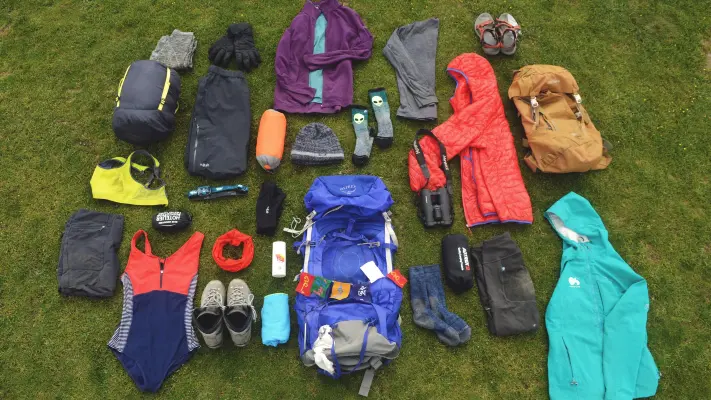
Packing for Salkantay

Footwear

  • Waterproof hiking boots with good traction soles and mid or high ankle support (well broken-in before the trip)
  • Light sandals or flip-flops for the campsite and the Cocalmayo hot springs

Technical mountain gear

  • 20 to 30-liter daypack with waterproof rain cover
  • Trekking poles (your own or rented in Cusco: between 8 and 15 dollars for the entire trek)
  • Headlamp with spare batteries (essential for the nighttime departure on the second day)
  • Water bottle of at least 1 liter or a hydration bladder system
  • Water purification tablets or portable filter
  • Small multi-tool knife (optional but useful)

Sleeping bag and bedding

  • Sleeping bag rated for 0°C comfort temperature or lower (the agency provides one, but verify the temperature rating before departure)
  • Silk or cotton sleeping bag liner (adds between 3 and 5 degrees of warmth and keeps the agency’s sleeping bag clean)

Hygiene and personal care

  • Antibacterial wet wipes (10 to 15 large wipes for days without showers)
  • Small bottle of antibacterial gel
  • Dry shampoo
  • Toothbrush and toothpaste
  • Compact microfiber towel
  • Toilet paper in a waterproof bag
  • Resealable plastic bags for managing trail trash
  • Non-aerosol deodorant (aerosols can be problematic in checked luggage)
  • SPF 50 sunscreen or higher
  • Lip balm with sun protection
  • Insect repellent (especially useful in the valleys on the third and fourth days)

Personal first aid kit

  • Paracetamol or ibuprofen for altitude headaches
  • Hydrocolloid blister bandages such as Compeed in different sizes
  • Anti-diarrheal medication and antacid
  • Antihistamine for allergies if you are sensitive
  • Kinesiology tape or elastic bandage for ankle or knee support
  • Your regular personal medication with enough supply for 5 days plus an extra reserve
  • Acetazolamide (Diamox) if prescribed by your doctor for altitude sickness prevention

Photography and electronics

  • Cell phone fully charged before leaving Cusco
  • Power bank with enough capacity for 2 or 3 full phone charges
  • Phone charging cable
  • Camera if bringing one separately from your phone
  • Spare memory cards
  • Waterproof case or bag to protect electronic devices
  • Headphones with music or podcasts downloaded offline (there will be no signal during the first days)

Personal trail snacks

  • Nuts or a mix of nuts and chocolate
  • Energy bars or granola bars
  • Dried fruit
  • Energy gels if you normally use them during intense physical activity

Trail snacks are also provided by the agency in many packages, but bringing some personal snacks for the second day, the most demanding stage, is a precaution many participants in Incredible Peru Tours groups appreciate when their body asks for extra fuel halfway up the ascent to the pass.

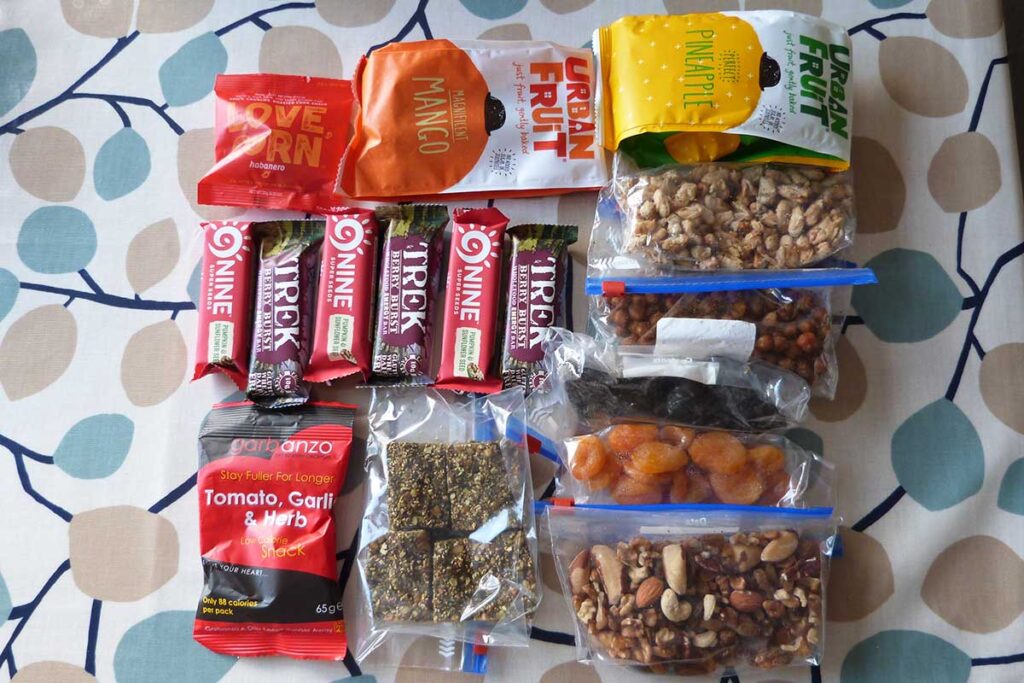
Trail Snacks

What you do not need to bring: lighten your backpack before leaving

Knowing what to leave at your hotel in Cusco is just as important as knowing what to bring. Camping equipment, tents, sleeping pads, and all meals are transported by the porters. Your daypack only needs what you will use during the hiking hours.

  • Excess change of clothes: with the correct layering system, three technical shirts are enough for five days.
  • Physical books or entertainment tablets: your phone with downloaded content serves the same purpose with minimal weight.
  • Full-size hygiene products: basic travel-size items are enough.
  • Additional shoes besides hiking boots and camp sandals.
  • Casual clothes for Cusco: leave them at the hotel and pick them up upon your return.

Final checklist before leaving Cusco

The night before starting the Salkantay Trek, a quick check of these five points is enough to leave with peace of mind:

  • Passport in your daypack, not in your duffel bag.
  • Headlamp charged and accessible without having to dig through your backpack.
  • Machu Picchu ticket downloaded offline on your phone.
  • Cash in soles in your pants pocket or in an easily accessible outer pocket.
  • Swimsuit for Cocalmayo in your backpack, not in the luggage left in Cusco.

Do you have questions about exactly what equipment is included in the package and what you need to bring yourself? At Incredible Peru Tours, we send every confirmed group a personalized packing list before departure, clearly indicating what is provided by the agency and what is each participant’s responsibility.

Inicio » salkantay » Page 2

It is one of the most frequently asked questions before booking the Salkantay Trek, and one of the questions with the fewest clear answers online. Most trekking websites avoid it or answer it with vague wording. At Incredible Peru Tours, we prefer direct honesty: this guide tells you exactly what is available in terms of showers and personal hygiene at each point along the route, so you arrive at the Soraypampa campsite without surprises.

The short answer: it depends on the point along the route and the type of package

The Salkantay Trek does not have showers available at every point along the route. Availability varies significantly depending on the campsite, the type of accommodation booked, and the operator. That variation is why a generic answer like “there are no showers” or “yes, there are showers” is not useful: the reality is more nuanced than either extreme.

The correct way to answer the question is point by point, night by night.

First night: Soraypampa (3,900 meters)

At the Soraypampa base campsite, where you spend the first night of the trek, shower availability depends almost entirely on the type of accommodation booked.

In packages with conventional camping, there is no shower available. Personal hygiene is handled with water from the container provided by the kitchen team in the morning and with wet wipes. The temperature at 3,900 meters at any time of year makes that limitation less uncomfortable than it may seem from home: showering outdoors with cold water at several degrees below freezing is not something most people actively miss.

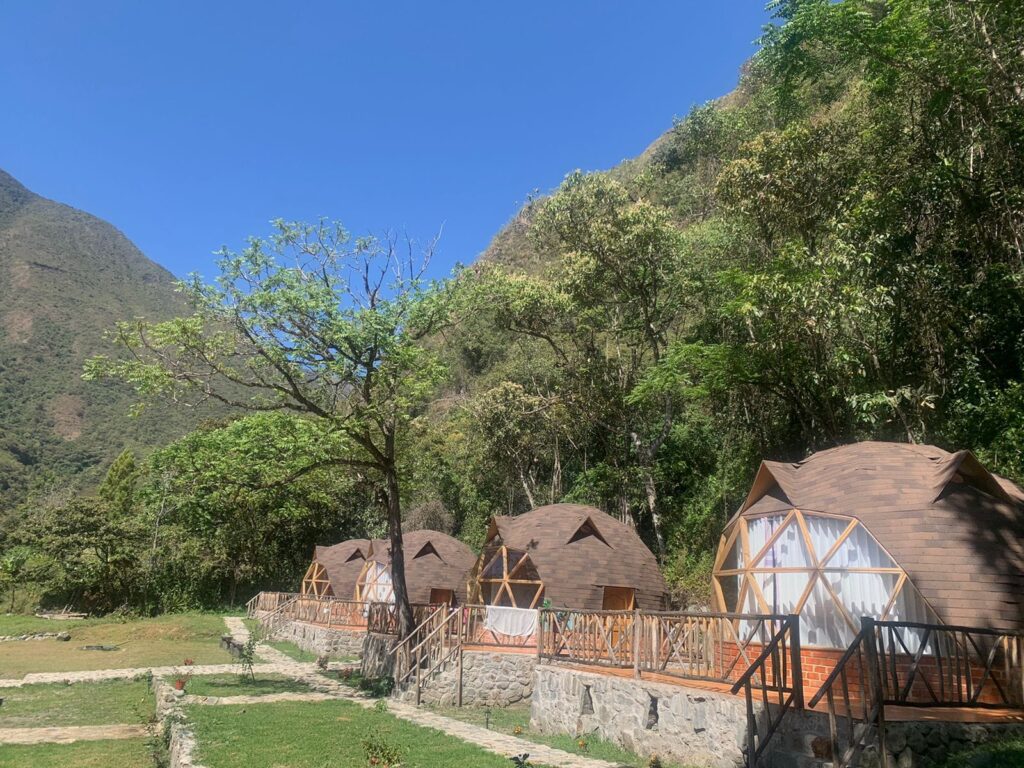
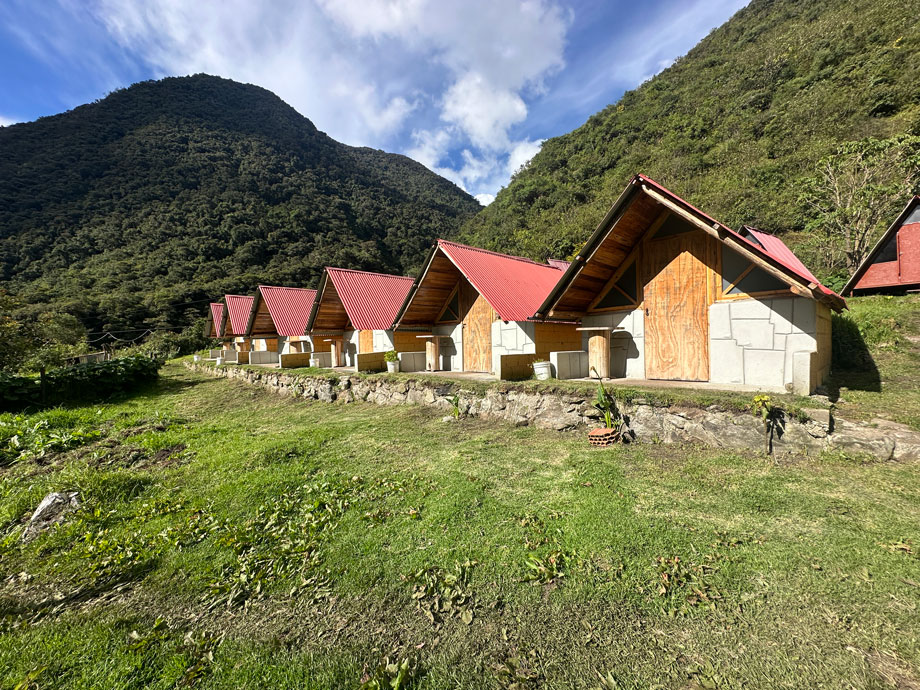
In packages with domes or ecolodges in the Soraypampa area, some complexes have hot showers available for guests. The quality and temperature of the water vary depending on the complex: some have solar heating systems that work well on sunny days and less effectively on cloudy days, while others use gas heating systems that are more consistent regardless of the weather. Before booking a package with domes in Soraypampa, at Incredible Peru Tours, the first night of the Salkantay Trek is spent in comfortable domes in Soraypampa, which include showers. However, we recommend checking in advance whether hot water is continuously available and what heating system the complex uses, in order to avoid incorrect expectations during the first night.

IPT Domes (Incredible Peru Tours)
I.P.T Domes (Incredible Peru Tours)

Second night: Chaullay or transition valleys (2,900 to 3,200 meters)

The second campsite, located in the transition area between the highlands and the intermediate valleys, has conditions similar to Soraypampa in terms of showers for standard camping packages: there is no shower available, and personal hygiene is managed with basic camping resources.

Some dome complexes located along this section of the route, at a more manageable altitude than Soraypampa, have facilities with hot showers and, in some cases, outdoor jacuzzis that combine hot water with the cool mountain night air. This intermediate point is where the difference between conventional camping and glamping becomes more noticeable in terms of nighttime comfort, because the temperature is already warm enough to enjoy a shower without extreme cold being a limiting factor.

Chaullay Camping
Chaullay Camping

Third night: Santa Teresa and the Cocalmayo Hot Springs (1,500 to 1,800 meters)

The third overnight point is where the situation changes most noticeably. The Santa Teresa area has local accommodations with private bathrooms and hot showers available for groups staying in lodging facilities instead of camping. And although conventional camping in that area still does not include a shower, there is something that more than makes up for it: the Cocalmayo Hot Springs.

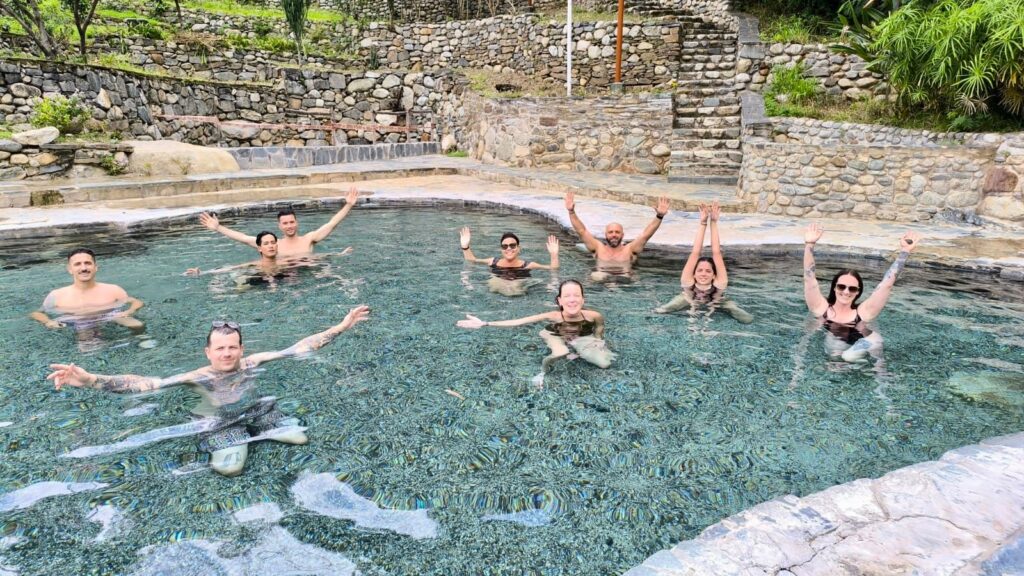
The Cocalmayo Hot Springs are natural thermal pools at approximately 29 degrees Celsius, located next to the Santa Teresa River, just a few minutes from the camping area. After the second, most demanding day of the trek and the descent from the Salkantay Pass, getting into that hot water at sunset on the third day creates a feeling of physical recovery and cleanliness that no conventional shower can match in that specific context. At Incredible Peru Tours, we include the stop at Cocalmayo in the third-day itinerary because, after years of operating the Salkantay Trek, we know that this moment is one of the most memorable parts of the route for almost every group.

Cocalmayo Hot Springs (Santa Teresa)

Fourth night: Aguas Calientes (2,040 meters)

The fourth and final night of the Salkantay Trek is spent in Aguas Calientes, in a hotel or hostel with fully conventional facilities. Hot shower, private or shared bathroom depending on the accommodation category, and all standard urban infrastructure. It is the first night of the trek with these conditions, and after three nights in the mountains, the shower at the hotel in Aguas Calientes takes on a level of importance that would normally go completely unnoticed.

The Aguas Calientes hot springs, the thermal pool complex in the center of town, are another hot-bath option available that night for anyone who wants to combine them with the hotel shower or use them as a relaxing alternative before dinner.

What to bring to manage personal hygiene during the trek

With the correct information about what is available at each point along the route, preparing your personal hygiene gear for the Salkantay Trek is simple and does not require overpacking.

  • Antibacterial wet wipes: They are the most practical substitute for a shower at campsites without facilities. One large wipe per day is enough for essential body hygiene. They take up almost no space and weigh less than they seem. Bringing between ten and fifteen for the five-day trek is more than enough.
  • Antibacterial hand gel: Essential before every meal and after using campsite restroom facilities. Washing your hands with soap and water is not always possible along the sections between campsites.
  • Dry shampoo: Useful for your hair on days when no shower is available. It takes up little space and helps avoid the greasy-hair feeling that, during a five-day trek, can be more uncomfortable than it may seem from home.
  • Compact microfiber towel: For the days when showers are available, especially in Aguas Calientes and in the domes of the intermediate valleys that have hot water. Microfiber towels weigh a fraction of cotton towels and dry in minutes.
  • Enough spare underwear: Bringing one clean change of underwear for each day of the trek is the personal hygiene item that provides the most comfort on a multi-day trek without regular showers. Quick-drying synthetic or merino underwear is the best option.

An honest perspective on five days without a conventional shower

Most people who complete the Salkantay Trek reach the end of the route with a different relationship to the idea of a mandatory daily shower. Not because going five days without showering is pleasant in itself, but because the context of the trek completely shifts that concern toward experiences that carry much more weight in the overall journey.

The body that crosses the Salkantay Pass at 4,630 meters, descends 1,500 meters to the second-day campsite, gets into the Cocalmayo Hot Springs at sunset on the third day, and reaches Machu Picchu on the fifth day has more important things to think about than whether it showered yesterday. And the hotel shower in Aguas Calientes at the end of the fourth day has, in that context, a pleasure that no everyday shower can match.

Do you have questions about the Salkantay Trek facilities or want to know what type of accommodation your package includes at each point along the route? Contact Incredible Peru Tours, and we will inform you about the details of each night before you confirm any booking.

Inicio » salkantay » Page 2

One of the questions we receive most often at Incredible Peru Tours before confirming a Salkantay Trek reservation is about the food. What do you eat during the five days? Is the quality good? What if I am vegetarian or have dietary restrictions? These are completely reasonable questions for a route where there are no restaurants to rely on if the camp food is disappointing, and where the body’s nutritional condition has direct consequences on physical performance each day.

This guide answers all of those questions with the practical information you need before heading out on the trail.

How the kitchen works on the Salkantay Trek

The kitchen team on the Salkantay Trek includes one cook, and on larger groups sometimes two, whose exclusive responsibility during the five days of the route is preparing all meals. The cook travels with the porters and arrives at the next point on the itinerary before the group so the food is ready when participants arrive at the end of each day.

Ingredients are carried from Cusco in boxes and bags distributed among the porters. There is no refrigerator or cooling source: foods that require preservation are selected and organized using logistical criteria that experienced cooks on the route know well. The kitchen equipment includes portable gas stoves, complete utensils, and on higher-level packages, a separate kitchen tent that allows meals to be prepared even under heavy rain.

At Incredible Peru Tours, we select our cooks for their knowledge of Andean cuisine and their specific experience with high-mountain logistics. The difference between a cook who knows the route and one who does not is noticeable in the quality of every meal, because adapting preparation to altitude, weather, and the available resources at each point on the route is a skill learned over time, not in courses.

Incredible Peru Tours

Breakfast: fuel for the toughest day

Breakfast on the Salkantay Trek is served early, between 5:00 and 6:30 in the morning depending on the day. On the second day, when the departure toward the Salkantay Pass begins before sunrise, breakfast may be moved up to 4:30 so the body has time to process the fuel before the climb.

The usual structure includes a hot drink to begin with: tea, coffee, Andean herbal infusions, or coca tea. This is followed by a light soup or broth that acts as the first source of calories and hydration. The main breakfast dish includes eggs prepared in different ways, accompanied by bread, pancakes, or toast with jam and butter. On colder days, some operators add cooked oatmeal or quinoa as a higher-calorie alternative.

The breakfast on the second day, the one before crossing the Salkantay Pass, is the most important of the five. Eating well at that moment, even if the appetite at 4:30 in the morning is not always there, is part of the performance strategy for the most demanding section of the route.

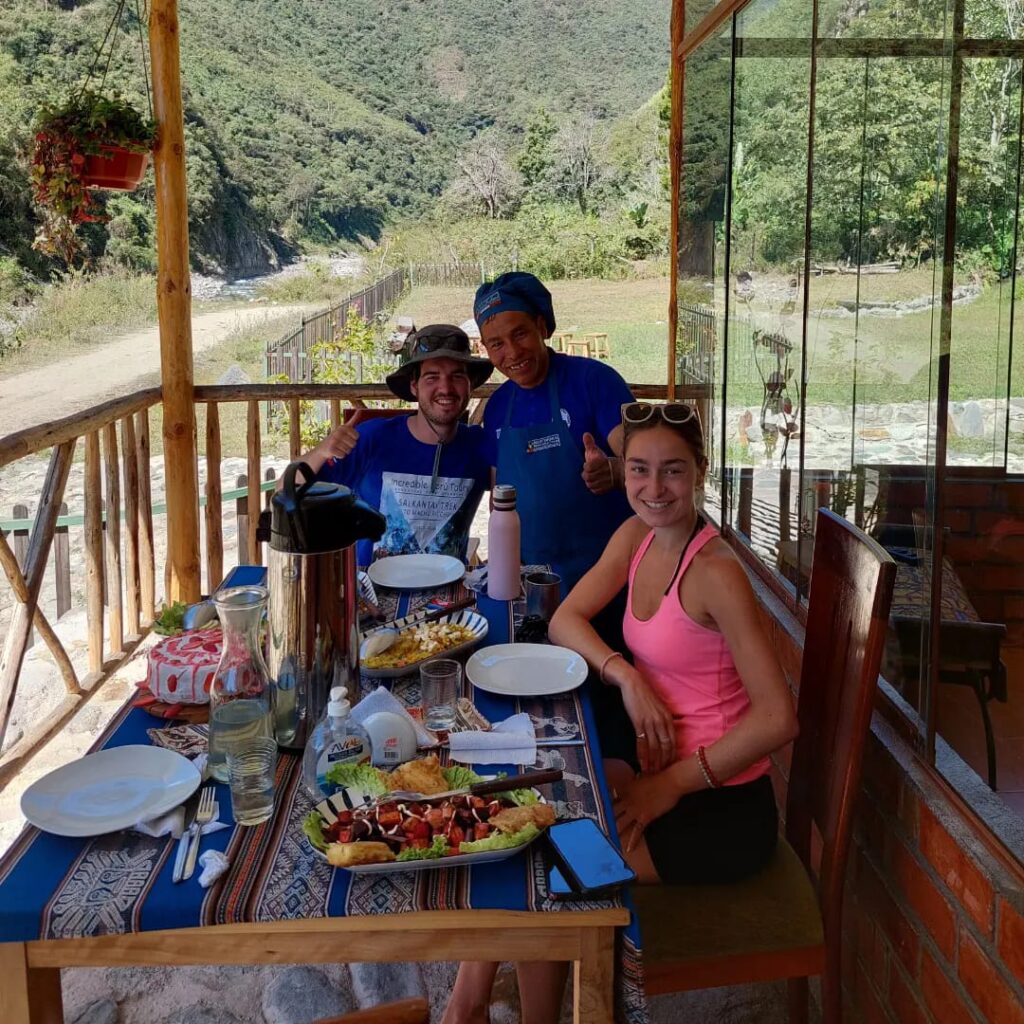
Breakfast with Incredible Peru Tours

Lunch: the meal that surprises everyone

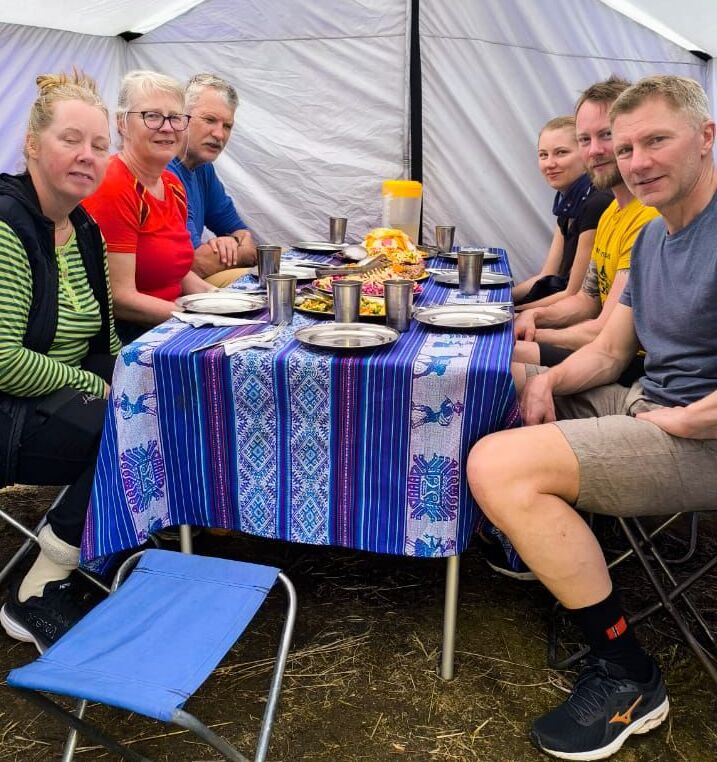
Lunch on the Salkantay Trek is the moment that most surprises people who arrive without clear expectations about the quality of mountain food. The kitchen team moves ahead of the group to the designated lunch point, sets up folding tables and chairs, and has the meal prepared when participants arrive. Seeing a table with a tablecloth, plates, and cutlery in the middle of a high-mountain trail creates an impression that at Incredible Peru Tours we have seen repeated in virtually every group we operate.

Lunch is usually the most elaborate meal of the day. It begins with a hot soup or cream, followed by a main dish that includes rice, pasta, or potatoes as a base with chicken, trout, or another protein, and ends with fruit or dessert. It is a complete meal that, in the context of the morning’s effort, feels more necessary and more appreciated than any lunch in a conventional restaurant could be.

Dinner: the social moment of the campsite

Dinner on the Salkantay Trek has a dimension that goes beyond nutrition. After hours of hiking, when the group gathers in the dining area prepared by the kitchen team with headlamps on and the mountain night surrounding them, a kind of connection develops that everyday noise rarely allows. Hot food in that setting carries a weight it does not have in any restaurant.

The dinner menu is the most varied of the day. It starts with a light appetizer, continues with a hearty soup made with quinoa, noodles, or vegetables, followed by a main dish with protein and side dishes, and ends with dessert and hot infusions. The cook plans different menus for each night to avoid repetition, and in the packages we operate at Incredible Peru Tours, we include dishes from Andean gastronomy that many participants experience for the first time at camp: quinoa in different preparations, native potatoes, Urubamba trout, and purple corn.

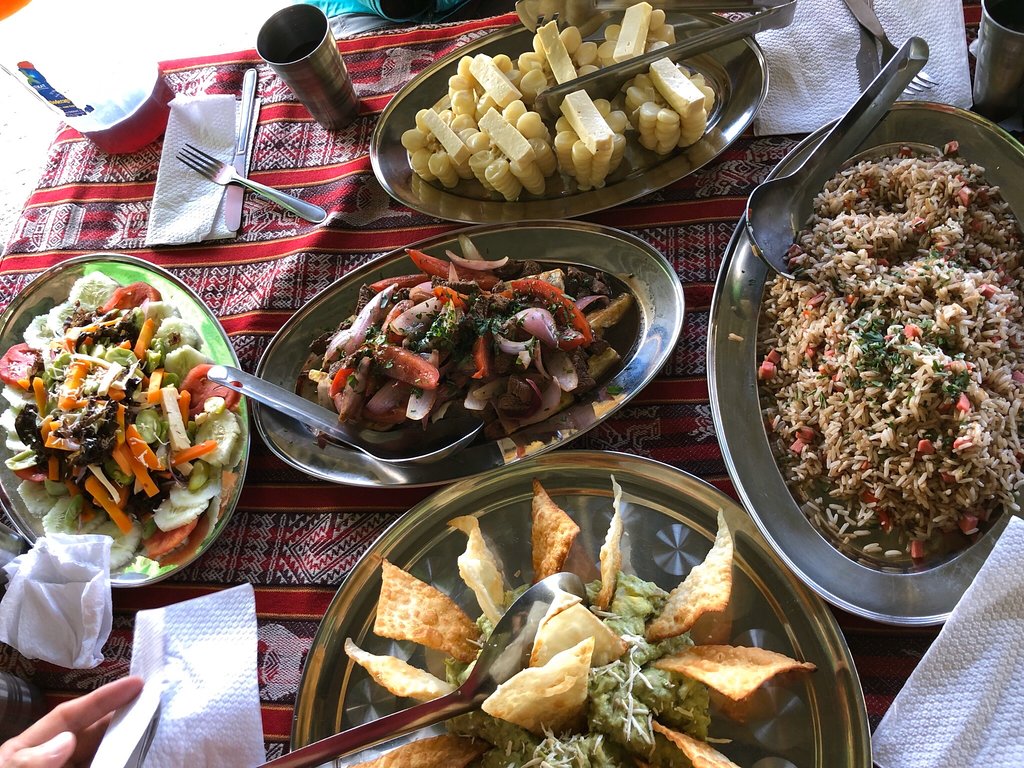
Peruvian dishes served along the route

The cuisine on the Salkantay Trek is not international camping food. It has a recognizable Peruvian identity that for many international travelers is their first real introduction to local gastronomy, much closer and more authentic than what tourist restaurants in Cusco or Aguas Calientes offer.

Quinoa soup is the most common dinner during the first days: the quintessential Andean grain, rich in protein and relatively easy to digest at high altitude. Grilled trout or trout cooked in garlic sauce appears as the main protein in several lunches, prepared with fish sourced from the streams and rivers of the region. Native potatoes in their many varieties, served with huancaína sauce or simply steamed, are the most frequent side dish. And mazamorra morada, that purple corn dessert with fruits and spices served warm, often appears during dinners on the second and third days as a sweet and nutritious ending to the day.

Meals prepared on the Salkantay route

Snacks between meals: a small detail with real impact

On the second day of the Salkantay Trek, with the ascent to the pass and the later descent to the Chaullay campsite, energy expenditure clearly exceeds what breakfast and lunch alone can cover. Snacks between meals are not a luxury: they are a performance tool that operators experienced on the route include systematically.

Popcorn, cookies, peanuts, chocolate, dried fruit, or energy bars are the most common formats. They are distributed at rest points along the trail or carried in a small accessible bag inside the daypack. At Incredible Peru Tours, we include them in all Salkantay packages because we have confirmed that the difference in mood and available energy from midday on the second day onward is noticeable and direct.

Dietary restrictions and special diets

The Salkantay Trek is perfectly compatible with vegetarian, vegan, gluten-free, and other common dietary restrictions. The condition is communicating them to the agency with enough advance notice before departure, not the day before or the same day at the starting point.

Salkantay cooks work with ingredients carried from Cusco. Once on the trail, there is no possibility of obtaining additional products or replacing ingredients that were not brought from the start. If the restriction was not communicated in advance, the cook will do the best possible with what is available, but the result may be far below what proper planning could have achieved.

At Incredible Peru Tours, we request information about dietary restrictions at the time of booking, confirm it one week before departure, and verify it again with the cook the day before the trek begins. That triple verification may seem excessive, but during five days without the possibility of correction, it is exactly the level of attention the situation deserves.

Hydration: just as important as food

Water during the Salkantay Trek is provided by the agency at campsites through purified containers. During meals, hot beverages are always available. During hiking hours, each participant carries their own water bottle in their daypack and can refill it at points the guide identifies as safe along the route.

At high altitude, the body loses fluids faster than at sea level because accelerated breathing from physical effort expels more water vapor with each cycle. Drinking before you feel thirsty, taking a sip every twenty or thirty minutes during hiking hours, is the difference between arriving at camp with energy available and arriving with a fatigue level that does not correspond to the visible effort of the day.

What food quality says about the agency

In the world of multi-day trekking, food quality is one of the most reliable indicators of how an agency operates in every other aspect of service. An operator who takes care of the food also takes care of camping equipment, porter conditions, and guide training. One who cuts corners on the menu to lower the package price is probably also cutting corners on elements that are equally invisible from home but become obvious on the trail.

That connection between food and the overall quality of service is something we at Incredible Peru Tours take seriously from the design of every Salkantay Trek package. The cook is not a secondary logistical element: they are part of the trekking experience, and their work at the end of each day is what makes it possible for the body to have what it needs for the next day.

Do you have questions about the Salkantay Trek menu or how we manage dietary restrictions for your group? Contact Incredible Peru Tours, and we will provide details about our menus and the way we coordinate with the kitchen team so every participant eats well throughout the five days of the trek.

Partners

Partners and Agreements

Backed by the world's best tourism organizations

Dircetur
Fodor's
Lonely Planet
PromPerú
TripAdvisor