The Cusco Tourist Ticket is an official pass that lets you visit several archaeological sites, museums, and cultural spaces in the city of Cusco, the Sacred Valley, and the South Valley. It includes places like Sacsayhuamán, Qenqo, Puka Pukara, Tambomachay, Pisac, Ollantaytambo, Chinchero, Moray, Tipón, Pikillacta, and certain museums, depending on the type purchased.
There are two main options: the Integral Tourist Ticket and the partial circuit tickets. The choice depends on the places you want to see, the days you have available, and your booked itinerary. It’s not always worth buying the broadest ticket if you’ll only be visiting one area.
What the Cusco Tourist Ticket is
The Cusco Tourist Ticket is a managed entry pass for accessing different attractions included in official tourist circuits. Its purpose is to group several entries into a single document, so travelers don’t have to pay for each site separately when they’re part of the same system.
This ticket doesn’t include transportation, a guide, hotel pickup, or meals. Nor does it cover every attraction in the region. Places like Machu Picchu, the Cusco Cathedral, Coricancha, and the Maras salt pans have independent tickets or their own entry conditions.
How the ticket works
Travelers must choose between the Integral option or one of the three partial circuits. The Integral ticket covers the widest set of attractions, while the partial ones are designed for specific routes: sites near Cusco, the city and South Valley, or the Sacred Valley.
The ticket is personal and must be presented at each entry point. Staff at the checkpoints usually stamp or record the visit, so it’s a good idea to keep it in good condition throughout your trip. If it’s lost or damaged, it can be hard to use again.
Validity and terms of use
The validity period of the Cusco Tourist Ticket depends on the type purchased. The Integral ticket usually has a longer validity than the partial tickets, which are meant for one-day or short trips.
Before paying, check that the usage dates match your tours. Keep the ticket until you’ve finished all your visits, and bring the document used at purchase, such as a passport, national ID, or student card, depending on the rate requested.
What places the Cusco Tourist Ticket includes
The Cusco Tourist Ticket includes attractions grouped by area. This division helps you choose better, since not every traveler visits the same places, and not every tour covers the full circuit.
It’s also important not to mix these attractions up with independent tickets. For example, Moray is included in the tourist ticket, but the Maras salt pans are paid separately. Likewise, Sacsayhuamán may be included, but the Cathedral is not.
Archaeological sites near Cusco
The archaeological sites near the city included in the ticket are Sacsayhuamán, Qenqo, Puka Pukara, and Tambomachay. They’re located in the upper part and surrounding areas of Cusco, so they’re usually visited in half a day.
These places are usually part of the Cusco City Tour. In that case, the tour may include transportation and a guide, but entry is covered by the Cusco Tourist Ticket or must be paid separately, depending on the package booked.
Sacred Valley attractions
In the Sacred Valley, the ticket includes Pisac, Ollantaytambo, Chinchero, and Moray. These are frequent stops on full-day tours or combined routes toward Ollantaytambo before catching the train to Machu Picchu.
The actual stops depend on the tour booked. Some tours visit Pisac and Ollantaytambo, others include Chinchero, Moray, and Maras. In this last case, remember that Maras isn’t part of the Tourist Ticket and its entry is paid separately.
South Valley attractions
In the South Valley, the main archaeological sites covered by the ticket are Tipón and Pikillacta. This route usually takes half a day and heads southeast of the city of Cusco.
Tipón stands out for its hydraulic channels and terraces, while Pikillacta is a former pre-Inca urban center. Both draw smaller crowds than the better-known circuits, but require good transportation planning.
Museums and cultural spaces
Depending on the current ticket type, it can include museums, monuments, and cultural centers in the city. Among the names that usually appear in official information are the Regional Historical Museum, the Museum of Contemporary Art, the Museum of Popular Art, the Qoricancha Site Museum, the Pachacuteq Monument, and the Qosqo Native Art Center.
Before publishing or traveling, it’s a good idea to verify names, hours, and conditions with the official source, since the operation of some venues can change. If a museum is closed for maintenance or has special hours, the ticket doesn’t always let you swap it for another attraction.
Types of Cusco Tourist Ticket
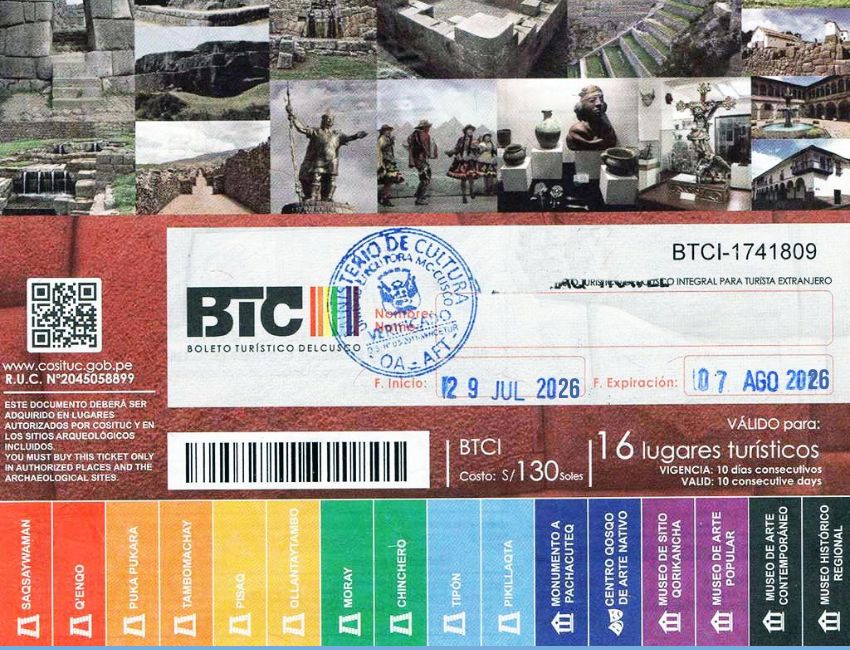
The Cusco Tourist Ticket is divided into one Integral option and three partial circuits. The main difference lies in the number of places included, the validity period, and the type of route you’re planning.
To choose well, don’t look at price alone. Compare how many attractions you’ll actually visit, on which dates, and whether your tour already covers some entries. Buying the Integral ticket can be worthwhile for multi-day trips, but unnecessary for short tours.
Integral Tourist Ticket
The Integral Tourist Ticket grants access to the broadest set of attractions included in the system. It brings together sites near Cusco, places in the Sacred Valley, South Valley attractions, and certain cultural spaces in the city.
It’s worthwhile for travelers spending several days in Cusco who’ll be visiting different areas. If your itinerary includes the City Tour, Sacred Valley, South Valley, and some museums, this option tends to be more practical than buying separate circuits.
Partial Ticket, Circuit I
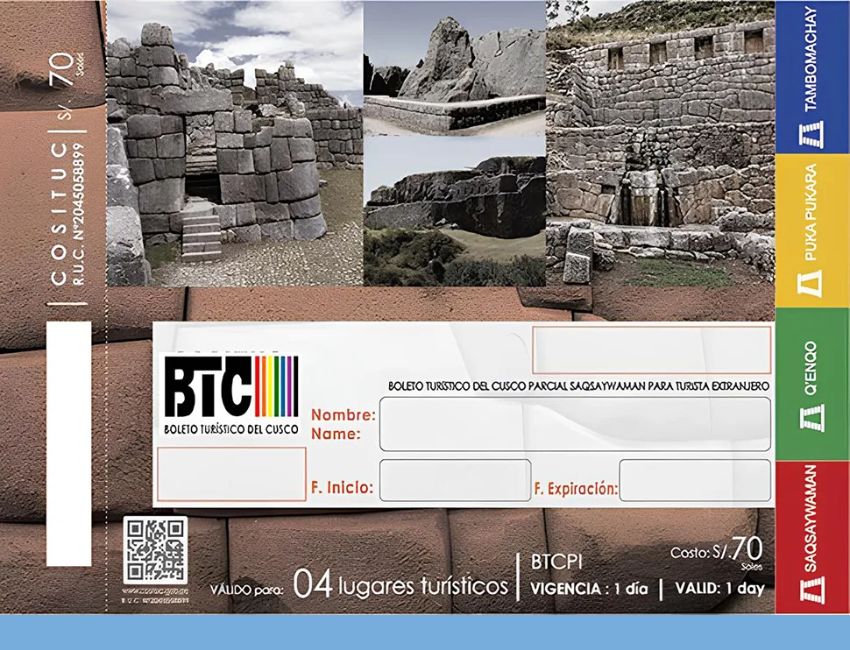
The Partial Ticket for Circuit I is aimed at the archaeological sites near the city: Sacsayhuamán, Qenqo, Puka Pukara, and Tambomachay. It’s the most commonly used option for those doing the Cusco City Tour.
Its main advantage is that it covers exactly what’s needed for that tour. If you’ll only be in Cusco for an afternoon, or won’t be visiting the Sacred Valley or the South Valley, this circuit can save you a bigger expense.
Partial Ticket, Circuit II
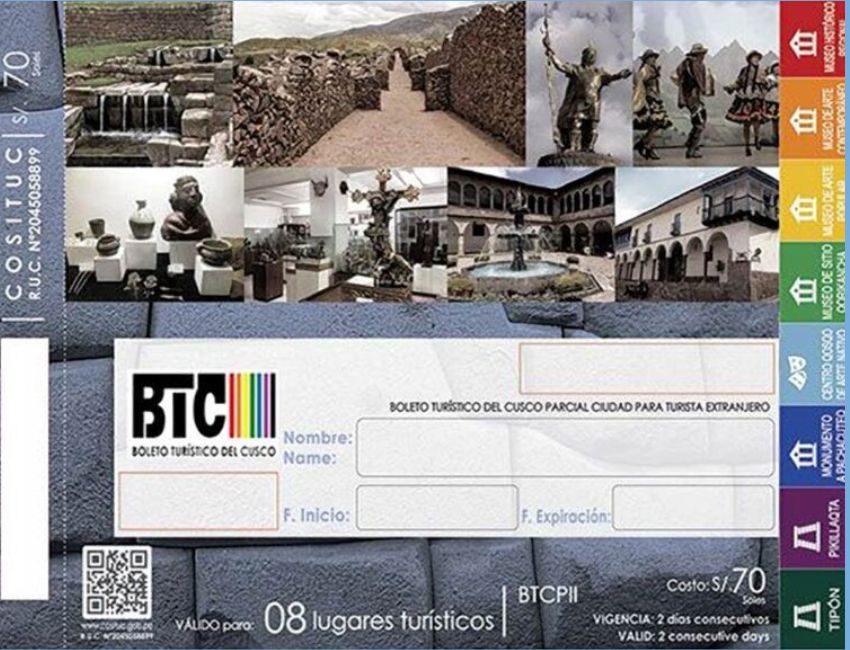
The Partial Ticket for Circuit II combines cultural attractions in the city with South Valley sites. It usually includes the Regional Historical Museum, the Museum of Contemporary Art, the Museum of Popular Art, the Qoricancha Site Museum, the Pachacuteq Monument, the Qosqo Native Art Center, Tipón, and Pikillacta, depending on the current ticket type.
The usual validity for this circuit is 2 days, though this should be verified before buying. It’s useful if you plan to visit museums in Cusco and take a trip to the South Valley, without including the City Tour sites or the main Sacred Valley attractions.
Partial Ticket, Circuit III
The Partial Ticket for Circuit III focuses on the main archaeological sites of the Sacred Valley: Pisac, Ollantaytambo, Chinchero, and Moray. It’s a practical option when your trip is centered on this area.
It can work for a full-day Sacred Valley tour or a two-day route with a night in Ollantaytambo or Urubamba. If you’ll also be visiting Sacsayhuamán or the South Valley, compare this partial ticket against the Integral Tourist Ticket.
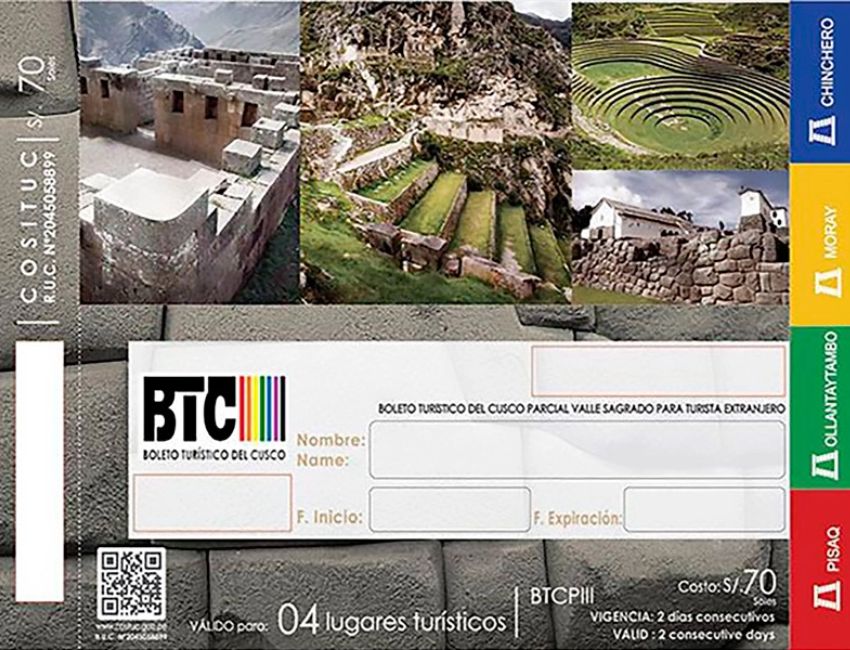
Cusco Tourist Ticket prices
The official rates for the Cusco Tourist Ticket are published in Peruvian soles. Below are reference prices in US dollars, based on the official rate sheet available for 2026 and an approximate conversion. The final amount in dollars can vary depending on the day’s exchange rate.
Before paying, verify the current rates at the official source or authorized point of sale. Prices, requirements, and ticket types can be updated without prior notice.
| Type | Foreign tourist | National tourist | Typical validity |
|---|---|---|---|
| Integral Tourist Ticket, adult | approx. USD 35 (S/130) | approx. USD 19 (S/70) | 10 days |
| Integral Tourist Ticket, student | approx. USD 19 (S/70) | approx. USD 11 (S/40) | 10 days |
| Partial Ticket, Circuit I | approx. USD 19 (S/70) | approx. USD 11 (S/40) | 1 day |
| Partial Ticket, Circuit II | approx. USD 19 (S/70) | approx. USD 11 (S/40) | 2 days |
| Partial Ticket, Circuit III | approx. USD 19 (S/70) | approx. USD 11 (S/40) | 2 days |
Rates for foreign tourists
For foreign visitors, the Integral Tourist Ticket has a reference rate of approx. USD 35 (S/130), based on official figures available for 2026. The partial circuits have a reference rate of approx. USD 19 (S/70) each.
The rate is normally paid in Peruvian soles. If you’re carrying dollars, consider exchanging a reasonable amount before heading to the point of sale, since not every location accepts payment in foreign currency or by card.
Rates for national tourists
For Peruvian citizens, the Integral Tourist Ticket has a reference rate of approx. USD 19 (S/70). The partial tickets have a reference rate of approx. USD 11 (S/40), based on the rate sheet available for 2026.
To access this rate, a valid national ID must be presented. If the document isn’t available or doesn’t match the traveler’s information, the point of sale may apply the general rate or decline the requested category.
Student discounts
The student rate applies to travelers who meet the conditions set by the administering entity. A valid university ID or valid student accreditation is generally required, and there’s usually an age limit that should be checked before buying.
Documents must be original and in good condition. Photographs, screenshots, or digital copies may not be accepted. If you’re traveling on the student rate, also bring your passport or ID to validate your information.
Which Cusco Tourist Ticket to choose
The best type depends on three factors: the attractions you’ll visit, the length of your trip, and your booked tours. If you’ll only be doing one specific tour, a partial ticket may be enough. If you’ll be visiting several areas, the Integral ticket may be more worthwhile.
A common mistake is buying the Integral ticket on the first day without a clear itinerary. Before deciding, check whether your route includes the City Tour, Sacred Valley, South Valley, museums, or a combination of several circuits.
To visit Sacsayhuamán and the nearby sites
If your plan is to visit Sacsayhuamán, Qenqo, Puka Pukara, and Tambomachay, the type you need is the Partial Ticket for Circuit I. It’s the right option for most travelers doing the Cusco City Tour.
This circuit is usually used in an afternoon. If you don’t plan to visit other attractions included in the system, you don’t need to buy the Integral ticket just for this tour.
To tour the Sacred Valley
If your itinerary includes Pisac, Ollantaytambo, Chinchero, or Moray, you should consider the Partial Ticket for Circuit III. It’s the type focused on the Sacred Valley’s main archaeological sites.
If you’ll also be visiting Sacsayhuamán, Tipón, Pikillacta, or included museums, compare the cost of Circuit III plus other partial tickets against the Integral Tourist Ticket. On multi-day trips, the difference can justify buying the Integral ticket.
To see the South Valley
To visit Tipón and Pikillacta, the right option is usually the Partial Ticket for Circuit II. This type can also include cultural spaces in the city, depending on current official information.
It’s a good option if you want to dedicate one day to the South Valley and another to museums or cultural centers. It doesn’t cover Sacsayhuamán or the main Sacred Valley sites, so it won’t work for a classic City Tour or for Pisac or Ollantaytambo.
For a multi-day trip
If you have three or more days in Cusco and plan to visit different areas, take a careful look at the Integral Tourist Ticket. It can be more practical if your route combines the City Tour, Sacred Valley, South Valley, and museums.
The comparison should be based on the actual number of attractions you’ll visit, not on every place available. If your itinerary is tight or only covers one area, buying partial tickets can be more sensible.
Where to buy the Cusco Tourist Ticket
The Cusco Tourist Ticket must be bought at authorized points of sale. The safest option is to go to the official administering office or to the tourist entry points authorized to sell it.
Before going, check business hours, payment methods, and availability of the type you need. Some locations may only sell certain circuits and don’t always accept cards.
Official offices and points of sale
The usual official reference point is the COSITUC office in Cusco, located at Av. El Sol 103, Galerías Turísticas. This address should be confirmed before going, since hours and service conditions can change.
Buying at an authorized office lets you resolve questions about circuits, validity, and rates. If you need the national or student rate, bring the original documents from the start to avoid having to go back to your hotel.
Buying at the tourist entry points
The ticket can also usually be purchased at some entry points of the included attractions, such as Sacsayhuamán, Pisac, Ollantaytambo, Chinchero, Moray, Tipón, or Pikillacta. Availability can vary depending on the location and the type requested.
Not every entry point offers every option. If you need the Integral ticket or a special rate, it’s a good idea to confirm beforehand. For tours with tight schedules, buying in advance reduces delays at the start of the visit.
Required documents
To buy the ticket, foreign visitors must present a passport or valid ID document. Peruvian citizens must present their national ID to access the national rate.
Students must bring the original accreditation required by the administering entity, along with their ID document. If the document doesn’t meet the requirements, they may be asked to pay the regular rate.
Places not included in the Tourist Ticket
The Cusco Tourist Ticket doesn’t cover every attraction in the region. This confusion is common because many tours combine included places with others that have independent tickets.
Always check the tour details and separate the cost of the service from the cost of entry tickets. This way you’ll avoid assuming a visit is paid for when it’s actually charged at the entrance.
Machu Picchu
Machu Picchu is not included in the Cusco Tourist Ticket. It has its own entry system, with circuits, schedules, and limited quotas that must be booked independently.
If your trip includes Machu Picchu, arrange that ticket separately along with trains, buses, and schedules. The Tourist Ticket can be used for other days in Cusco, but it doesn’t replace entry to the citadel.
Cathedral and Coricancha
The Cusco Cathedral may require an independent ticket, even though it’s part of some city tours. The same goes for Coricancha, whose entry shouldn’t be confused with the Qoricancha Site Museum included in certain tickets.
On a City Tour, the agency may or may not include these entries in the price. Check the program in writing to know whether you should bring extra cash on the day of the tour.
Maras salt pans
The Maras salt pans are paid separately and are not part of the Cusco Tourist Ticket. This is worth clarifying because many tours visit Moray and Maras on the same outing.
Moray is part of the Sacred Valley circuit, but Maras has a different administration. If your tour includes both stops, factor in the tourist ticket for Moray and an additional payment for the salt pans.
Do tours include the Tourist Ticket
It depends on the agency and the package booked. Some tours include tickets in the total price, while others only cover transportation and a guide, leaving the Tourist Ticket as an additional expense.
The best way to avoid confusion is to check in writing what’s included. Ask for the program to specify whether the tourist ticket, independent entry tickets, meals, and other expenses are covered or not.
Services usually included
Many tours around Cusco include tourist transportation, a guide, and pickup from your hotel or a meeting point. These services can vary depending on the operator, the location of your lodging, and the type of service booked.
Assistance during the tour and schedule coordination may also be included. Even so, these services don’t automatically mean the entry tickets are paid for. They should be clearly listed as included in the package details.
Expenses that may be paid separately
Among the expenses that are usually paid separately are the Cusco Tourist Ticket, independent entry tickets such as the Cathedral, Coricancha, Machu Picchu, or the Maras salt pans, meals, and personal expenses.
If a tour has a very low price, check the exclusions more carefully. Sometimes the final cost rises once you add entry tickets, extra transfers, or on-route payments.
Tips before buying the ticket
Buying the Cusco Tourist Ticket is simple, but it’s a good idea to do it with a clear sense of your itinerary. A poor choice can lead to unnecessary expenses or validity problems.
Before paying, confirm which areas you’ll visit, how many days you have, and which entries your tour already covers. These steps help you choose between the Integral ticket and the partial circuits.
Define your itinerary first
First choose the tours and attractions you actually want to visit. Then check which ticket type covers those places. This sequence avoids buying a ticket that’s too broad, or one that doesn’t fit your route.
If your itinerary isn’t finalized yet, wait before buying. The ticket has a limited validity period, and it’s not worth activating it if you won’t use the entries within the allowed window.
Check the validity period
The ticket’s duration should match the dates you plan for your visits. The Integral ticket allows more margin, while the partial ones tend to have a shorter validity.
If you have tours on separate days, verify that the ticket you choose covers the entire period. This point is especially useful when combining the Sacred Valley, Machu Picchu, and other tours on consecutive days.
Review what the tour includes
Before buying on your own, ask whether the agency already factors the entry tickets into the total price. Some complete packages may include the ticket or arrange the purchase in advance.
Request the details in writing. If the program says entries are not included, you should factor the Tourist Ticket and other independent entries into your travel budget.
Check official prices
Verify rates, conditions, and points of sale with the official source before making the payment. Although prices tend to stay stable for long periods, they can change due to administrative updates.
Also check the requirements for the student or national rate. Bringing incomplete documents can force you to pay a different rate than expected.
Frequently asked questions about the Cusco Tourist Ticket
These answers clear up common questions before buying the ticket. If your itinerary combines several tours, review each case with your travel program on hand.
Conditions can change, so it’s a good idea to confirm official information close to your travel date.
Does the Tourist Ticket include Machu Picchu
No. Machu Picchu uses an independent entry system, with its own circuits and schedules. The Cusco Tourist Ticket doesn’t grant entry to Machu Picchu.
To visit Machu Picchu you must buy a specific ticket and arrange the train, bus, and entry time. That process is organized separately from the tourist ticket.
Can individual tickets be purchased
It depends on the attraction. Places like Machu Picchu, the Cathedral, Coricancha, or the Maras salt pans have independent tickets and aren’t part of the same system.
At several sites included in the Tourist Ticket, entry is granted through the corresponding Integral or partial type. Conditions can vary, so it’s a good idea to confirm before arriving at the entrance.
Does the ticket include transportation and a guide
No. The ticket covers only entry to the attractions specified in the type purchased. It doesn’t include transportation, a guide, hotel pickup, or meals.
If you book a tour, those services may be included by the agency. Even so, the entry tickets need to be clearly listed within the price to be considered paid for.
How many times can you visit each place
Generally, each included attraction can be visited only once during the ticket’s validity period. Staff usually record or stamp the visit at entry.
If you want to return to the same site, check the current conditions at the point of sale. Don’t assume the ticket allows unlimited re-entry.
What’s the best ticket for the Sacred Valley
For a route centered on Pisac, Ollantaytambo, Chinchero, or Moray, the Partial Ticket for Circuit III tends to be the most direct option. It covers the main included sites in the Sacred Valley.
If your trip also includes the City Tour, South Valley, or museums, compare Circuit III against the Integral Tourist Ticket. The best option depends on the actual number of attractions you’ll visit.
Choose your Tourist Ticket and organize your Cusco itinerary
The Integral Tourist Ticket is worthwhile for multi-day trips with visits to different areas. Circuit I works for Sacsayhuamán and the sites near Cusco. Circuit II combines the city’s cultural spaces with Tipón and Pikillacta. Circuit III is designed for the Sacred Valley.
Before buying, define your route, check the validity period, and confirm whether your tour includes entry tickets. If you need help organizing tours, tickets, schedules, and transfers without paying for unnecessary entries, you can consult with the team at Incredible Peru Tours and ask for a review of your itinerary before traveling.


