
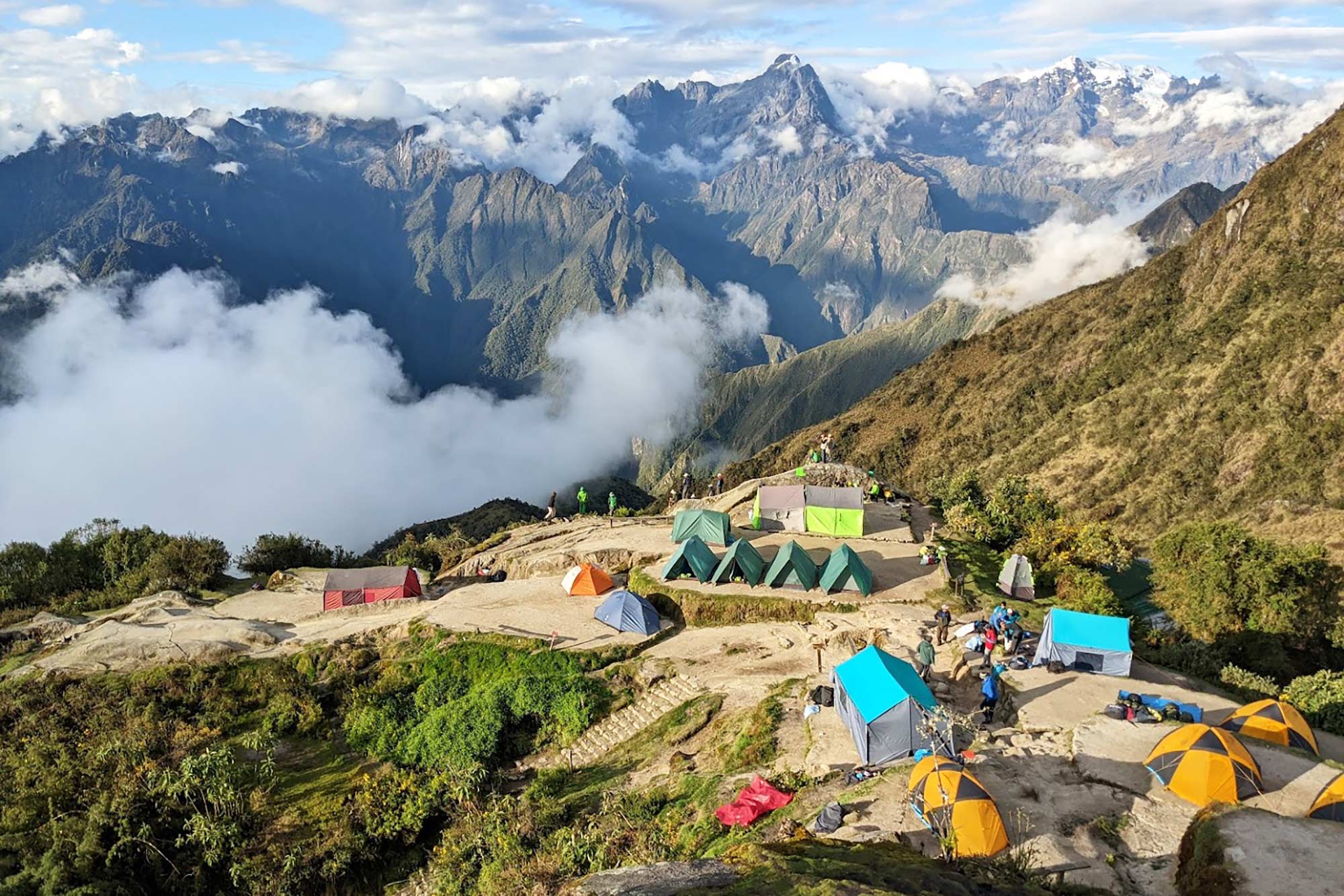
The Inca Trail is not just the stretch between Kilometer 82 and the citadel. It also includes three nights at specific points along the protected corridor, each with its own altitude, landscape, and temperature conditions. Knowing in advance where you will sleep each night, what to expect from the surroundings, and what each campsite offers allows you to arrive prepared and without surprises at the end of each day.
How the campsites on the Inca Trail work
The campsites on the Inca Trail are not fixed facilities with permanent lodging infrastructure. They are designated and regulated areas established by SERNANP within the protected corridor where authorized operators set up tents, field kitchens, and portable sanitary facilities for each group. Each campsite area has a maximum capacity that the permit system regulates indirectly through the daily entry quota.
Porters leave before the group every morning so they can reach the next campsite with enough time to set up the tents, prepare hot water, and have dinner ready when the group arrives. In practice, the traveler reaches camp and finds their tent already set up, the dining table in place, and the meal being prepared. It is part of the standard service of any operator with experience on the route.
Sanitary facilities vary from one campsite to another. Some have permanent toilets, while others only have latrines. None have hot showers. Personal hygiene at the campsites depends on the water the operator heats in the field kitchen and the personal items each traveler carries in their backpack.
The night before: Cusco or Ollantaytambo
Most groups do not spend the night in Ollantaytambo before starting the trek. The most common arrangement is to leave Cusco between 4:30 and 5:30 a.m. on Day 1 and arrive at Kilometer 82 between 7:00 and 8:00 a.m., a drive of approximately an hour and a half to two hours.
However, some operators offer the option of staying overnight in Ollantaytambo the night before, especially for groups arriving from Lima on the same day the trek begins or for those who prefer not to leave so early from Cusco. The advantage is practical: from Ollantaytambo to Kilometer 82 it is only a 20- to 30-minute drive, which allows for a more comfortable departure and more rest the night before.
This option is not included in standard packages and comes at an additional cost. Ollantaytambo offers accommodations for different budgets, from basic hostels to boutique hotels within the historic Inca town, as well as several restaurants serving Peruvian and international cuisine.
Night 1 — Wayllabamba (3,000 meters)
Location and arrival
Wayllabamba is the first campsite on the Classic Inca Trail and the only one located within an active community. It sits at the confluence of the Llulluchayoc and Cusichaca rivers, at 3,000 meters above sea level, in the district of Ollantaytambo. Getting there from Kilometer 82 involves a hike of four to six hours with moderate elevation gain through high-altitude forest, with orchids and bromeliads in the wetter sections.
The first day covers approximately 12 kilometers from the starting point to Wayllabamba, passing the archaeological sites of Llaqtapata and Huayllabamba and crossing the Cusichaca River several times via wooden and stone bridges.
The campsite surroundings
Wayllabamba is surrounded by montane forest vegetation with eucalyptus trees, alders, and high-altitude shrubs. The community of the same name has an active presence along the edges of the campsite: it is common to see local residents walking along the trails around the camping area. There is a small stand where drinks and snacks are sold at local prices, the last opportunity to stock up before the protected corridor enters an area with no commerce of any kind.
Nighttime temperatures in Wayllabamba range from 5 °C to 12 °C during the dry season and from 8 °C to 15 °C during the rainy season. It is the warmest of the three nights and allows for relatively comfortable sleep before the most demanding day of the trek.
What you should do when you arrive
The afternoon in Wayllabamba is the ideal time to check your gear, make sure your sleeping bag is easy to access, and mentally prepare for the next day’s hike. The climb to Warmiwañusca begins only a few hours after waking up. Guides usually give an informational briefing about the second day after dinner, with advice on pacing, rest stops, and the signs of altitude sickness to watch for.
Staying well hydrated during the afternoon and evening is one of the most effective ways to improve performance on the ascent. High altitude increases water loss through breathing and reduces the sensation of thirst, which can lead to silent dehydration if you do not drink consciously.
Night 2 — Pacaymayo (3,600 meters)
Location and arrival
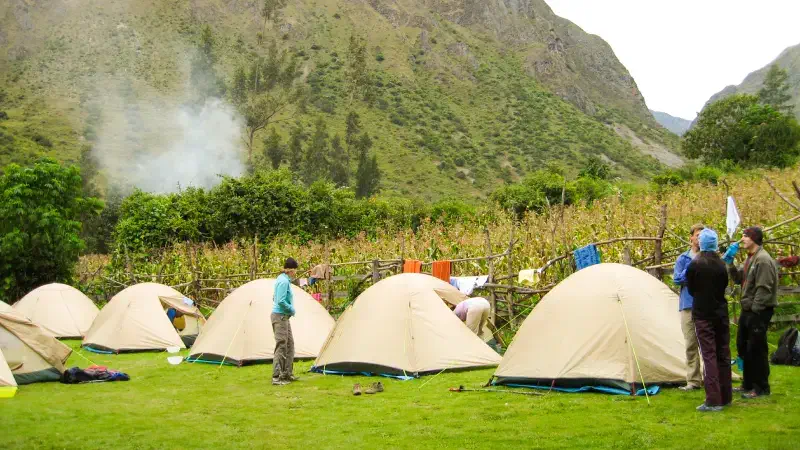
Pacaymayo is the highest campsite on the route and the one that follows the crossing of Warmiwañusca, the most demanding pass of the four-day trek. It is located at 3,600 meters above sea level at the bottom of the valley of the same name, surrounded by dense cloud forest, and is reached after descending from the summit of the pass on a stretch that takes between an hour and a half and two hours.
The name Pacaymayo means “river of the pacay trees” in Quechua, referring to the native fruit tree whose white pods are characteristic of the montane forest. The river that runs through the campsite flows directly from the surrounding glaciers and has cold, clear water year-round.
The campsite surroundings
Pacaymayo is completely surrounded by cloud forest with dense vegetation: tree ferns rising more than three meters high, moss covering every rock and fallen trunk, and wild orchids blooming on the lower branches of the trees at any time of year.
The forest humidity is constant. The tents are covered with exterior condensation in the morning whether it rains or not, and the campsite ground stays permanently damp, making camp shoes necessary even for short walks between the tent and the dining area.
Nighttime temperatures in Pacaymayo are the coldest of the trek. During the dry season, between June and August, they can drop to between -3 °C and -8 °C. A sleeping bag suitable for those conditions is not optional during those months; it is the item that determines whether you sleep well or spend the night awake.
What you should know about this night
After the effort of the second day, the body needs recovery. Dinner in Pacaymayo is usually substantial: experienced operators know the group needs to replace calories and get ready for the third day, which includes more miles and more archaeological sites than any other stage.
The third day begins early, usually between 6:00 and 7:00 a.m. Sleeping well in Pacaymayo depends largely on arriving hydrated, eating a good dinner, and packing your daypack the night before so you do not have to do it at dawn in the cold.
Night 3 — Wiñaywayna (2,650 meters)
Location and arrival
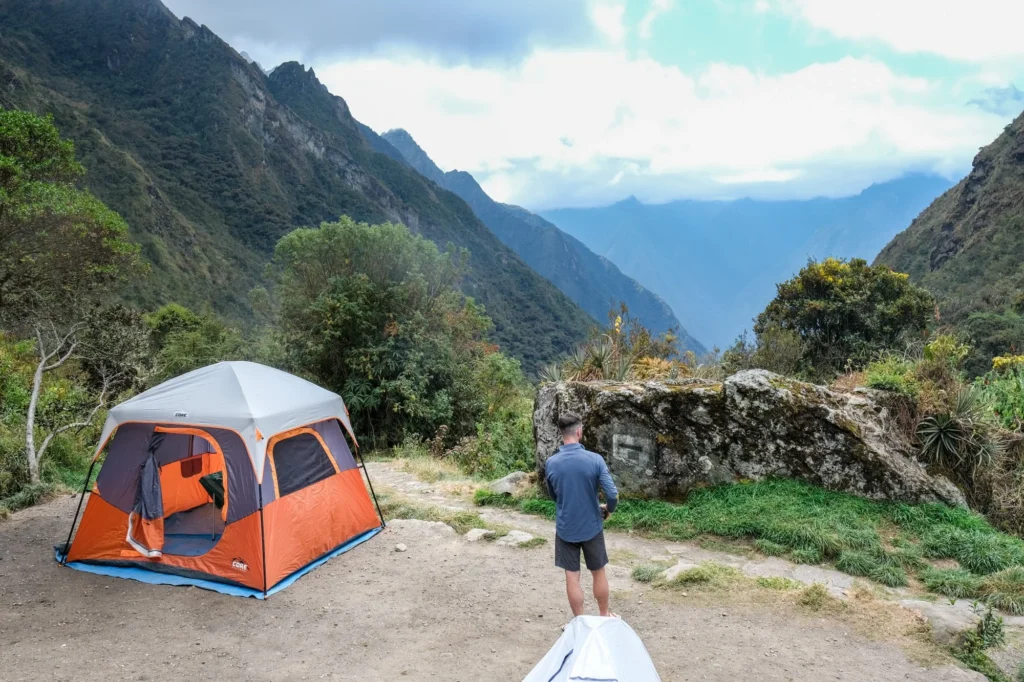
Wiñaywayna is the last campsite on the route before Machu Picchu. It is located at 2,650 meters above sea level on a hillside above the Urubamba River canyon, immediately next to the archaeological site of the same name.
You arrive there at the end of the third day, after crossing the Runkurakay and Phuyupatamarca passes and descending from the latter through the moss-covered stone steps that form the most technical section of the route. Arrival time depends on the group’s pace and how much time is spent at the archaeological sites along the way, but under normal conditions it usually falls between 3:00 and 5:00 in the afternoon.
The Wiñaywayna archaeological site
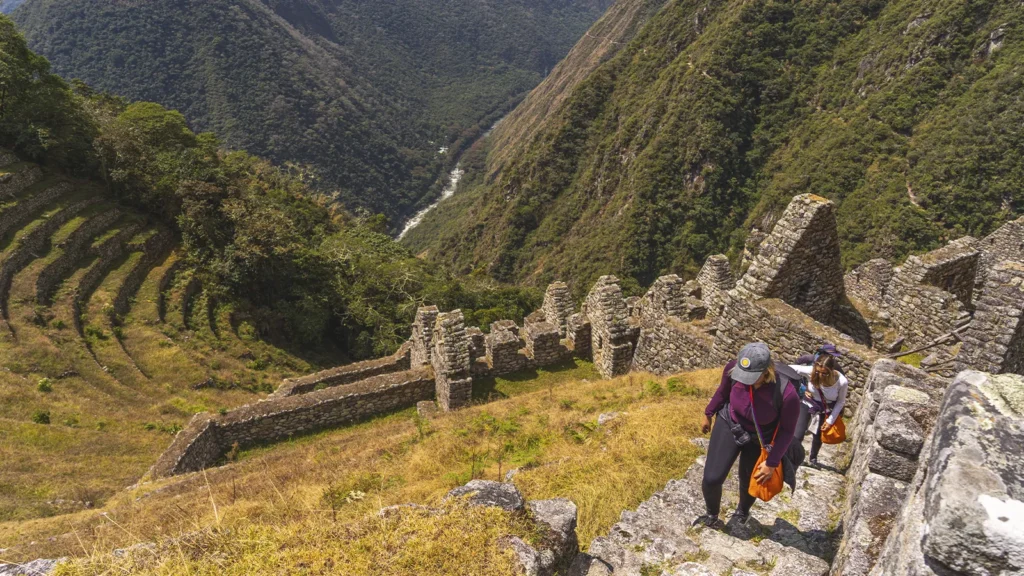
The name means “forever young” in Quechua, referring to the wild orchid of the same name that grows abundantly in the area and blooms year-round. The archaeological site combines cascading agricultural terraces, residential enclosures, a sequence of sixteen ceremonial water fountains, and storage sectors.
The terraces were built on a steep hillside with a direct view of the Urubamba Canyon. The ceremonial fountains form a cascade of stone channels that run down among the structures, with the hydraulic system still functioning.
The campsite surroundings
The Wiñaywayna campsite is set on a designated platform next to the archaeological site. It has basic permanent infrastructure: a building with bathrooms and cold showers, a covered dining area available to some operators, and a small snack bar where drinks and snacks are sold at the highest prices on the entire route, since everything sold there is carried in by porters.
Nighttime temperatures range from 8 °C to 15 °C in the dry season and from 12 °C to 18 °C in the rainy season. The lower altitude and the protection of the Urubamba Canyon create a milder microclimate than the one in Pacaymayo.
The night before Machu Picchu
The night at Wiñaywayna has a particular emotional weight. It is the last one before reaching the citadel and the shortest of the trek in terms of available sleeping hours. The group wakes up between 3:00 and 3:30 a.m. to leave before sunrise toward the Sun Gate with the goal of reaching Inti Punku at first light.
Getting everything ready the night before is essential: your headlamp within reach, your backpack packed, breakfast coordinated with the operator, and your Machu Picchu entry ticket easy to access. Some groups choose to eat dinner early and go to bed before 9:00 p.m. to maximize rest before the predawn wake-up call.
The final day: arrival in Aguas Calientes
After visiting the citadel on the fourth day, the group descends to Aguas Calientes either by bus or on foot via the trail of 400 to 500 steps that leads down from the sanctuary gate to the town.
Aguas Calientes, also called Machu Picchu Pueblo, is the only town with lodging infrastructure in the immediate surroundings of the citadel. It has hotels in different categories, restaurants serving a variety of cuisine, an artisan market, and municipal hot springs with temperatures ranging from 35 °C to 40 °C, the ideal ending to four days of trekking.
Most packages include the return train from Aguas Calientes to Ollantaytambo and ground transportation back to Cusco that same afternoon or evening. Some groups spend an additional night in Aguas Calientes at their own expense for a second visit to the citadel or simply to rest before the return trip.
Gear for the campsites
The shared gear (tents, sleeping pads, kitchen, and dining setup) is carried by the porters and included in the standard package. The personal gear each traveler must bring for the nights at camp is their own responsibility and has a direct impact on the quality of rest.
The sleeping bag is the most decisive item. Its comfort rating should match the time of year: in June and July, you need a sleeping bag rated for comfort down to -10 °C for Pacaymayo; during the rainy season, one rated to 0 °C is generally enough. Many operators include a sleeping bag in the package; it is worth checking its comfort rating before leaving Cusco and not assuming the gear provided is suitable for every season.
A headlamp is essential starting on the second night. Nighttime trips to the bathroom and the predawn wake-up at Wiñaywayna require light that does not depend on your phone screen.
Dry bags or packing cubes help keep dry clothes separated from wet ones inside your backpack, which by the second day makes a noticeable difference in the overall comfort of the trek.
Frequently asked questions about the campsites on the Inca Trail
Can I choose which campsite to sleep at each night? No. The campsites are determined by the standard four-day itinerary and the areas authorized by SERNANP within the corridor. Each night corresponds to a specific zone, and the operator cannot change that structure without altering the group’s permit.
Are the tents private or shared? It depends on the package booked. In standard packages, tents are double occupancy for two people. In premium packages, it may be possible to request a private tent, subject to porter load capacity and availability.
Is there electricity at the campsites? No. None of the campsites in the protected corridor have electrical outlets. The only source of power available is the portable battery each traveler carries with them. At Wiñaywayna there is an area with outlets in the bathroom building that some operators use, but access is not guaranteed.
How safe are the campsites? The protected corridor does not report significant security incidents affecting trekking groups. Access is controlled by SERNANP, and operator staff remain at the campsite overnight. It is recommended not to leave valuables inside the tent as a general precaution.
Can I stay an extra night at one of the campsites? No. The permit specifies the exact entry dates, and the itinerary cannot be extended within the corridor. If the group needs to stop for health reasons, the operator must coordinate the situation directly with SERNANP.
Do cheaper operators use the same campsites? Yes. The authorized campsites are the same for all approved operators. What varies between package categories is the quality of the tents, the variety and quality of the food, and the number of porters assigned to the group.


