
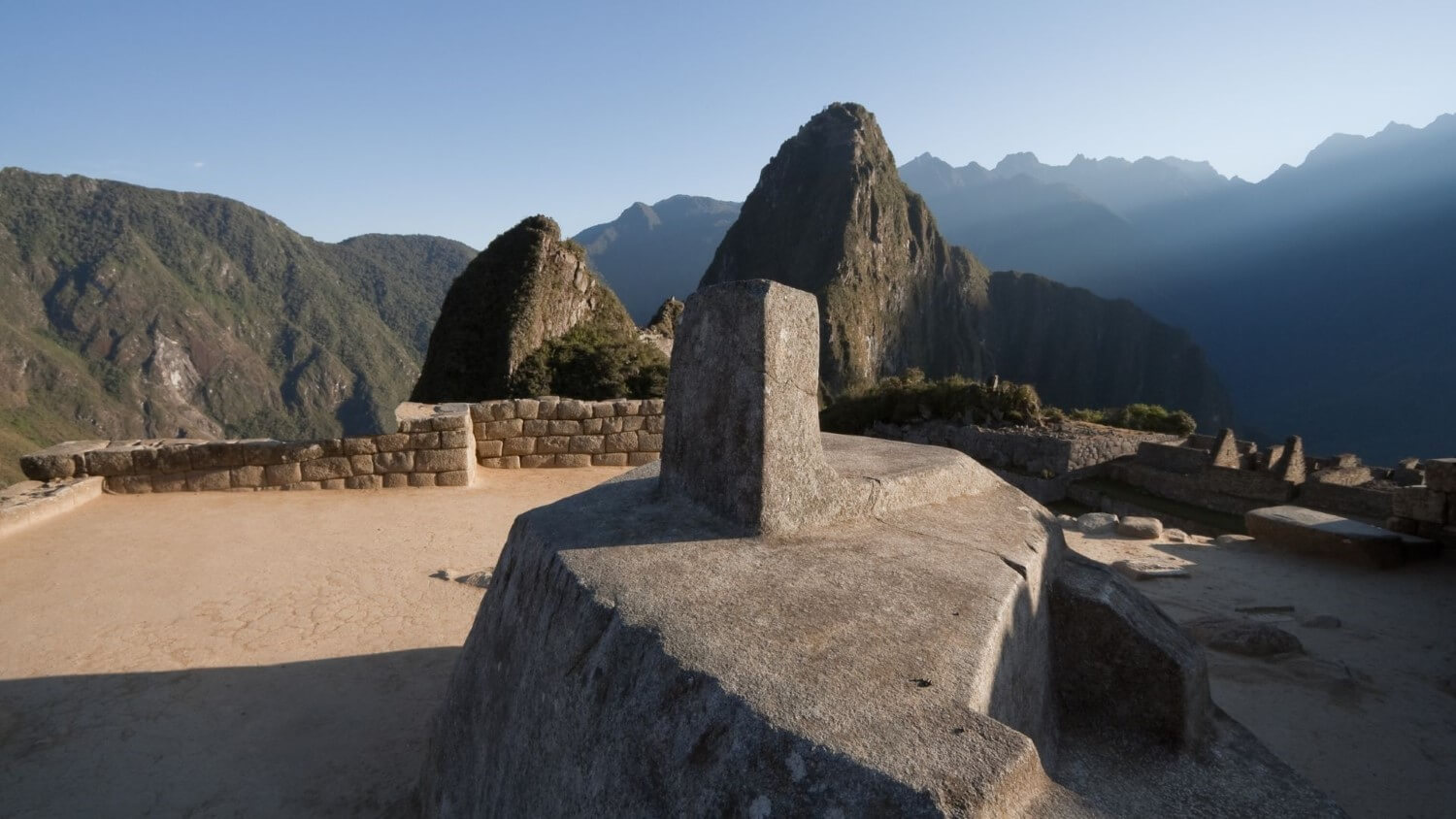
The Intihuatana is the highest point of Machu Picchu’s urban sector and one of the most meaningful objects in all of Inca heritage. It is not the largest structure, nor the most visible one at the site, but it is possibly the object that contains the most information about Andean astronomy, the sacred calendar of the Tahuantinsuyo, and the relationship between Inca imperial power and the control of time. This guide explains what the Intihuatana really is, why it has such deep meaning, and how to reach it within the site.
What Does Intihuatana Mean?
The name Intihuatana comes from Quechua and is roughly translated as “the place where the sun is tied” or “the hitching post of the sun.” The word combines Inti, the Quechua name for the sun and the solar deity that was the most important figure in the Inca pantheon, with huatana, which comes from the Quechua verb huatay, meaning to tie or fasten.
The literal translation may seem unusual at first, but it has a precise meaning within the context of the Inca ceremonial calendar. The winter solstice in the Southern Hemisphere, June 21, is the day when the sun reaches its lowest position on the southern horizon and then begins moving north again. In the Inca worldview, the sun’s movement toward the south during the months before the solstice was interpreted as the sun moving away from the earth, with consequences for agriculture, fertility, and the life cycle of the communities that depended on it. The Inti Raymi ritual, the festival of the sun celebrated on the June solstice, included a symbolic ceremony in which the priest tied the sun to the stone post to prevent it from moving farther away and to ensure its return toward the north. The Intihuatana was that post.
What Is the Intihuatana Physically?
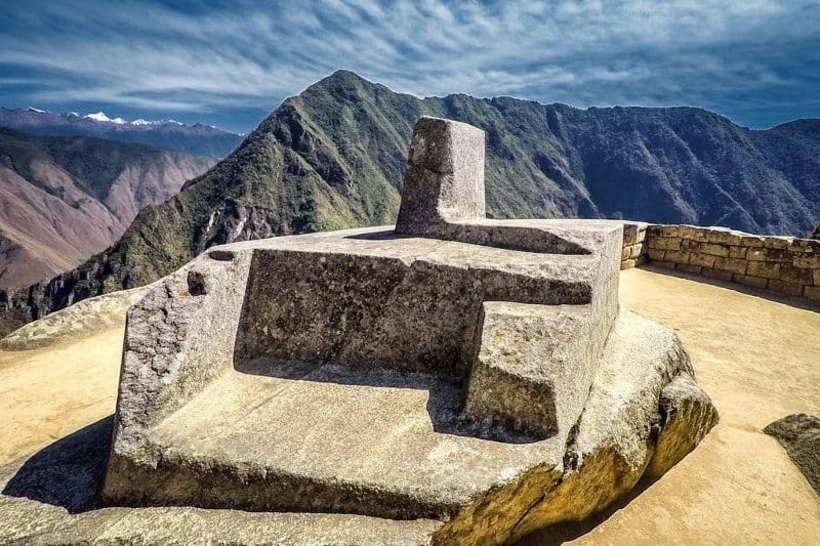
The Intihuatana of Machu Picchu is a granite column approximately 60 centimeters high, carved directly from the mountain’s bedrock, with a rectangular base that integrates it into the larger stone block on which it rests. It is not a separate stone placed on top of another one. It is a sculpture emerging from the natural rock of the mountain, carved continuously with the ground on which it stands.
The column has angular projections in different directions that have been interpreted as markers of the cardinal points and of the solar axes of the solstices and equinoxes. Archaeologists who have studied the object with measuring instruments have documented that several of these projections are precisely oriented toward specific points on the horizon that correspond to the sun’s position at key moments in the Andean astronomical calendar.
The stone as a whole has a design that evokes the shape of a miniature mountain, which has led some archaeologists to interpret it also as a symbolic representation of the Apu, or sacred mountain, in addition to its function as a solar gnomon and ritual object for the solstice ceremony.
Why the Machu Picchu Intihuatana Is Unique in the Inca World
Intihuatanas existed at many archaeological sites throughout the Inca Empire. They were part of the ritual infrastructure that the Inca state established in the most important ceremonial centers across the Tahuantinsuyo. However, the Spanish conquest of the 16th century included the systematic destruction of these objects as part of the campaign to eradicate idolatry. The Franciscan and Dominican friars who accompanied the conquistadors identified the Intihuatanas as objects of pagan worship and destroyed them at all Inca sites that were accessible to the conquerors.
Machu Picchu was not discovered by the Spanish conquistadors. The site was abandoned for reasons that archaeologists still debate and remained hidden beneath vegetation for centuries until Hiram Bingham documented it in 1911. That historical invisibility preserved the Intihuatana from the destruction that affected the others. The Machu Picchu Intihuatana is the only complete Intihuatana that survived in the entire territory of the former Inca Empire. This uniqueness makes that 60-centimeter granite block one of the irreplaceable objects of pre-Columbian heritage in the Americas.
The 2000 Incident and the Current Condition of the Intihuatana
In September 2000, during the filming of a beer commercial at the archaeological site, a crane fell onto the Intihuatana and fractured it. The incident damaged the upper part of the column, and the mark is still visible today. It caused international outrage and led the Peruvian government to strengthen restrictions on access and commercial activities at the archaeological site.
The damage was partially restored, but the fracture cannot be completely repaired without altering the authenticity of the object. Today, the Intihuatana of Machu Picchu remains in the same condition it was left in after the incident, with the fracture still visible on the upper part of the column. This detail, which some visitors do not know before arriving, is part of the object’s recent history and a reminder of the risks that insufficiently regulated tourism can pose to archaeological heritage.
Where Is the Intihuatana Located Within the Site?
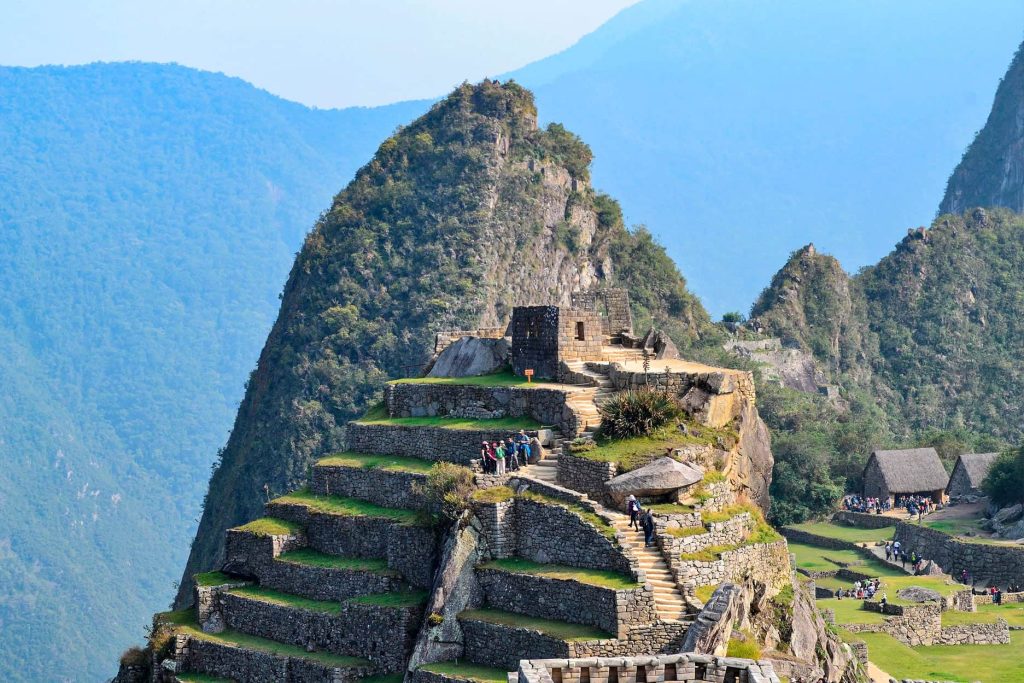
The Intihuatana is located at the highest point of Machu Picchu’s urban sector, at the top of a stepped terrace pyramid accessed from the main temple sector. To reach it from the site’s entrance checkpoint, visitors must walk through the urban sector toward the north, pass by the Temple of the Three Windows and the Sacristy, and climb the stairways of the pyramid to the upper platform where the object is located.
Its location at the highest point of the urban sector is part of its meaning: it stands in the most elevated position of the inhabited space, symbolically closer to the sun, with clear lines of sight toward the four cardinal points and toward the horizons where the sun rises and sets at different times of the year.
From the Intihuatana platform, the view of the archaeological site and the surrounding mountains is one of the most complete views available without climbing any of the mountains in the complex. The agricultural sector to the south, the Urubamba Canyon below, Huayna Picchu to the north, and Machu Picchu Mountain to the southwest can all be seen from this point in a way that is not available from any other place within the site’s inner circuit.
Which Circuit Includes the Intihuatana?
The Intihuatana is included in Route 2A Classic Designed, which is the most complete circuit through the urban sector and includes the largest number of elements from the site’s ceremonial complex. It is also included in most routes that cover the northern urban sector in some depth.
For visitors with a specific interest in the Intihuatana and its astronomical meaning, the combination of Route 2A with a private guide specialized in Andean astronomy offers the most complete experience. The orientation of the column’s projections, the relationship between each axis and the solar points of the calendar, and the history of the Inti Raymi ceremony associated with the object require a level of explanation that no audio guide can provide with the same depth as a specialist on site.
How to See It Without Other Groups Blocking the View
During high season, the Intihuatana is one of the points on the circuit where group concentration can be highest because its physical size is small compared to the number of people who want to see and photograph it at the same time. The platform on which it rests is not large, and during the busiest moments it can be completely surrounded by groups waiting to get closer.
The most efficient strategy for seeing it with enough space is to include it in your route during the first hours of the first morning entry time, before the groups from the second time slot reach the urban sector. With a 6:00 a.m. entry, visitors who arrive at the Intihuatana between 7:30 and 8:00 a.m. still have a reasonable chance of finding the area with fewer groups than after 9:00 a.m.
Do you want to visit the Intihuatana with complete astronomical and archaeological context and the most suitable circuit for your Machu Picchu visit? At Incredible Peru Tours, we coordinate Machu Picchu tickets with the right circuit and specialized guides in Andean archaeology who turn the Intihuatana and the other ceremonial sites around it into an experience with a depth that an independent visit cannot provide in the same way.


