
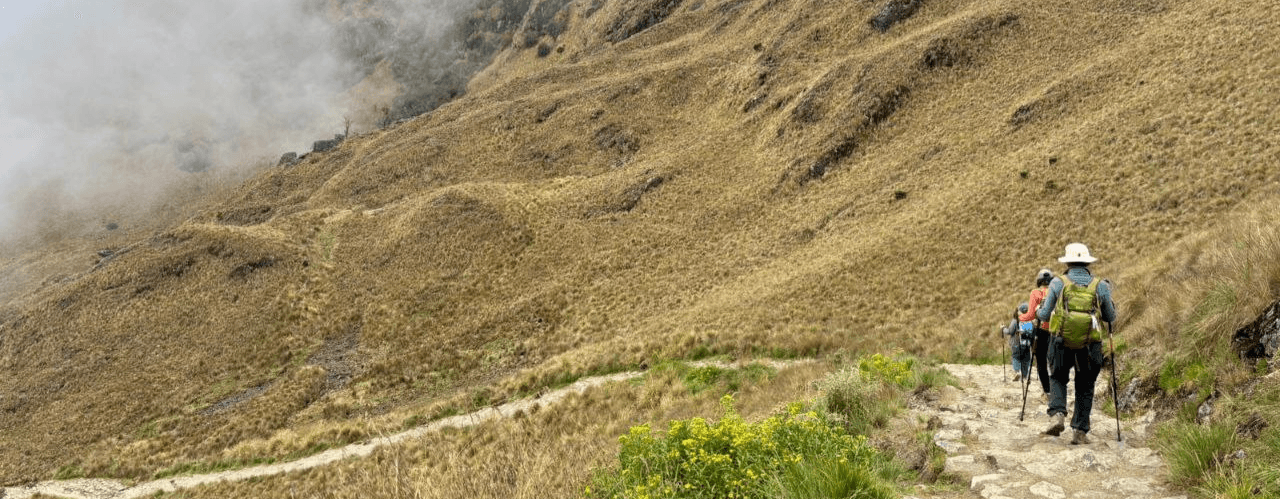
There is a common idea in the trekking world that turns the Inca Trail into an experience almost reserved for younger people with backpacks full of energy and no urgent work obligations. It is the wrong image. Every season, a significant number of people over 50, 60, and even 65 complete the route and reach Machu Picchu through the Sun Gate in excellent condition. Not because they are elite athletes, but because they arrived with the right preparation, chose the right version of the trek, and took seriously the aspects that in your twenties you can ignore without consequences.
If you are over 50 and the Inca Trail is on your list of unfinished dreams, this guide is not written to discourage you. It is written to give you the specific information that allows you to reach the trail in the best possible condition and enjoy every mile without age being the limit.
age is not the determining factor: this is what really matters
Before talking about adaptations and precautions, it is worth putting things in perspective. Chronological age is a very imprecise indicator of a person’s real ability to do the Inca Trail. There are people in their fifties with cardiovascular and muscular fitness that surpasses that of many trekkers in their thirties. And there are people in their forties who arrive unprepared and spend the second day in a state of exhaustion that has nothing to do with age and everything to do with lack of prior training and poor acclimatization.
The factors that truly determine whether the Inca Trail is within reach for someone over 50 are three: cardiovascular health, musculoskeletal condition—especially the knees and ankles—and individual response to altitude. None of those three factors depends directly on age, although the likelihood that one of them may need specific attention does increase over time.
A medical checkup before the trip, including blood tests, an electrocardiogram, and blood pressure evaluation, is a time investment that for this age group is not optional. Not to look for reasons to avoid the trek, but to identify whether anything needs attention before departure and to arrive at the trail with clear information about the body’s real condition.
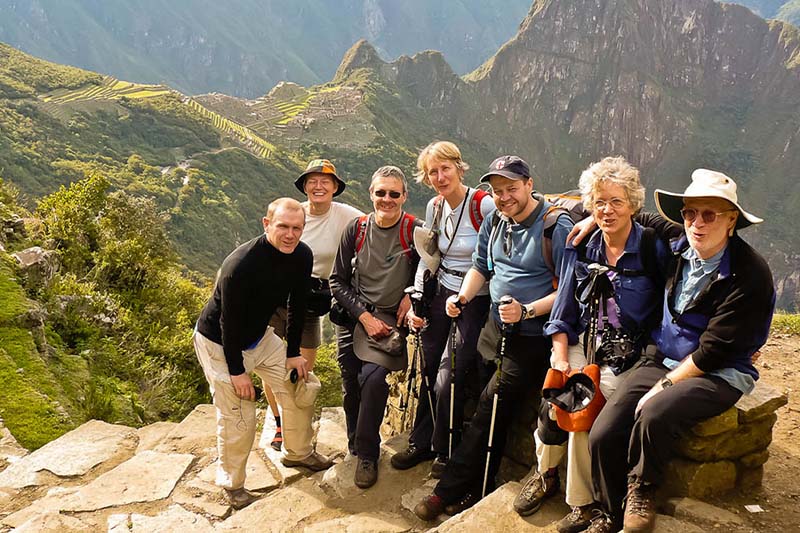
which version of the Inca Trail to choose based on your fitness level
Choosing the right version of the route is especially important in this age group because the difference between the available options is not only about distance or duration: it is about level of difficulty and real risk at the highest points of the trail.
The four-day Classic Inca Trail is completely doable for people over 50 who are in good physical condition, do not have uncontrolled heart problems, and have had proper prior acclimatization. The most demanding part is still the second day, with the ascent to Dead Woman’s Pass at over 4,200 meters. The key is not to avoid that section but to approach it at the right pace: very slowly, with frequent stops, and without trying to keep up with younger participants in the group. At 50 or 55, the body can absolutely reach the same destination it could at 30: it simply needs more time to do it and more respect for its fatigue signals.
The two-day Short Inca Trail is the most recommended alternative for those who have some limitation in the knees, cardiovascular capacity, or tolerance to extreme altitude. The route from kilometer 104 to the citadel avoids the three mountain passes of the classic trail, stays below 2,700 meters at its highest point, and still reaches Machu Picchu through the Sun Gate. For those who prioritize the historical experience and the destination over the physical challenge of the process, this option offers exactly that with a considerably more moderate physical demand.
Private service, in any of its versions, is especially recommended for people over 50 who are traveling alone or as a couple. In a shared group, the pace is set by the guide based on the overall group, and in some groups that pace may be too fast for someone who needs to move more slowly on the most demanding sections. In a private service, the traveler sets the pace freely, and the guide adapts the day to what the group needs at every point along the route.
the knees: the most common point of concern
If there is one part of the body that concentrates the greatest number of complaints in trekkers over 50 during the Inca Trail, it is the knees. Not so much on the climbs, which are usually manageable with the right pace, but on the descents: the steep Inca stone stairways between Phuyupatamarca and Wiñay Wayna can place strain on the cartilage and ligaments of the knee that by the third and fourth day becomes real, limiting pain.
There are three measures that significantly reduce that impact. The first is using trekking poles from the first day, especially on descents. Poles shift part of the body weight onto the arms and reduce stress on the leg joints during downhill sections in a way that people who have never used them usually underestimate until they try them. The second is strengthening the quadriceps in the weeks before the trip: those muscles act as active stabilizers for the knee and reduce impact with every downhill step. The third is always descending with the foot firmly planted on each step, without rushing and without trying to make up lost time on flatter sections.
If you have a previous knee, meniscus, or ligament injury, consult an orthopedic specialist before deciding which version of the route you are going to do. In many cases, a well-recovered previous procedure is not a real obstacle for the trek, but a specific medical evaluation is essential to know that with certainty.
altitude after 50: what changes and what does not
The body’s response to altitude does not necessarily worsen with age, but there are factors associated with aging that can influence how the body handles oxygen deficit at high elevation. Lung capacity gradually decreases after age 40, which can make adaptation to altitude take a little longer. Blood pressure, which tends to rise with age, may also show additional fluctuations during the first days above 3,000 meters.
None of this prevents you from doing the Inca Trail. What it does require is more careful prior acclimatization and, in some cases, a longer acclimatization period than what is usually recommended for younger groups. If the general standard is two nights in Cusco before starting the trek, for people over 55 or with a history of high blood pressure, three nights is the more cautious recommendation. That extra day of adaptation can make the difference between a second day remembered with satisfaction and one remembered only for the effort.
People who take medication for high blood pressure, cholesterol, or blood thinners should consult their doctor before the trip about possible interactions with altitude and whether acetazolamide—the preventive medication for altitude sickness—is compatible with their usual treatment. Some medication combinations can amplify the effects of oxygen deficit instead of reducing them, and that is exactly the kind of information worth having before you arrive at kilometer 82.
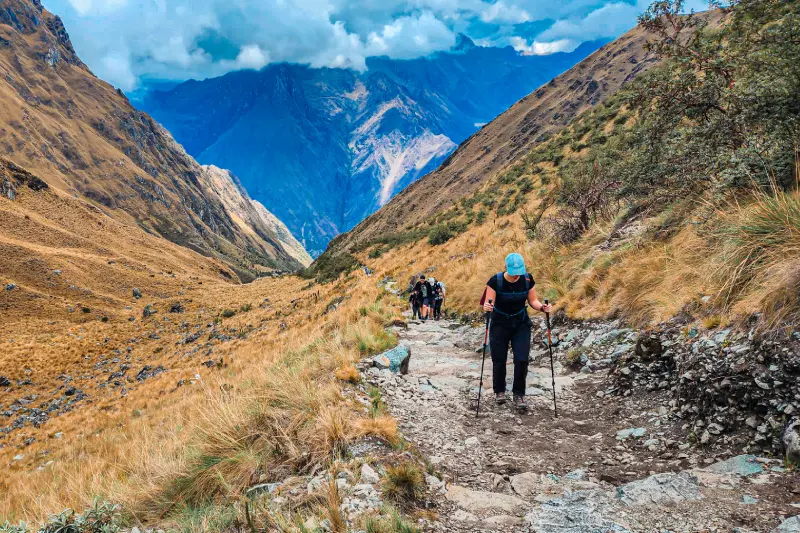
pace: the most important variable on the trail
If there is one piece of advice that guides with experience in older groups repeat again and again, it is this: the most common mistake is not arriving out of shape but starting too fast on the first day. The excitement of the beginning, the scenery of the Sacred Valley, and the energy of those first hours on the trail encourage a pace that the body will not be able to sustain on the second day when the terrain becomes harder and the altitude truly starts to weigh on you.
The right strategy is the opposite: begin the first day more slowly than seems necessary, save energy for the afternoon, and reach camp with something left in reserve. The second day, with the climb to the highest point of the route, is handled much better from a position of relative freshness than from the accumulated exhaustion of having gone too fast the day before.
Guides on the Inca Trail often talk about a steady, unhurried rhythm that allows you to reach any destination regardless of altitude. It is a concept deeply aligned with the wisdom Andean peoples have applied to these same trails for centuries: move consistently, without rushing, and let endurance do the work.
specific physical preparation for this age group
Training for the Inca Trail after 50 does not need to be high-intensity, but it does need to be consistent and progressive for at least eight weeks before the trip. The goal is not to reach an athletic level that is unnecessary for the route, but to prepare the musculoskeletal system and the cardiovascular system for the sustained effort of several hours a day on uneven terrain over four consecutive days.
The most useful activities during that period are long hikes with elevation gain, ideally on natural terrain and not only on a treadmill, using the backpack and footwear you will wear on the trek. Two or three weekly sessions of between 90 minutes and two hours, with a gradual increase in distance and elevation over the weeks, prepare the body in a very specific way for what it will encounter on the trail.
Strength work for the quadriceps, hamstrings, and glutes complements hiking and directly reduces impact on the knees during descents. You do not need a gym: squats, lunges, and stair climbing with weight are completely accessible exercises that produce real results in just a few weeks.
what many people over 50 describe when they reach the Sun Gate
There is something about arriving at Machu Picchu after four days on the Inca Trail that, after a certain age, takes on a dimension that younger trekkers do not always experience in the same way. It is not only the physical achievement of completing the route. It is the awareness that this accomplishment is happening at a stage of life when society often assumes these kinds of adventures are already behind you, and the satisfaction of proving that assumption wrong.
Testimonials from people who have done the Inca Trail between ages 55 and 65 share a pattern that appears too often to be a coincidence: arriving at Inti Punku and seeing the first view of the citadel produces in this age group an emotional response that many describe as unexpectedly intense. Not because the image is more beautiful than it is for other travelers, but because the personal context from which that moment is lived is completely different.
That is not guaranteed in any itinerary. But knowing that it is possible, that thousands of people over 50 have experienced it in exactly that way, is sometimes the only argument missing to finally decide to book it.
Are you over 50 and want to do the Inca Trail with the right preparation and support? At Incredible Peru Tours, we have experience with groups of all ages and know how to adapt the pace, logistics, and service so that age is not a limit, but simply one more detail of the group.


