
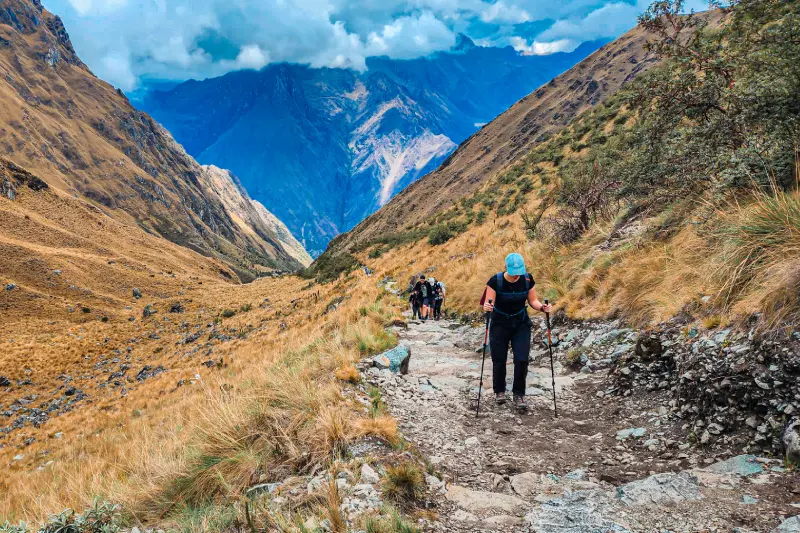
Trekking poles on the Inca Trail are not an optional accessory only for those who arrive with knee injuries. They are a biomechanical tool that any participant on the route can benefit from, especially on the downhill sections of the second and third days, which generate the most joint stress. The question is not whether to use them, but what is more practical: bringing them from home or renting them in Cusco.
Why trekking poles matter specifically on the Inca Trail
The Inca Trail has two downhill sections that concentrate most of the joint impact of the four days. The first is the descent from Dead Woman’s Pass at 4,215 meters to the Pacaymayo campsite on the second day, a negative elevation change of several hundred meters over uneven rocky terrain. The second, and longer one, is the Inca stone stairway that descends from Phuyupatamarca toward Wiñay Wayna on the third day, with hundreds of steps of different heights and angles that in some sections may be wet or covered with moss.
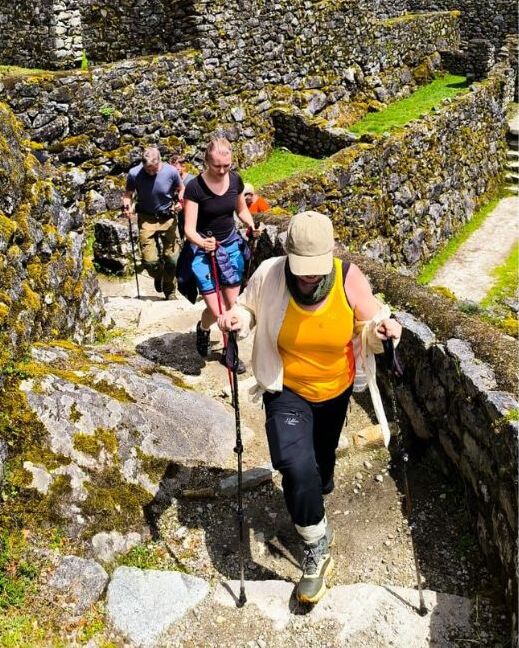
On those two sections, a properly placed pole in front of the foot with each downhill step distributes part of the body weight toward the arms and reduces the eccentric work of the quadriceps and the impact on the knee joint. The benefit does not require advanced technique: it is obtained simply by placing the pole before the foot and putting weight on it before transferring it completely to the leg. Those who do this from the beginning of the second day reach the fourth day with their knees in better condition than those who stored the poles in their backpack after the first camp.
The most common mistake is exactly that: using the poles on the ascent to Dead Woman’s Pass, where the slope makes their function obvious, and putting them away when reaching the top because “now it is only downhill.” Downhills are where they are needed most, not less.
What is available to rent in Cusco
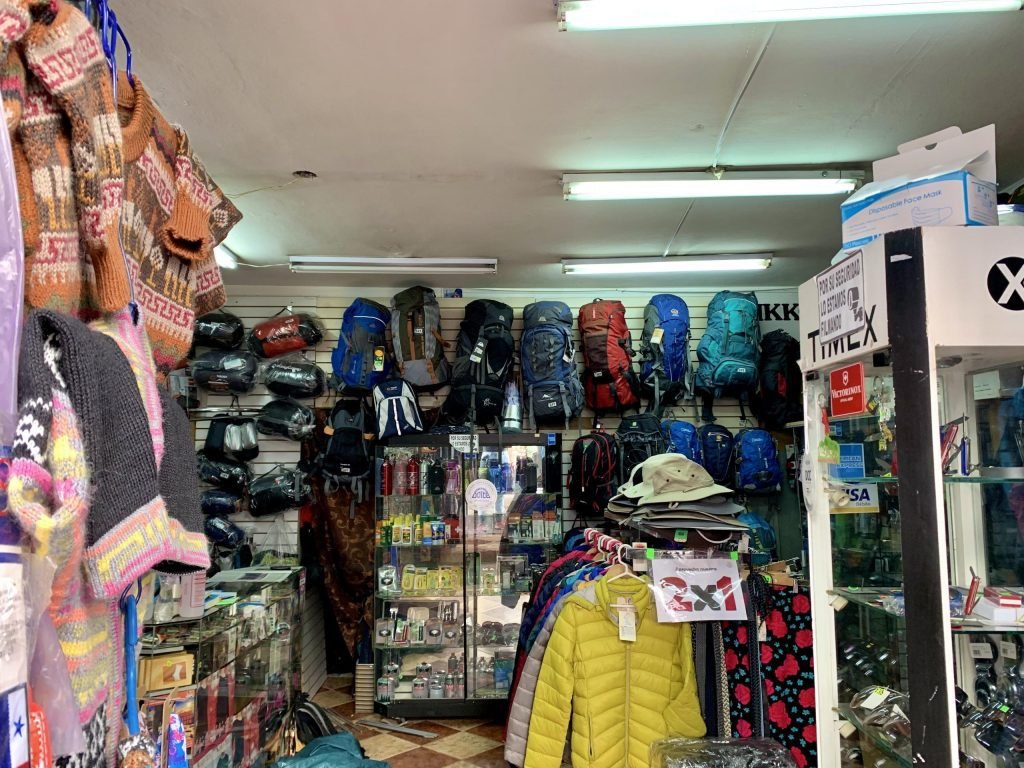
The trekking pole rental options in Cusco are broad. The mountain gear shops in the historic center, mainly concentrated on Plateros Street and the surrounding area, have poles available for rent in price ranges between $8 and $15 for the full four-day period of the Inca Trail.
The quality of the stock varies. Shops with better maintenance of their equipment have aluminum poles with functional locking systems, ergonomic grips, and tips in good condition. Shops that do not maintain their equipment as well have poles with worn locking systems that loosen during the descent, eliminating precisely the support function that makes the pole useful.
There are two types of locking systems in Cusco’s trekking pole rental market. The lever-lock system, the most common, opens and closes with a single movement and works well even with gloves on during the cold morning of the second day. The twist-lock system requires strength to tighten and can be difficult to adjust with cold fingers at 4,000 meters. When renting, extend the pole to the length you normally use, lock it with the locking system, and pull down firmly: if the pole collapses or gives way, the mechanism is not reliable for the hours of descent ahead.
Many Inca Trail agencies offer them directly
A significant number of Inca Trail operators include trekking poles as part of the package equipment or offer them as an additional rental option at a lower cost than city shops. If the agency provides them, that option simplifies logistics because it avoids having to look for them in Cusco the day before departure, when time is already limited and the stress of final preparation is at its highest.
The locking system check applies just as much to the agency’s poles as to those from a rental shop. Picking them up the day before departure, extending them to the correct length for your height, and checking that the lock holds under downhill pressure is the same procedure in either case.
Bringing your own poles: when it makes sense for the Inca Trail
Traveling from your home country with your own trekking poles makes sense in specific situations. If you already have good-quality poles from previous hikes and your luggage allows it, bringing them avoids the rental search and gives you the advantage of familiarity: the length is already adjusted to your height, you already know the locking system, and the weight in your wrist is already familiar.
If you are planning several treks during the same trip to Peru, such as the Inca Trail plus the Salkantay Trek or another multi-day route, the accumulated rental cost for each one may exceed the cost of buying a basic pair of quality poles before leaving home.
If, on the other hand, the Inca Trail is the only trek of the trip and you do not already own poles, renting them in Cusco is the most practical option in terms of cost and travel logistics.
The problem with trekking poles in airplane carry-on luggage
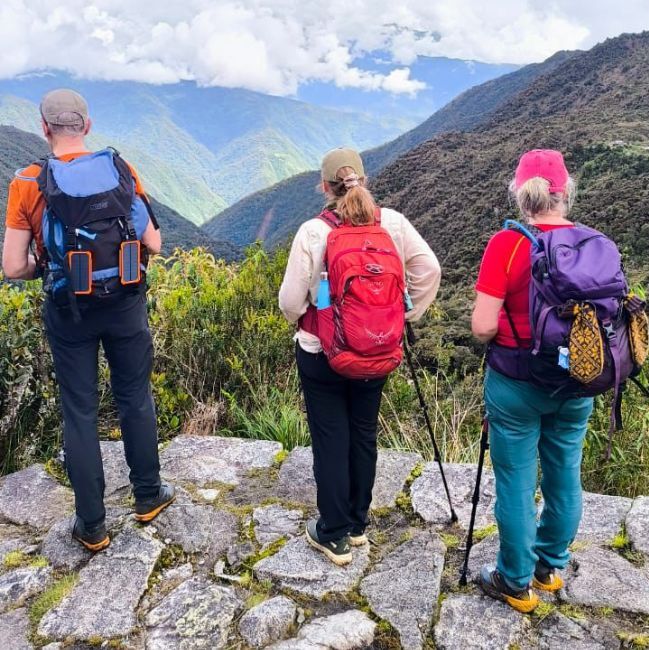
If you decide to bring your own poles from your home country, there is an airline security restriction that many travelers discover at the airport when there is no longer a convenient solution available. Trekking poles are classified as potentially dangerous objects by most airlines and cannot go in carry-on luggage. They must be checked in as hold luggage.
For those traveling only with carry-on luggage to avoid the cost of checking a bag, bringing poles from home is not an option. The alternative is to rent them in Cusco or buy them there, where the mountain gear market has a reasonable selection at more accessible prices than in Europe or North America.
The correct length for the Inca Trail
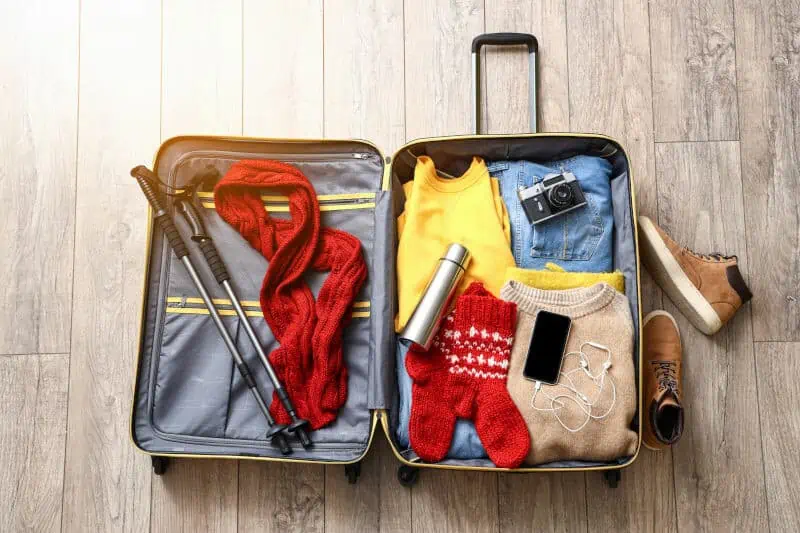
The pole adjustment length changes depending on the type of terrain. On the uphill sections toward Dead Woman’s Pass on the second day, a shorter pole provides more efficient support without forcing the elbow too high. On the downhill sections of the third day’s stairways, a longer pole allows the support to reach the ground with the arm almost extended, maximizing weight relief on the knee.
The simplest practical rule is to adjust the pole so that, with your elbow at a right angle, the tip touches the ground on flat terrain. From that length, shortening it by about five centimeters for ascents and lengthening it by about five centimeters for descents is the most common adjustment. On the third day of the Inca Trail, having the poles at their maximum downhill length from the moment the descent from Phuyupatamarca begins is one of those simple adjustments that makes a noticeable difference in the condition of your knees when you reach Wiñay Wayna.
The bamboo poles at kilometer 82: the emergency alternative
Near kilometer 82, the starting point of the Inca Trail, there are local vendors who offer handmade bamboo poles at very low prices. They are one-piece poles with no length-adjustment system and no carbide tip, with the advantage of being lightweight and reasonably functional for basic support on moderate terrain.
They are not the right option for the downhill stairways of the third day, where an adjustable-length pole makes a real difference in joint support. But for someone who arrives at kilometer 82 without poles and could not find rental availability the day before, a bamboo pole is clearly better than having none on the long descents of the route.
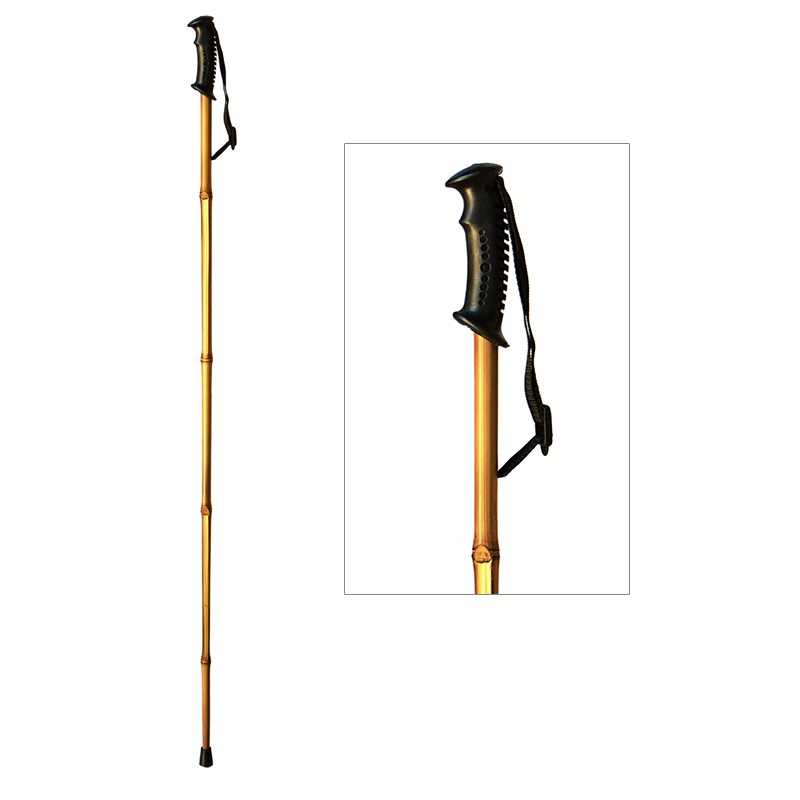
Important: avoid mentioning carbide tips as an advantage for the Inca Trail, because metal tips can damage the trail; the recommended option is to use rubber tips.
Final verdict: what to choose according to your situation
For most first-time Inca Trail participants, renting poles in Cusco or requesting them from the agency is the most practical option. The cost is lower than any quality pole on the market, it avoids the carry-on luggage problem on the plane, and the rental options in the city are sufficient if the condition of the equipment is checked before departure.
Bringing your own poles makes sense for those who already have them and have space in checked luggage, for those doing several treks on the same trip, or for those who value the familiarity of their own equipment over the convenience of traveling light.
What makes no sense in any case is doing the third day of the Inca Trail, with its wet stone stairways from Phuyupatamarca to Wiñay Wayna, without poles when they are available for just a few dollars of rental in Cusco. The joint benefit on that specific section justifies the cost by itself.
Do you have questions about Inca Trail equipment before booking? At Incredible Peru Tours, we inform each group about what to bring and what can be rented in Cusco before confirming the reservation.


